
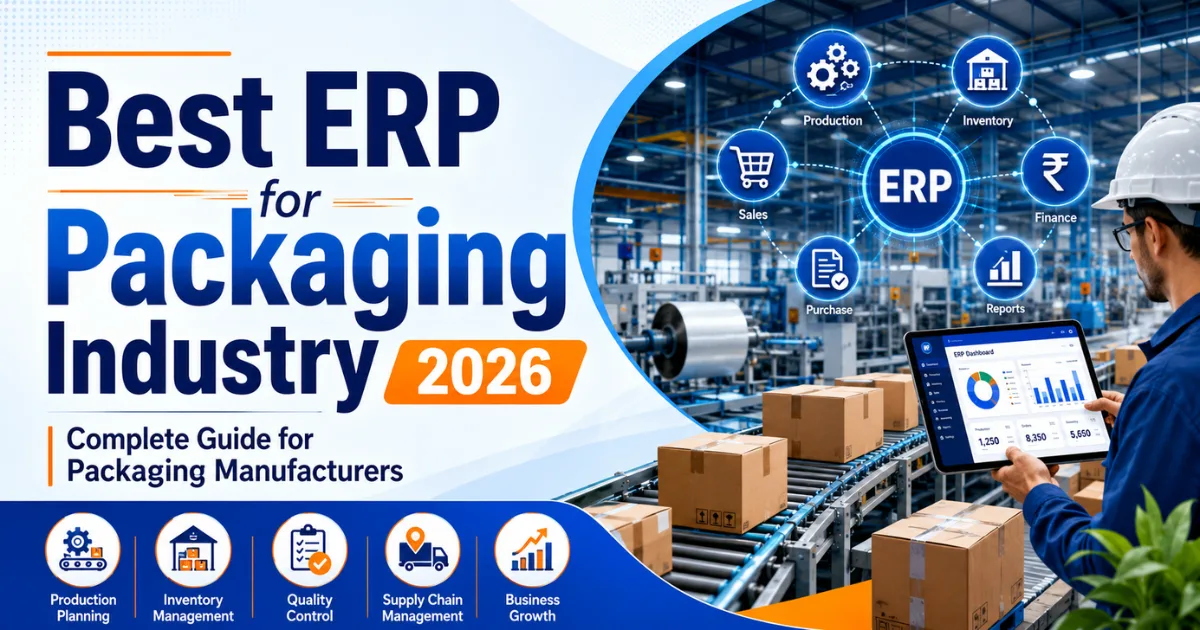
The packaging industry is undergoing a significant transformation. Rising raw material costs, increasing customer expectations, tighter regulatory requirements, and the demand for sustainable packaging have created a business environment where operational efficiency is no longer optional—it is essential.
Many packaging manufacturers still rely on spreadsheets, disconnected software, or manual workflows to manage production, inventory, procurement, and customer orders. While these methods may have worked in the past, they often result in production delays, inaccurate inventory, material wastage, and reduced profitability.
This is where Enterprise Resource Planning (ERP) systems make a measurable difference.
The Best ERP for Packaging Industry connects every department—from procurement and production to warehouse management, finance, sales, and quality control—within a single integrated platform. Instead of managing multiple disconnected systems, manufacturers gain real-time visibility into every stage of their operations, allowing them to make faster and more informed decisions.
Whether you manufacture corrugated boxes, flexible packaging, labels, cartons, rigid packaging, or customized packaging products, choosing the right ERP can improve operational efficiency, reduce costs, and support long-term business growth.
This guide explores everything packaging manufacturers need to know before investing in an ERP solution in 2026.
Why the Packaging Industry Needs ERP More Than Ever
The packaging sector has become increasingly complex over the past decade.
Manufacturers now deal with:
- Fluctuating raw material prices
- Shorter production timelines
- Customized customer requirements
- Multi-location operations
- Strict quality standards
- Growing sustainability initiatives
- Increasing supply chain disruptions
Managing these challenges manually creates operational bottlenecks that affect productivity and profitability.
Modern ERP software for packaging industry centralizes business operations into one system, allowing teams to collaborate with accurate, real-time information.
Instead of reacting to problems after they occur, manufacturers can proactively monitor production, inventory levels, machine utilization, customer orders, procurement, and financial performance.
Common Challenges Faced by Packaging Manufacturers
Before selecting an ERP system, it is important to understand the operational challenges it should solve.
1. Inventory Inaccuracy
Packaging manufacturers often manage hundreds—or even thousands—of raw materials, including paper, board, films, adhesives, inks, laminates, chemicals, and finished goods.
Without accurate inventory visibility, businesses face the following:
- Overstocking
- Stock shortages
- Emergency purchases
- Production interruptions
- Increased carrying costs
An ERP provides live inventory tracking across warehouses, ensuring materials are available when needed while reducing excess stock.
2. Production Planning Difficulties
Packaging production frequently involves multiple stages, machine scheduling, material dependencies, and customer-specific specifications.
Manual planning often results in the following:
- Machine downtime
- Production delays
- Schedule conflicts
- Missed delivery dates
Advanced packaging industry ERP software automatically schedules production based on resource availability, machine capacity, and customer priorities.
3. Material Wastage
Material waste directly impacts profit margins.
Without proper monitoring, manufacturers struggle to identify the following:
- Excessive scrap
- Process inefficiencies
- Incorrect material consumption
- Production losses
ERP systems compare planned versus actual material usage, helping management reduce wastage and improve production efficiency.
4. Poor Cost Visibility
Many businesses know their overall expenses but lack visibility into product-level manufacturing costs.
Without accurate costing, pricing decisions become difficult.
ERP software tracks:
- Raw material costs
- Labor costs
- Machine utilization
- Production overhead
- Packaging costs
This enables manufacturers to calculate actual product profitability.
5. Limited Supply Chain Visibility
Delayed supplier deliveries often create production bottlenecks.
ERP improves procurement planning by providing:
- Vendor performance tracking
- Purchase planning
- Material requirement forecasting
- Automated purchase orders
- Delivery monitoring
This results in a more resilient supply chain.
What Makes the Best ERP for Packaging Industry?
Not every ERP solution is designed to meet the operational needs of packaging manufacturers.
The best systems include industry-specific functionality that supports manufacturing workflows while remaining scalable for future growth.
Here are the essential capabilities to look for.
Production Planning and Scheduling
Production planning is the backbone of every packaging business.
An ERP should help manufacturers:
- Plan production orders
- Allocate machine capacity
- Optimize shift schedules
- Reduce idle machine time
- Track work orders
- Improve on-time delivery
With automated scheduling, production managers spend less time planning and more time improving operational performance.
Inventory Management
Inventory management goes beyond tracking stock quantities.
Modern ERP solutions provide the following:
- Real-time inventory visibility
- Batch tracking
- Barcode integration
- Warehouse management
- Automated stock replenishment
- Lot traceability
- Multi-location inventory control
These capabilities reduce inventory carrying costs while improving order fulfillment accuracy.
Bill of Materials (BOM) Management
Every packaging product has its own material composition.
For example, a corrugated box may include the following:
- Kraft paper
- Corrugated board
- Adhesives
- Printing ink
- Lamination
- Labels
A robust ERP manages complex Bills of Materials (BOMs), ensuring production teams always use the correct materials and quantities.
This is particularly important for manufacturers producing customized packaging.
Procurement Management
Procurement delays directly affect production schedules.
ERP helps purchasing teams by automating:
- Supplier management
- Purchase requisitions
- RFQs
- Purchase orders
- Vendor comparisons
- Goods receipt
- Invoice matching
This reduces manual effort while improving supplier relationships.
Quality Control
Quality expectations continue to rise across industries.
Packaging manufacturers supplying sectors such as food, pharmaceuticals, cosmetics, and FMCG must maintain strict quality standards.
ERP software enables organizations to:
- Perform quality inspections
- Track defects
- Record non-conformities
- Maintain compliance documentation
- Monitor corrective actions
This improves product consistency and customer satisfaction.
Financial Management
Financial reporting should not be separated from manufacturing operations.
An integrated ERP automatically connects production with accounting.
This allows businesses to monitor:
- Revenue
- Manufacturing costs
- Profit margins
- Cash flow
- Budget performance
- Cost center analysis
Management gains access to accurate financial reports without manual reconciliation.
Business Intelligence and Analytics
Data-driven decision-making has become a competitive advantage.
Modern ERP dashboards provide real-time insights into the following:
- Production efficiency
- Inventory turnover
- Order status
- Material consumption
- Equipment utilization
- Sales performance
- Profitability
Instead of relying on historical reports, decision-makers gain actionable intelligence that supports continuous improvement.
Which Packaging Businesses Benefit Most from ERP?
ERP is valuable across virtually every segment of the packaging industry, including:
Corrugated Box Manufacturers
An ERP for corrugated box manufacturers helps manage paper inventory, production planning, converting processes, costing, dispatch scheduling, and warehouse operations from one centralized system.
Flexible Packaging Manufacturers
Businesses producing films, laminates, pouches, and multilayer packaging benefit from ERP for flexible packaging industry through improved batch traceability, production scheduling, quality control, and material planning.
Carton and Folding Box Manufacturers
ERP supports die-cutting, printing, finishing, inventory management, and order tracking while improving production visibility and delivery performance.
Label and Printing Companies
Manufacturers handling customized labels and printed packaging can streamline job costing, production scheduling, artwork approvals, inventory management, and customer order processing.
Rigid Packaging Manufacturers
Companies producing plastic containers, drums, bottles, jars, and industrial packaging use ERP to coordinate procurement, manufacturing, warehouse operations, and customer deliveries efficiently.
Why Odoo Is Becoming a Popular Choice for Packaging Manufacturers
In recent years, Odoo ERP for packaging industry has gained significant attention among small and mid-sized manufacturers because of its flexibility, modular architecture, and ability to integrate business functions on a single platform.
Unlike traditional ERP systems that often require businesses to invest in large, complex deployments, Odoo allows manufacturers to start with essential modules—such as Manufacturing, Inventory, Purchase, Sales, and Accounting—and expand the system as operational needs grow.
Its support for production planning, Bill of Materials (BOM), work orders, quality management, barcode operations, warehouse management, and real-time reporting makes it a practical option for many packaging manufacturers looking to modernize operations without unnecessary complexity.
How to Choose the Best ERP for Your Packaging Business
Selecting the right ERP is a strategic investment that can influence your company's efficiency and growth for years. While features are important, the success of an ERP implementation depends on choosing a solution that aligns with your business processes, future goals, and workforce capabilities.
Here are the key factors to evaluate before making a decision.
Understand Your Business Requirements
Start by identifying the operational challenges you want the ERP to solve.
Ask questions such as:
- Are production delays affecting customer deliveries?
- Do inventory inaccuracies increase operational costs?
- Is financial reporting taking too much time?
- Do different departments work in disconnected systems?
- Are manual processes slowing down productivity?
A clear understanding of these pain points helps you prioritize ERP features that deliver the highest business value.
Choose Industry-Specific Functionality
General ERP software may not address the unique requirements of packaging manufacturers.
Look for a solution that supports:
- Production planning
- Multi-level Bill of Materials (BOM)
- Batch and lot traceability
- Inventory optimization
- Quality management
- Job costing
- Warehouse management
- Procurement automation
Industry-focused functionality reduces customization efforts and speeds up implementation.
Prioritize Scalability
Your ERP should support business growth.
Whether you expand production capacity, open new manufacturing units, or introduce additional product lines, your ERP should scale without requiring a complete replacement.
Cloud-based ERP solutions often provide greater flexibility for growing manufacturers.
Evaluate Integration Capabilities
Modern manufacturing relies on multiple business systems.
A good ERP should integrate with:
- CRM platforms
- E-commerce portals
- Shipping providers
- Barcode scanners
- Business intelligence tools
- Accounting software
- HR systems
Seamless integration eliminates duplicate data entry and improves operational efficiency.
Focus on User Experience
Even the most powerful ERP system will struggle to deliver value if employees find it difficult to use.
Choose software with:
- Intuitive dashboards
- Mobile accessibility
- Role-based permissions
- Simple navigation
- Customizable workflows
Higher user adoption leads to faster ROI and smoother day-to-day operations.
Best Practices for ERP Implementation
ERP implementation is not simply an IT project—it is a business transformation initiative.
Organizations that follow a structured implementation strategy are more likely to achieve successful outcomes.
Define Clear Objectives
Establish measurable goals before implementation begins.
Examples include:
- Reduce inventory carrying costs by 20%
- Improve production planning accuracy
- Increase on-time deliveries
- Shorten order processing time
- Improve inventory accuracy
Clear objectives make it easier to evaluate project success.
Clean Existing Data
Migrating inaccurate or duplicate data into a new ERP creates unnecessary problems.
Before implementation:
- Remove duplicate records
- Verify inventory data
- Standardize customer information
- Update supplier records
- Review product master data
Clean data improves reporting accuracy and system reliability.
Train Employees Early
Technology alone does not improve business performance.
Employees need proper training to understand new workflows and system capabilities.
Regular workshops, hands-on practice, and department-specific training sessions help improve adoption and reduce resistance to change.
Implement in Phases
Instead of deploying every module simultaneously, many manufacturers begin with core functions such as the following:
- Inventory
- Procurement
- Manufacturing
- Sales
- Finance
Additional modules can be introduced after the initial deployment has stabilized.
This phased approach minimizes operational disruption.
Monitor Performance After Go-Live
ERP implementation does not end after deployment.
Regularly review KPIs such as:
- Inventory turnover
- Production efficiency
- Machine utilization
- Order fulfillment rate
- Customer satisfaction
- Manufacturing costs
Continuous optimization ensures long-term business value.
Future Trends Shaping Packaging ERP in 2026
ERP technology continues to evolve alongside manufacturing innovation. Packaging companies investing today should consider solutions that support future advancements.
Artificial Intelligence for Smarter Planning
AI-powered ERP systems are helping manufacturers improve forecasting, identify production bottlenecks, and optimize inventory planning using historical and real-time data.
IoT-Enabled Manufacturing
Internet of Things (IoT) devices connect machines directly with ERP systems, providing live production data, machine health monitoring, and predictive maintenance alerts.
This reduces unexpected downtime and improves equipment utilization.
Advanced Business Analytics
Modern dashboards provide deeper operational insights, enabling management teams to monitor profitability, production efficiency, customer demand, and supply chain performance in real time.
Cloud-First ERP Adoption
Cloud ERP continues to gain popularity due to its flexibility, automatic updates, lower infrastructure costs, and remote accessibility.
Manufacturers with multiple plants particularly benefit from centralized cloud-based operations.
Sustainability Reporting
As sustainability becomes a business priority, ERP systems increasingly support:
- Waste tracking
- Energy consumption monitoring
- Carbon reporting
- Material utilization analysis
- Compliance reporting
These capabilities help organizations meet environmental goals while improving operational efficiency.
Real-World Example
Consider a mid-sized corrugated box manufacturer handling hundreds of customer orders each month.
Before implementing ERP, the company relied on spreadsheets for production planning, inventory management, and purchasing. Material shortages frequently delayed production, inventory counts were often inaccurate, and management lacked real-time visibility into manufacturing costs.
After implementing a modern packaging manufacturing ERP software solution, the business centralized production planning, procurement, warehouse management, accounting, and sales into a single platform.
Within months, the manufacturer experienced the following:
- Improved inventory accuracy
- Faster production scheduling
- Reduced material wastage
- Better on-time delivery performance
- More accurate financial reporting
- Increased visibility across departments
While individual results vary depending on implementation quality and business processes, this example reflects the operational improvements many manufacturers achieve through ERP adoption.
Conclusion
The packaging industry is becoming more competitive, customer-driven, and technology-focused. Manufacturers that continue relying on disconnected systems and manual processes may struggle to keep pace with rising customer expectations, increasing operational costs, and evolving market demands.
Choosing the Best ERP for Packaging Industry is about more than adopting new software. It is about creating a connected, data-driven organization capable of making faster decisions, optimizing resources, improving product quality, and supporting sustainable growth.
Whether you manufacture corrugated boxes, flexible packaging, labels, cartons, or rigid packaging products, the right ERP solution can streamline production planning, strengthen inventory control, improve financial visibility, and enhance overall operational efficiency.
As you evaluate ERP options in 2026, focus on solutions that combine manufacturing expertise, scalability, integration capabilities, and user-friendly design. An ERP should not only solve today's operational challenges but also prepare your business for tomorrow's opportunities.
A thoughtful ERP investment can become the foundation for long-term digital transformation and a lasting competitive advantage.