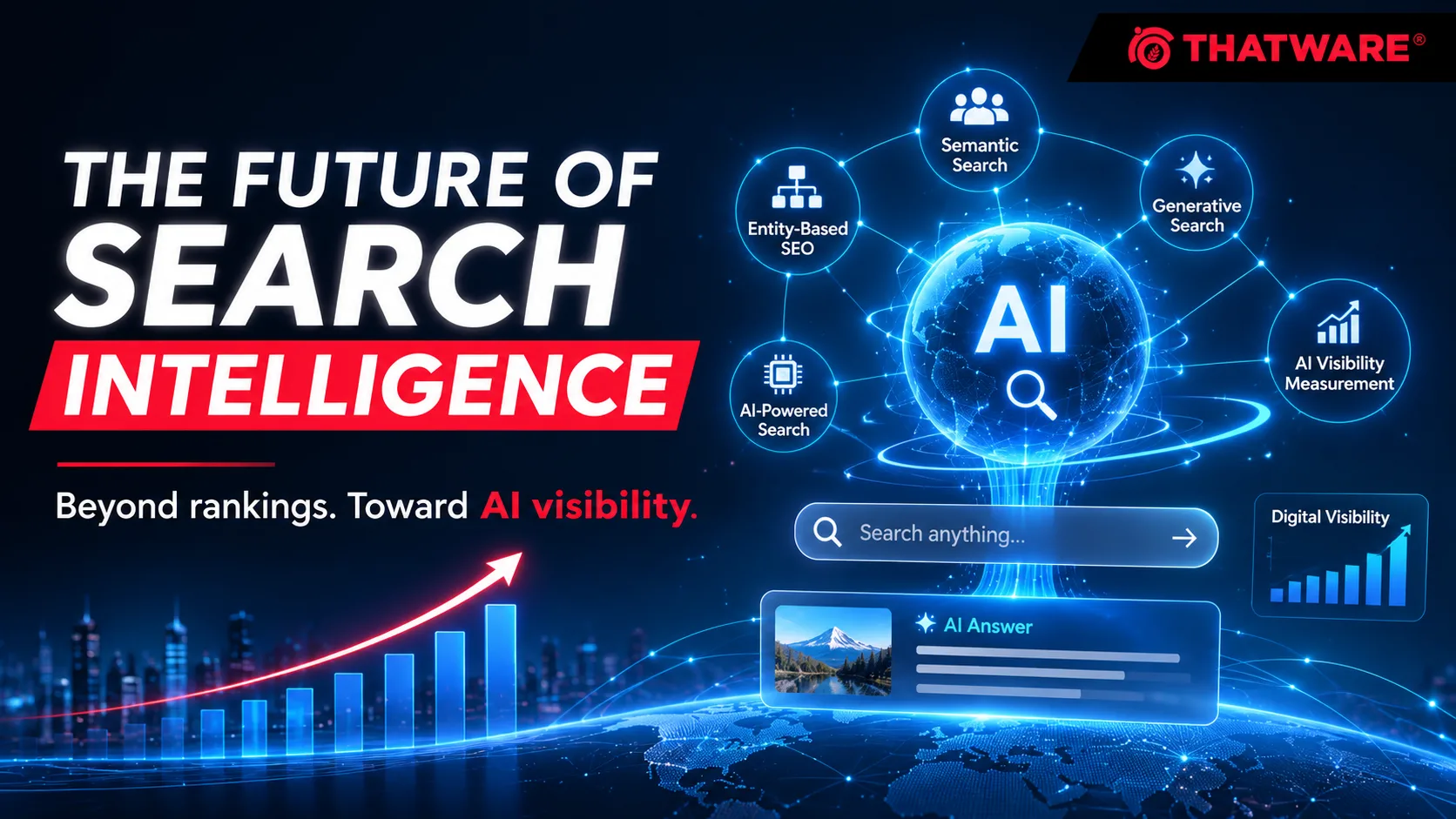
The digital search landscape is experiencing a significant transformation. Businesses can no longer depend exclusively on traditional keyword rankings, backlinks, and website traffic to establish their online presence. Artificial intelligence, conversational search, and intelligent information retrieval are changing how people discover brands and evaluate solutions. ThatWare LLP is exploring this evolution through advanced search technologies, research-driven methodologies, and innovative approaches to digital visibility.
As AI-powered platforms become an increasingly important part of online discovery, businesses must understand how technology interprets their brand, evaluates information, and selects sources for generated answers. This shift creates opportunities for organizations to move beyond conventional SEO and build a more intelligent, measurable approach to online visibility.
The Evolution of Search: From Rankings to Intelligent Discovery
Traditional SEO primarily focuses on improving website positions in search engine results. While rankings remain valuable, modern search experiences involve much more than displaying a list of webpages.
Users increasingly interact with AI-powered platforms to ask questions, compare solutions, and receive summarized recommendations. These systems interpret meaning, identify relationships between information, and retrieve content that appears relevant to a particular query.
This development makes AI search intelligence an important consideration for businesses seeking long-term digital visibility.
Modern search optimization must address several questions:
- Does AI understand what a business offers?
- Is the brand associated with relevant industry topics?
- Can AI systems retrieve useful information from its website?
- Does the brand appear in relevant AI-generated answers?
- Are the company's services represented accurately?
Answering these questions requires a broader approach to digital optimization.
Five Technologies and Strategies Transforming Modern SEO
1. Artificial Intelligence and Search Behaviour Analysis
Artificial intelligence is changing how digital information is processed and presented. Search systems increasingly use machine learning, natural language processing, and contextual interpretation to understand user intent.
Businesses can benefit from analyzing search patterns, identifying audience interests, and creating content that addresses specific information requirements.
AI-assisted analysis also helps marketers identify content gaps, understand competitors, and develop more relevant optimization strategies.
2. AI Visibility Measurement
Traditional analytics platforms provide information about impressions, clicks, rankings, and website traffic. However, these metrics do not completely explain how a brand appears across AI-generated responses.
AI visibility measurement introduces another dimension to digital performance analysis by examining brand mentions, citations, recommendations, and representation across AI-powered search experiences.
Businesses can use this approach to investigate:
- Whether AI platforms mention their brand.
- How frequently their business appears for relevant queries.
- Whether AI-generated descriptions are accurate.
- How competitors are represented in similar responses.
- Which content improvements could strengthen visibility.
This creates a more comprehensive understanding of brand discoverability.
3. Entity-Based Search Optimization
Search engines and AI systems increasingly interpret information through entities, relationships, and contextual connections.
Entity-based SEO focuses on helping search systems understand what a business represents, which services it provides, what topics it specializes in, and how its information connects with other relevant entities.
Important optimization activities include:
- Consistent brand information across digital platforms.
- Structured data and schema implementation.
- Clearly organized service pages.
- Relevant internal linking.
- Authoritative industry references.
- Consistent topical coverage.
Strong entity clarity helps establish a recognizable digital identity.
4. Generative Search Optimization
Generative AI platforms are introducing new ways for people to discover information. Instead of navigating multiple websites, users can receive synthesized answers containing explanations, recommendations, and supporting references.
Generative search optimization focuses on improving the accessibility, relevance, clarity, and trustworthiness of information so that generative systems can better interpret and retrieve it.
Businesses should prioritize original insights, clearly structured content, meaningful explanations, reliable references, and comprehensive topic coverage.
Although no optimization technique guarantees inclusion in AI-generated answers, improving information quality and accessibility can support broader search discoverability.
5. Semantic Search and Contextual Relevance
Modern search systems aim to understand the meaning behind queries rather than simply matching individual keywords.
A well-developed semantic search strategy connects related concepts, user questions, industry terminology, and supporting information throughout a website.
For example, a company providing digital marketing services can create connected resources covering SEO, content strategy, conversion optimization, AI search, and online brand visibility.
This interconnected approach helps establish topical relevance while creating a more useful experience for website visitors.
Traditional SEO vs AI-Driven Search Optimization
Both approaches serve important purposes, but their primary objectives and measurement methods differ.
| Comparison factor | Traditional SEO | AI-driven search optimization |
|---|---|---|
| Primary focus | Search engine rankings | AI search visibility and retrieval |
| Content approach | Keyword and topic optimization | Contextual and semantic clarity |
| Visibility measurement | Rankings, impressions, clicks | Mentions, citations, recommendations |
| Optimization | Technical SEO and backlinks | Entity clarity, retrieval readiness, trust |
| User discovery | Search result listings | Conversational and generated answers |
| Performance analysis | Organic traffic and conversions | AI representation and brand visibility |
The most effective strategy combines both approaches rather than treating them as competing disciplines.
How ThatWare Labs Is Exploring the Future of Search
ThatWare Labs represents a research-oriented approach to understanding the changing digital discovery environment.
Its documented framework connects three important concepts: AI Visibility Metric (AVM), Visibility and Entity Measurement (VEM), and Generative Engine Optimization (GEO).
Each contributes a different perspective:
AVM – AI Visibility Metric: Examines how brands appear across AI-powered platforms, including mentions, citations, recommendations, and brand representation.
VEM – Visibility and Entity Measurement: Examines how clearly a brand is understood as an entity and how consistently its identity, services, and topical relationships are represented.
GEO – Generative Engine Optimization: Focuses on improving brand discoverability within AI-generated answers, summaries, and recommendations.
Together, these frameworks provide a structured way to investigate visibility beyond conventional ranking reports.
Building a Future-Ready Digital Strategy
Businesses preparing for the next generation of search should consider a combination of technical excellence, useful content, and intelligent optimization.
A practical strategy includes:
- Strengthen website foundations: Improve crawlability, indexing, mobile usability, and technical performance.
- Develop authoritative content: Publish original resources that address meaningful customer questions.
- Improve entity consistency: Maintain accurate brand and service information across digital platforms.
- Expand AI visibility analysis: Monitor relevant AI-generated responses and identify visibility gaps.
- Build topical authority: Connect related subjects through organized content and internal linking.
- Measure performance continuously: Evaluate traditional SEO results alongside emerging AI visibility indicators.
These activities can help businesses adapt to evolving discovery experiences while maintaining a strong foundation in traditional SEO.
Conclusion
The future of SEO is moving toward a more intelligent approach to digital discovery. Rankings and website traffic remain important, but businesses must also consider how AI systems understand their identities, retrieve their information, and represent their expertise.
Through research-driven frameworks such as AVM, VEM, and GEO, ThatWare Labs is exploring new dimensions of search visibility and brand intelligence.
ThatWare LLP aims to help businesses navigate this changing environment through advanced SEO methodologies, AI-focused optimization, and strategic digital innovation. Organizations that begin preparing today can build a stronger foundation for visibility across both traditional and emerging search platforms.
Frequently Asked Questions
1. What is AI search intelligence, and why does it matter for businesses?
AI search intelligence involves understanding how artificial intelligence systems interpret queries, retrieve information, and present brands in generated responses. It matters because businesses increasingly need visibility across both conventional search engines and AI-powered discovery platforms.
2. How is AI visibility different from traditional SEO rankings?
Traditional SEO rankings measure a website's position in search results. AI visibility examines whether a brand is mentioned, cited, recommended, or accurately represented in AI-generated answers. Both provide valuable but different performance insights.
3. What are AVM, VEM, and GEO in ThatWare Labs?
AVM (AI Visibility Metric) evaluates brand visibility across AI platforms. VEM (Visibility and Entity Measurement) examines brand entity clarity and consistency. GEO (Generative Engine Optimization) focuses on improving discoverability within AI-generated answers and recommendations.
4. How can businesses optimize their websites for AI-powered search?
Businesses can improve AI search readiness by publishing original and informative content, implementing relevant structured data, maintaining consistent brand information, strengthening topical authority, improving website accessibility, and developing clear answers to relevant customer questions.