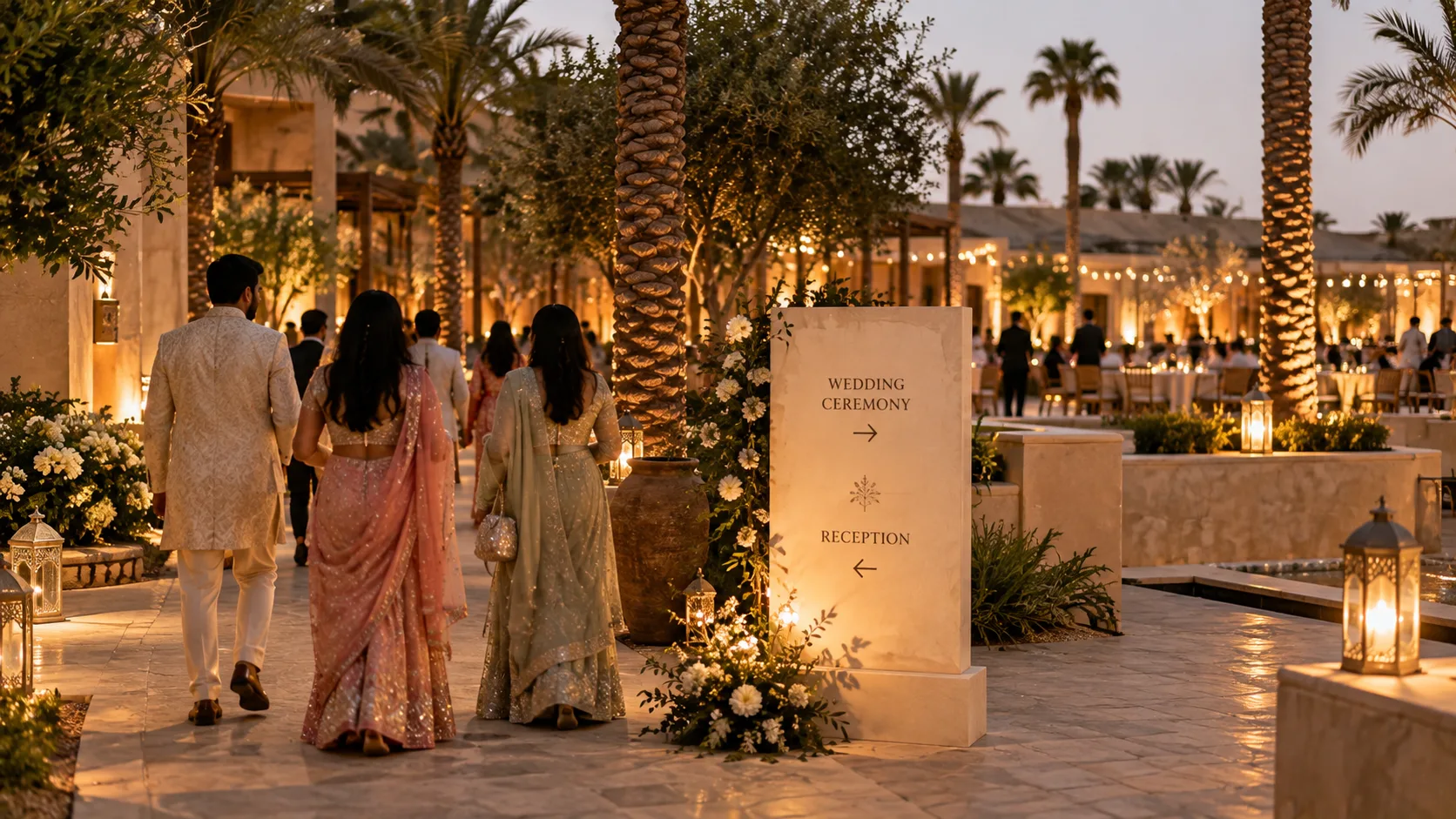
A destination wedding in Ras Al Khaimah can bring together guests from different cities and countries, several wedding functions and a variety of spaces within the same resort or destination. In that setting, small details can make a surprisingly large difference. One of them is signage.
Wedding signs are often treated as decoration: a welcome board at the entrance, a seating chart near dinner or a small sign pointing towards the ceremony. But well-planned signage has another job. It helps guests understand where they are going, what is happening next and which parts of the venue are intended for them.
That becomes especially useful in Ras Al Khaimah, where wedding celebrations can take place across beach resorts, gardens, desert environments, mountain locations and large hotel properties.
Why Wedding Wayfinding Matters More at a Destination Wedding
At a local wedding, many guests may already know the venue. At a destination wedding, that is often not the case. Guests could be arriving at a large resort they have never visited before, checking into unfamiliar rooms and attending several functions in different parts of the property.
A guest who attends a Mehendi in one area may later need to find a Sangeet elsewhere. Another family member may be trying to locate the dining area, while an elderly relative may simply want to find the nearest comfortable route back to the hotel rooms. Without clear guidance, people naturally stop and ask someone else.
That creates unnecessary work for family members and hotel staff. Good wayfinding removes much of that uncertainty before it starts. It does not need to be elaborate. A few well-positioned, easy-to-read signs can often do more than a large collection of decorative boards placed around the venue.
Start With the Guest Journey
The best way to plan wedding signage is to follow the guest journey from beginning to end.
Think about the first moment guests arrive at the property. What do they need to understand immediately? They may need to know where to check in, where the welcome gathering is taking place or which direction leads to the wedding area. Once inside, the questions change. Guests may need directions to the ceremony, dining area, washrooms, elevators or outdoor event space.
The same exercise should be repeated for every major function. A destination wedding can include a welcome dinner, Mehendi, Haldi, Sangeet, wedding ceremony and reception, and each event may use a different part of the property. Rather than assuming guests will remember the route from one function to another, use consistent visual cues that make each transition simple.
The Ras Al Khaimah wedding destinations page can help couples understand the wider variety of locations available across the destination. Once the venue is selected, the signage plan should be built around the actual guest movement within that property.
Not Every Sign Needs to Be Decorative
One of the easiest mistakes is designing every sign as though it were part of the wedding décor.
A directional sign has a different purpose from a welcome sign. A seating chart has a different purpose from a menu board. Each should be designed for the information it needs to communicate.
A welcome board can be more expressive because guests have time to stop and look at it. Directional signage needs to be understood almost immediately. The text should be large enough to read from a reasonable distance, while the wording should remain short and direct.
Instead of writing a long sentence such as “We are delighted to welcome you to the wedding celebrations and kindly request you to proceed towards the garden for the evening reception,” a simple “Reception → Garden” may be much more effective.
The goal is not to make the sign say more. It is to make the guest understand it faster.
Use the Same Visual Language Throughout the Wedding
A consistent signage system makes a multi-day wedding feel more organised.
The same typeface, colours, symbols and directional style can be used throughout the celebration. Guests begin to recognise the visual language, which means they do not have to interpret every new sign from scratch.
For an Indian wedding, this can be especially useful when functions have their own themes. The Mehendi may have bright colours, while the Sangeet could use a darker evening palette and the wedding ceremony may be more traditional. The individual events can still have their own identities while retaining one common navigation system.
The Avenues for All section reflects the variety of wedding settings available in Ras Al Khaimah, from beachfront celebrations to mountain and resort environments. That variety makes a consistent signage system useful because the visual environment can change significantly from one function to another.
Think About Signs From a Guest's Eye Level
Placement is just as important as design.
A beautiful sign hidden behind flowers is not useful. Neither is a small board positioned where guests cannot see it until they have already passed the turn they needed to take.
Directional signs should normally be placed before a decision point rather than after it. If guests need to choose between two corridors, the sign should appear before the split. If a path to the garden turns left, the directional information should be visible while guests still have time to change direction comfortably.
Large resorts can make this even more important. Ras Al Khaimah's current accommodation portfolio includes a wide range of properties, from beachfront resorts and island hotels to desert properties and city accommodation.
A signage plan should therefore be based on the actual property rather than copying a generic wedding template.
Create Separate Signs for Important Moments
Some moments deserve dedicated signage because they involve a large number of guests moving at the same time.
The transition into a Sangeet is one example. Guests may need to move from rooms or a welcome area towards the main event space, and the route may change once the evening setup is ready.
The wedding ceremony can require another layer of guidance. Guests may need directions to the ceremony, seating sections or reception afterwards. If dinner is being served somewhere different, that movement should be clear before the ceremony finishes.
Even simple signs such as “Wedding Ceremony,” “Dinner,” “Reception,” “Guest Seating” and “Restrooms” can reduce uncertainty when they are positioned correctly.
Seating Charts Should Be Easy to Use
The seating chart is often one of the most crowded information boards at a wedding.
A beautifully decorated chart can still become frustrating when 150 or 200 guests gather around it trying to find their names.
Keep the information organised and easy to scan. Names should follow a predictable order, table numbers should be clear and the overall arrangement should make it obvious how guests are supposed to find their table.
For larger weddings, consider separating the seating information into multiple boards or sections instead of creating one oversized display. This spreads people out and reduces the crowd around a single point.
The same principle applies to welcome desks and guest books. Every high-traffic information point should be designed around how many people will use it at the same time.
Account for International Guests
Destination weddings often bring together guests who speak different first languages or who are unfamiliar with local terminology.
Simple English signage can usually make the main navigation straightforward, but symbols can make it even easier. Universal icons for restrooms, dining, elevators and exits can reduce the amount of text required.
This is particularly useful for guests who may not immediately understand event-specific terms such as Mehendi, Sangeet or Baraat. Where necessary, the wedding team can combine the event name with a simple explanation, such as “Sangeet — Evening Celebration.”
The idea is not to remove the cultural character of the wedding. It is to make sure every guest can understand what the information means.
Outdoor Locations Need More Thought
Signage becomes especially important when a wedding uses outdoor spaces.
A beach, garden, desert setting or mountain venue can be visually striking, but the boundaries between different spaces may be less obvious than they are inside a ballroom. Guests may need a clearer indication of where the event begins, which direction to take and where facilities are located.
Ras Al Khaimah's official wedding offering includes outdoor environments such as beaches, gardens, desert settings and Jebel Jais, as well as indoor hotel venues.
Outdoor signs should therefore be stable, visible and appropriate for the environment. They should also be checked shortly before guests arrive. A sign that was perfectly positioned during setup can become less useful once tables, floral arrangements or other décor are installed.
Make Signage Part of the Final Venue Walk-Through
The signage plan should be reviewed during the final venue inspection rather than being left until the wedding day.
Walk the property exactly as a guest would. Start from the entrance and follow the route to each major function. Look for places where someone could reasonably hesitate or take the wrong turn.
Then look at every sign and ask three simple questions:
Can the guest see it?
Can they understand it quickly?
Does it appear before they need to make a decision?
If the answer to any of these is no, the sign probably needs to move, simplify or become larger.
This final walk-through can also reveal unnecessary signs. Too many signs can be just as confusing as too few, especially when decorative boards compete with directional information.
Let the Wedding Feel Personal Without Making It Difficult to Navigate
The best wedding signage does not make a venue feel like an airport.
It should still look like part of the celebration.
Couples can incorporate their wedding monogram, colours, illustrations, floral details or cultural elements into the design while keeping the information itself simple. A refined welcome sign can establish the visual identity of the wedding, while smaller directional signs quietly guide guests through the property.
That balance is particularly effective for luxury weddings, where the goal is often to make practical information feel almost invisible.
The signage should support the experience rather than dominate it.
Frequently Asked Questions
How many signs does a destination wedding need?
There is no fixed number. The requirement depends on the size of the property, number of functions and complexity of guest movement. Signs should be placed at meaningful decision points rather than added simply to fill space.
Should every wedding function have separate signage?
Not necessarily. The event name can change while the overall visual language remains consistent. This helps guests understand that different signs belong to the same wedding.
Where should directional signs be placed?
Ideally, they should appear before a guest has to make a decision, such as choosing between corridors, entrances or outdoor paths. Signs placed after a turn are often too late to be useful.
Does outdoor wedding signage need special planning?
Yes. Outdoor settings can have less obvious boundaries and longer walking routes. Signs need to remain visible, stable and easy to understand while also fitting naturally into the surroundings.
Conclusion
A successful destination wedding in Ras Al Khaimah is built from hundreds of small decisions, and signage is one of the easiest to overlook. Yet when guests can move confidently between rooms, gardens, beaches and event spaces, the entire celebration feels calmer and more thoughtfully organised.
The destination already provides a wide range of wedding environments, from luxury resorts and beaches to desert and mountain settings. The role of good signage is simply to help guests experience those spaces without having to stop and ask where they should go next.
Explore the Ras Al Khaimah wedding hotels, wedding destinations and Avenues for All while planning the overall guest journey.
Because the best wedding directions are the ones guests barely notice — they simply know where to go.