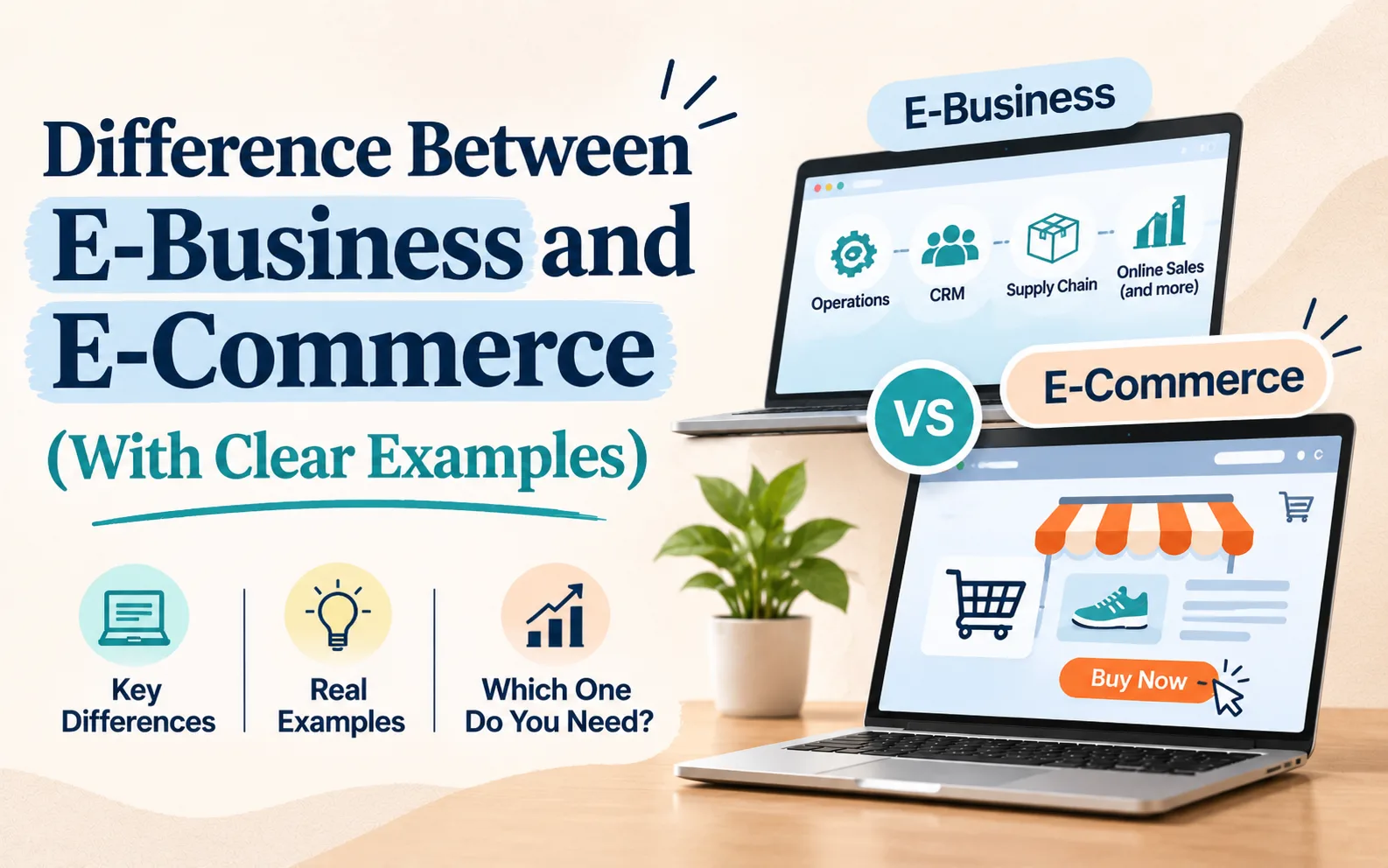
The two terms get swapped constantly, even in business textbooks and job descriptions. They aren't the same thing, and knowing the difference between e-business and e-commerce matters when you plan a budget, hire a team or choose a marketing strategy. Here's a straightforward explanation.
The short answer
E-commerce means buying and selling goods or services over the internet. E-business is the bigger umbrella: every business activity that uses the internet, including selling, but also operations, supplier management, customer service and internal communication.
In one line: all e-commerce is e-business, but not all e-business is e-commerce.
What e-commerce covers
E-commerce is about the transaction. A customer finds a product, places an order, pays and receives delivery. Examples include an online clothing store, a ticket booking site, a course platform and a food delivery app. The key measure is sales made online.
Common models include B2C (a brand selling to individuals), B2B (a wholesaler selling to retailers), D2C (a brand selling direct without middlemen) and C2C (individuals selling to each other on marketplaces).
What e-business covers
E-business includes the transaction but also everything around it. A company might use cloud accounting, automated inventory updates, a supplier portal, an employee training app and a CRM, none of which directly sells anything. They still make the business run online.
A hospital that uses online record systems and appointment scheduling is practising e-business. A bank offering net banking, internal digital workflows and online customer support is too.
Side-by-side comparison
| Point | E-commerce | E-business |
| Scope | Online buying and selling | All online business processes |
| Focus | Transactions and revenue | Efficiency, collaboration, growth |
| Users | Mainly customers | Customers, staff, suppliers, partners |
| Examples | Online shop, marketplace | ERP, CRM, supplier portal, online sales |
| Needs | Website, payments, delivery | Those plus internal systems and integrations |
Why the difference matters in practice
Planning. If you only think about e-commerce, you may build a lovely store with no plan for stock updates, returns or customer support. An e-business mindset forces you to connect those pieces.
Budgeting. E-commerce spending usually goes to the storefront, ads and fulfilment. E-business budgets also cover software, integrations and training.
Marketing. An online shop needs product pages, shopping ads and conversion work. A service company that runs digitally but sells through consultations needs lead generation, content and trust building instead. Choosing the right mix is part of what a digital marketing company in Navi Mumbai will help work out before spending begins.
Hiring. E-commerce roles lean towards merchandising and catalogue management. E-business roles include operations, systems and analytics.
Examples to make it concrete
Consider a bakery. Selling cakes through its website is e-commerce. Using an app to track ingredients, a shared calendar for deliveries and WhatsApp Business for customer queries is the wider e-business setup.
Or consider a software company. Its online subscription checkout is e-commerce. Its project tools, support desk and partner portal are e-business.
Common misunderstandings
Many people assume an e-business must have an online store. It doesn't. Others think e-commerce is only for big brands. A home baker on Instagram is already doing e-commerce. And some founders believe that setting up a website equals becoming an e-business, when the real shift happens in how daily work gets done.
If you'd like another explanation with more industry examples, see Startup Rabbit's guide on the difference between e-commerce and e-business.
Which one does your business actually need?
Most companies need both, in different proportions. If your income comes mainly from online orders, start with e-commerce fundamentals: a fast store, trustworthy checkout and dependable delivery. If your income comes from services, appointments or B2B contracts, start with the e-business basics instead: a clear website, online enquiry forms, digital invoicing and a way to follow up leads quickly. As you grow, connect the two. Link your store to your stock system, your CRM to your email tool and your support inbox to your order history. Each connection removes manual work and reduces mistakes, which is where e-business thinking pays for itself over time.
The takeaway
Think of e-commerce as the shop window and till, and e-business as the whole building: stockroom, office, delivery and customer desk. You can start with one and grow into the other. What matters is that your marketing, tools and team are planned for the version you're actually building.