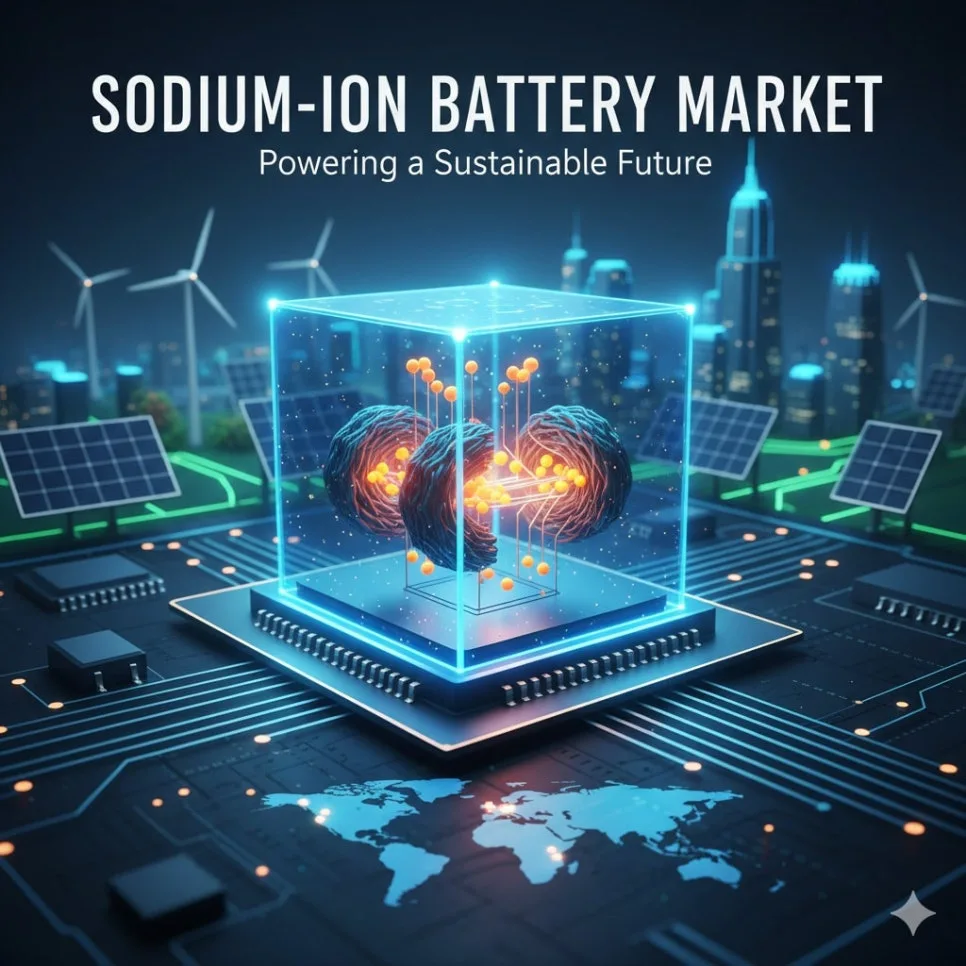
The sodium-ion battery market is emerging as a strong alternative to lithium-ion technology due to its lower cost, abundant raw material availability, and improved safety profile. Industries are increasingly adopting sodium-ion batteries for large-scale energy storage, electric mobility, and industrial applications. Growing investments, government initiatives, and technological advancements are expected to accelerate market growth over the coming years.
The global sodium-ion battery market is projected to reach $12,036.4 million by 2035 from $435.9 million in 2024, growing at a CAGR of 37.43% during the forecast period 2025-2035.
What are the Key Drivers of the Sodium-Ion Battery Market?
- Rising concerns regarding lithium supply shortages and price volatility are encouraging manufacturers to explore sodium-ion battery alternatives.
- Increasing demand for renewable energy integration and grid-scale energy storage systems is boosting sodium-ion battery adoption worldwide.
- Government funding and policy support for clean energy technologies are accelerating research, commercialization, and production capacity expansion.
- Advancements in battery chemistry and manufacturing technologies are improving energy density, safety, and charging efficiency of sodium-ion batteries.
What are the Latest Trends in the Sodium-Ion Battery Market?
- Major battery manufacturers such as CATL are expanding sodium-ion battery production to meet growing demand from energy storage and EV sectors.
- Large-scale stationary energy storage is becoming the leading application segment for sodium-ion batteries due to cost efficiency and operational safety.
- Automotive companies are increasingly investing in sodium-ion battery partnerships for affordable and sustainable electric vehicle solutions.
- The market is witnessing innovation in form factors such as cylindrical, pouch, and prismatic battery designs to support multiple industrial applications.
Why are Sodium-Ion Batteries Becoming Popular in Energy Storage?
Sodium-ion batteries are rapidly gaining attention in the large-scale stationary energy storage sector because of their cost-effectiveness, enhanced safety, and reliance on widely available raw materials like sodium. As lithium prices continue to fluctuate and global supply chains encounter environmental and geopolitical challenges, sodium-ion technology is emerging as a reliable alternative to lithium-ion batteries. Ongoing technological improvements have also enhanced their efficiency and performance, making them increasingly suitable for grid-scale energy storage applications. In March 2025, BYD announced investments in sodium-ion battery production facilities with the objective of reaching cost competitiveness with lithium-iron-phosphate (LFP) batteries.
Request A Sample for Sodium-Ion Battery Market - Focus on Application, Product, and Regional Analysis and Forecast, 2025-2035
What Challenges and Opportunities Exist in the Sodium-Ion Battery Market?
Challenges
- Sodium-ion batteries currently offer lower energy density compared to lithium-ion batteries, limiting their suitability for long-range electric vehicles.
- The industry still faces limited supply chain infrastructure and insufficient large-scale commercial deployment.
- Standardization, regulatory approvals, and optimization of battery materials remain ongoing challenges for manufacturers.
Opportunities
- The abundance and low cost of sodium create significant opportunities for affordable energy storage solutions globally.
- Increasing renewable energy projects and smart grid infrastructure are expected to create strong demand for sodium-ion battery systems.
- Emerging markets are likely to adopt sodium-ion batteries rapidly for low-cost electric mobility and industrial energy storage applications.
Conclusion
The sodium-ion battery market is expected to witness substantial growth as industries seek cost-effective and sustainable energy storage alternatives. Continuous advancements in battery technology, increasing investments, and supportive government initiatives are likely to strengthen market adoption. Although challenges related to energy density and commercialization remain, sodium-ion batteries are positioned to play a major role in the future global energy storage ecosystem.
Trending FAQs on Sodium-Ion Battery Market
What are Sodium-Ion Batteries?
Sodium-Ion Batteries are energy storage devices that use sodium ions to store and release energy, offering a more sustainable and cost-effective alternative to lithium-ion batteries.
How do Sodium-Ion Batteries compare to Lithium-Ion Batteries?
While SIBs offer lower energy density, they are more abundant, environmentally friendly, and cost-effective, making them suitable for large-scale energy storage applications.
Click Here to Download the ToC
Who are the leading companies in the Sodium-Ion Battery Market?
- Aquion Energy (Juline-Titans LLC)
- Faradion (Reliance Industries Ltd)
- HiNa Battery Technology Co., Ltd
- BENAN Energy Technology (Shanghai) Co., Ltd (BENAN ENERGY)
- AMTE Power plc (AGM Batteries Limited)
- Natron Energy, Inc
- TIAMAT
- Jiangsu Zhongna Energy Technology Co., Ltd.
- Contemporary Amperex Technology Co. Limited (CATL)
- Bluetti Power
- Li-FUN Technology Corporation Limited
- Indi Energy
- Altris AB
- Farasis Energy
- BYD Company Ltd