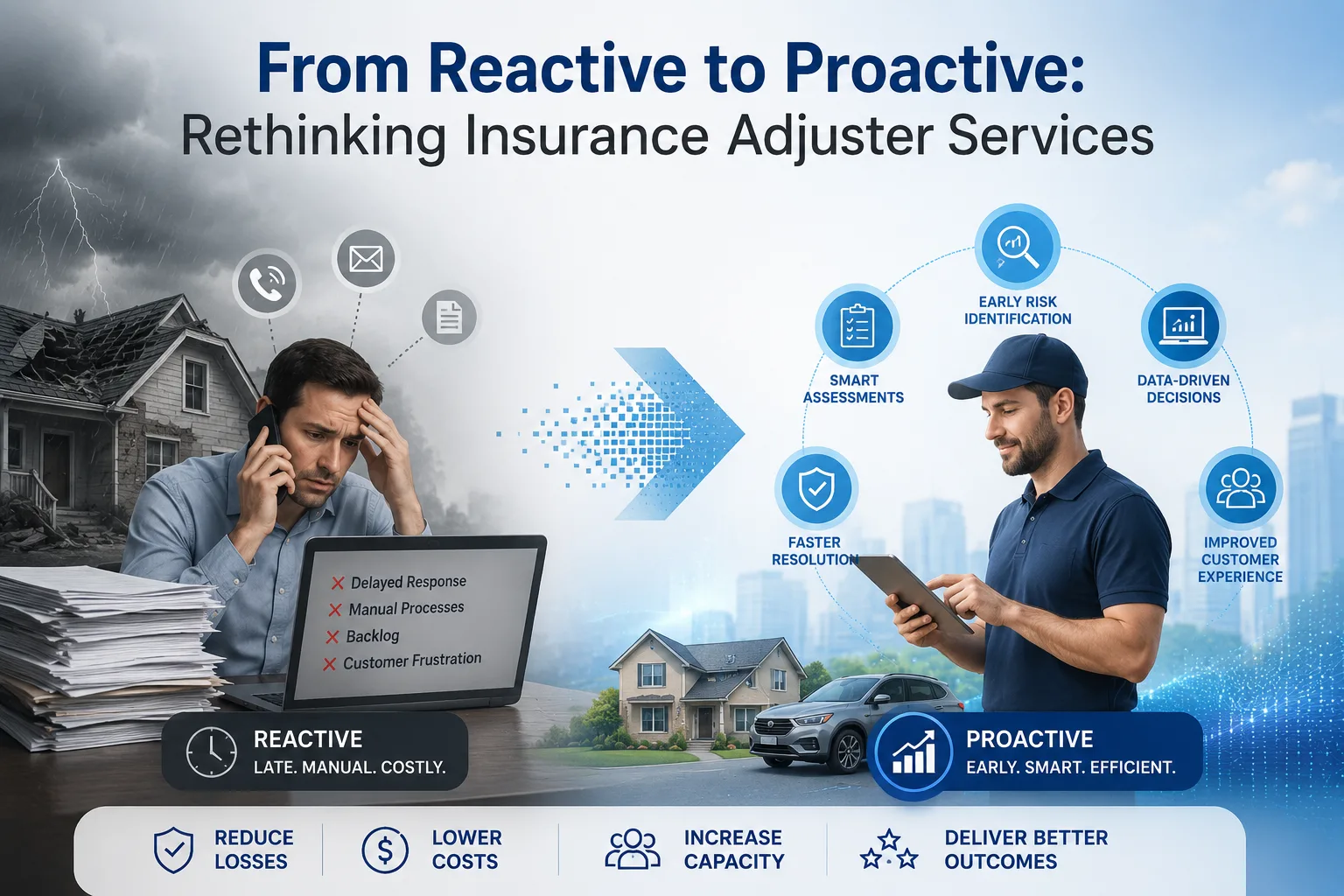
An average property claim now takes more than 44 days to travel from first notice of loss to final payment, the longest stretch since the J.D. Power property claims study began tracking the number in 2008. That figure is not a technology statistic. It is a customer sitting in a damaged home, calling for an update that the adjuster cannot give because 60 other files are stacked ahead of theirs. The math of the desk has not changed in decades: work arrives, the queue grows, and the adjuster spends the first hour of every file rebuilding context that a system already had.
Most insurance adjuster services were built for that reactive rhythm. They log the loss, route it, and wait for a human to read it cold. The better model does something different before the file is ever opened. It reads the claim, scores the risk, flags the fraud markers, and hands the adjuster a short list of what to do next. The desk stops being a queue and starts being a briefing. That shift, from reacting to what lands to anticipating what the file needs, is the argument this piece makes.
What Sits Inside Modern Insurance Adjuster Services
Strip the marketing away and the adjuster function is four jobs: verify the loss, value it, detect what is wrong with the story, and decide how to resolve it. Traditional services support each job separately. A claims system holds the file. A photo-estimating tool sits in another tab. A special investigations unit reviews suspicious claims weeks later, after the money is often gone.
Proactive insurance adjuster services connect those jobs into one flow that runs the moment a loss is reported. First notice of loss triggers data enrichment: policy history, prior claims, weather at the loss location, third-party repair costs. By the time the adjuster sees the file, the context is already assembled. The work that used to eat the first hour, gathering and cross-checking, is done. What remains is judgment, which is the part that actually needs a licensed human.
This is the practical difference between a tool and a service. A tool waits to be opened. A service reads ahead.
The distinction matters most on the claims that go sideways. A straightforward fender-bender rarely tests the system. The value shows up on the water-damage claim with a disputed cause of loss, or the commercial fire where coverage hinges on a policy endorsement nobody has read in two years. On those files, an adjuster working reactively burns hours assembling the facts before forming a view. An adjuster working from an enriched file starts with the facts already on the table and spends that time on the coverage question instead. Same claim, different starting line.
The Digital Solutions for Insurance Adjusters That Actually Move the Needle
Not every digital feature earns its keep. Four categories consistently change the shape of the workday, and they are worth naming precisely.
- Predictive triage: a model scores each incoming claim for severity, complexity, and litigation risk, then routes it. A minor auto glass claim goes one way; a total loss with injury goes to a senior adjuster with the right authority. Routing stops being a clerical guess.
- Computer-vision estimating: photos and video of the damage feed a model that produces a line-item repair estimate in minutes. The adjuster reviews and adjusts rather than measuring from scratch.
- Straight-through processing for simple claims: low-value, low-risk, well-documented claims settle automatically end to end, with a human spot-checking a sample. This is where cycle time collapses from days to minutes.
- Next-best-action guidance: for the claims that stay with a person, the system recommends the next step, the missing document, the reserve adjustment, or the call to make, ranked by impact.
McKinsey research on AI estimates (Source: mckinsey.com) that generative AI alone could automate nearly half of the manual activities in a typical claims process. The point is not that half the people disappear. The point is that half the keystrokes do, which frees the adjuster to spend time where a person adds value: the ambiguous claim, the unhappy customer, the coverage question that has no template.
Where Straight-Through Processing Ends and Judgment Begins
The hard question is not whether to automate simple claims. It is where to draw the line. Draw it too tight and the efficiency gain never arrives. Draw it too loose and a machine pays a claim it should have questioned. The line is a policy decision, not a technical one, and it belongs to the carrier, set by claim type, dollar threshold, and confidence score, then reviewed as the data accumulates.
AI Solutions for Insurance Adjusters: Catching the Problem Before the Payout
Fraud is the clearest case for working ahead of the file. Insurance fraud drains an estimated $308.6 billion from American consumers every year, according to Coalition Against Insurance Fraud data (Source: insurancefraud.org). The traditional model catches a fraction of that after payment, when recovery is slow and often impossible. The proactive model scores the claim for fraud markers at intake, before a dollar moves.
AI solutions for insurance adjusters read patterns a person scanning one file cannot see: a repair shop that appears across unrelated claims, a loss reported days after a lapsed policy was reinstated, injury descriptions that match a known staged-accident template. None of these signals proves fraud. Each one raises a flag that routes the claim to an investigator instead of a payment queue. The adjuster gets a reason to look closer, not a verdict.
Speed on the honest claims funds the scrutiny on the suspicious ones. When straight-through processing clears the routine work in minutes, the special investigations team has time to work the flagged files properly. The two capabilities reinforce each other, which is why bolting a fraud tool onto a slow process rarely works. The gain comes from the whole flow, not one feature.
A customer-experience angle rarely gets counted here. Every hour an investigator spends chasing a false positive is an hour a legitimate claimant waits. A model tuned only to catch fraud, with no regard for how often it flags honest claims, punishes the wrong people and erodes trust in the carrier. The tuning target is not maximum flags. It is the fewest false accusations for a given level of real recovery, measured and adjusted as the claim data grows.
The Human-in-the-Loop Model Is the Whole Point
A recommendation engine is not an adjuster. It does not hold a license, cannot be deposed, and does not answer to a regulator. The strongest claims adjuster solutions treat the model as a very fast, very well-read assistant that never signs the decision.
The pattern works like this: the system does the reading and the ranking, the adjuster does the deciding and the documenting. Every automated recommendation carries its reasoning and its source data, so the human can agree, override, or ask for more. The audit trail records who decided what and why. When a customer disputes an outcome or a regulator asks how a claim was handled, the answer is a named person and a documented rationale, not a black box.
That design also protects the workforce argument. Adjusters worried that these tools exist to replace them tend to relax once they use a system that removes the drudgery and leaves the judgment. The tenured adjuster who spent 15 years learning to read a claim becomes more valuable, not less, because the routine work no longer buries that skill.
It also changes how carriers hire and train. When a model handles enrichment and first-pass estimating, a newer adjuster reaches useful productivity faster, because the system carries the institutional memory that used to take years to absorb. The senior adjuster shifts toward the complex and contested files, mentoring on the judgment calls a model cannot make. The desk does not shrink. Its center of gravity moves toward the work that requires a person, which is a better use of a scarce and expensive skill.
Fair Claims, Explainability, and the Security Underneath
Proactive claims adjuster solutions run headfirst into the rules that govern insurance, and that is by design. A model that scores claims for fraud or routing can encode bias if no one checks it. Regulators noticed. More than half of U.S. states have now adopted the National Association of Insurance Commissioners (NAIC) model bulletin on AI systems, which expects each carrier to maintain a written program governing how its AI makes or supports claim decisions.
Three obligations sit at the center of that expectation:
- Explainability: an adverse decision, a denied claim or a lowered estimate, must come with a reason the customer and a regulator can follow. A confidence score is not a reason.
- Fair-claims compliance: automated routing and settlement cannot produce outcomes that discriminate across protected classes, which means testing the model against real claim populations, not assuming neutrality.
- Data security: claim files hold medical records, financial detail, and property information. The platform reading all of it needs encryption, access controls, and a clear boundary on what training data it retains.
None of this is optional friction. It is the difference between a system a carrier can defend and one that becomes a liability the first time a claim goes to court. Digital solutions for insurance adjusters that ignore governance do not survive contact with a market conduct exam.
Building the Case Internally
The technology is the easy part. The harder work is convincing a claims organization to trust a model with its most sensitive decisions. That trust is earned in narrow pilots: one claim type, one region, a measured comparison against the old process, and honest reporting when the model gets it wrong. Carriers that stage the rollout this way tend to keep the adjusters on board. Those that flip a switch across the whole book tend to spend the next year rebuilding confidence.
What Proactive Looks Like on a Tuesday
Picture two adjusters on the same morning. The first opens a queue of 40 files in the order they arrived, reads each cold, and reacts. The second opens a dashboard where the routine claims already settled overnight, three files carry fraud flags with the supporting evidence attached, and the rest are ranked by what needs a decision today. Same workload, same license, entirely different day.
That second desk is the argument for rethinking insurance adjuster services. The value was never in processing faster. It was in knowing more before the work begins, so the adjuster spends the day on the claims that genuinely need a person and lets the system carry the rest.
The organizations getting this right treat the shift as an operating-model change, not a software purchase. Damco builds toward that model with tooling for adjusters that pairs automated triage and estimating with human decision authority. The next generation of claims adjuster solutions will be judged less on how quickly they clear a file and more on how well they tell the adjuster what deserves attention first, which is where the honest work of a claim has always lived. Explore the technology built for adjusters to see how proactive claims handling holds up against a real backlog.