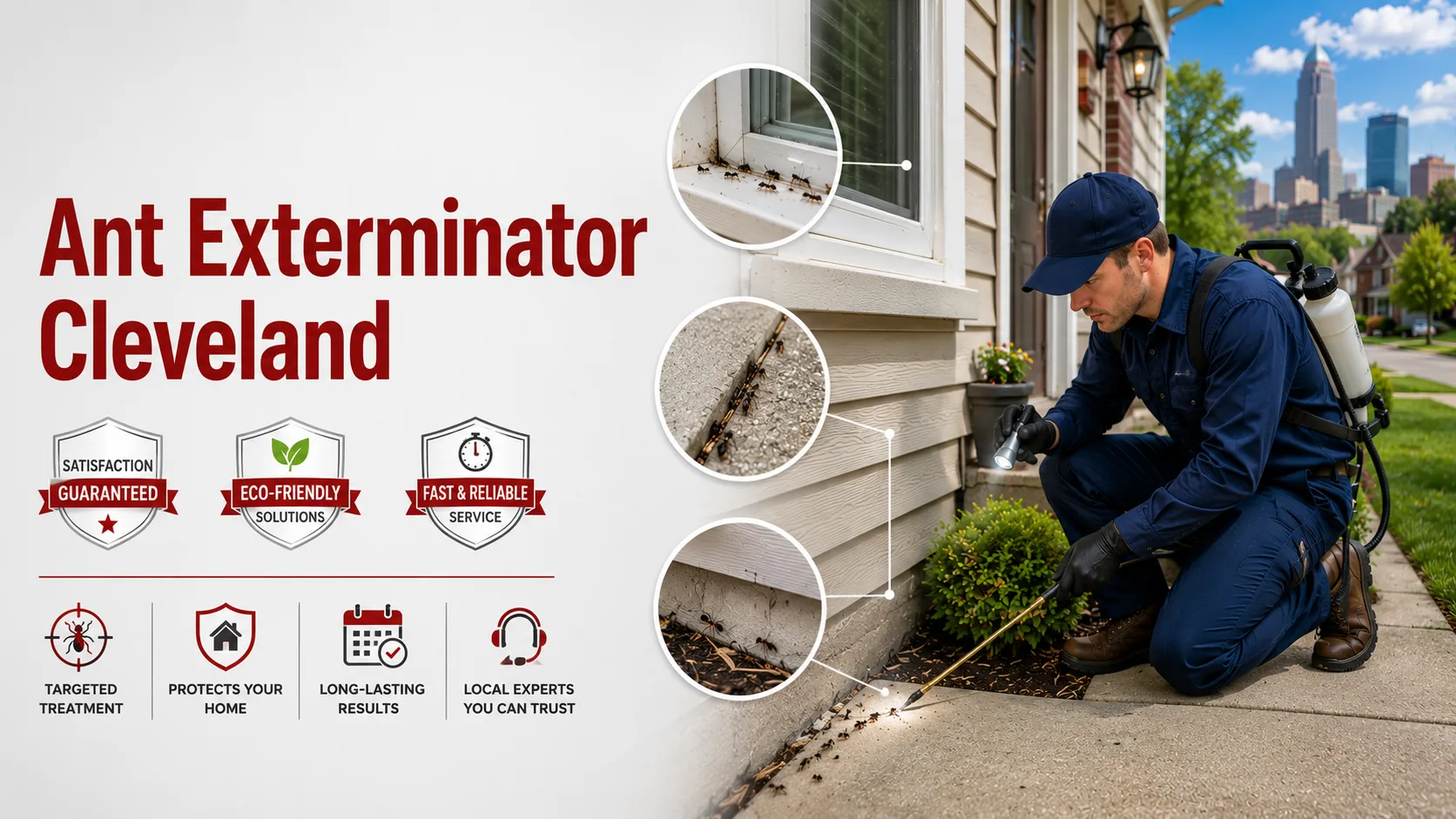
Ants are among the most common pest problems in Cleveland area homes and businesses. They enter structures through the smallest gaps, establish colonies in walls, under flooring, and inside insulation, and send workers out in steady trails that are often the first visible sign of a much larger problem beneath the surface.
A homeowner who spots a line of ants along a kitchen counter may be looking at thousands of workers from a colony that has been established for weeks or months. Store-bought bait and spray products address the ants that are visible. They rarely reach the queen or the nest, which means the colony survives and the problem returns.
This is why working with a qualified ant exterminator in Cleveland produces better outcomes than repeated attempts at self-treatment. Professional exterminators are trained to identify the species involved, locate the source of the infestation, and apply a treatment strategy that addresses the colony rather than just the visible workers.
How Ant Colonies Operate and Why That Matters
Understanding how ant colonies function helps explain why source treatment is the only reliable solution.
Most ant species that infest homes operate with a single reproductive queen or, in some species, multiple queens. Workers leave the colony to gather food and return with it. The workers that homeowners see represent a small fraction of the total colony population.
The Problem with Surface Treatment
When an ant spray is applied to visible trails, it kills the workers present at that moment. The colony registers the loss and sends new workers. It may also respond by relocating part of the colony to a secondary location, which spreads the infestation rather than eliminating it.
Effective ant control in Cleveland requires tracing worker trails back to their origin, identifying nesting sites, and applying treatment that workers carry back into the colony. Only when the queen and core colony are affected does an infestation actually end.
Species Identification Changes the Approach
Not all ants respond to the same treatment methods. Carpenter ants, for example, nest in wood and cause structural damage that resembles termite activity. Odorous house ants are small, fast-moving, and tend to form multiple sub-colonies. Pavement ants nest under concrete slabs and enter homes through foundation cracks.
A professional ant exterminator in Cleveland identifies the species before selecting a treatment approach. Applying the wrong bait type or the wrong application method to a specific species produces poor results and extends the time the infestation remains active.
What a Professional Ant Inspection Covers
Before any treatment begins, a licensed exterminator conducts a thorough inspection of the property. This step is not optional. Skipping directly to treatment without understanding the scope and source of the infestation leads to incomplete results.
Interior Inspection Points
Inside the structure, an inspector evaluates:
- Kitchen and bathroom areas are moisture sources that attract ants.
- Wall voids and baseboards for evidence of nesting or trailing activity
- Window and door frames for gaps that provide entry
- Utility lines and pipe penetrations that create pathways from outside
- Attic and crawl space areas are where carpenter ants commonly establish colonies.
Exterior Inspection Points
Outside the structure, the inspection focuses on:
- Foundation cracks and gaps at ground level
- Wood debris, mulch, and vegetation that touch the building
- Moisture accumulation near the foundation from drainage or plumbing issues
- Tree branches and shrubs that contact the roofline and serve as entry bridges
- Soil conditions around the perimeter that indicate underground nest activity
This combined assessment gives the exterminator a map of active activity and the conditions driving it, which shapes both the treatment plan and the prevention recommendations.
Treatment Methods Used by Professional Ant Exterminators
Ant exterminators use a range of methods depending on species, infestation severity, and property type. Professional treatment goes well beyond what is available in retail pest control products.
Bait Application
Baiting is one of the most effective methods for colony elimination. Workers are attracted to bait stations placed along active trails. They carry the bait back to the nest, where it affects the queen and other colony members. The process takes days to weeks, depending on colony size, but it reaches parts of the nest that sprays never contact.
Perimeter Treatment
A liquid or granular treatment applied around the exterior foundation creates a barrier that kills or deters ants before they enter the structure. This is often used in combination with interior bait placement to address both the existing infestation and new activity from outside.
Void and Direct Nest Treatment
When nesting sites are identified inside wall voids, under flooring, or in structural wood, a direct treatment is applied to the nest area. For carpenter ant colonies in structural wood, this may involve the injection of treatment material into the affected area.
Exclusion Work
Professional ant exterminators also seal entry points as part of a complete treatment plan. Sealing gaps around pipes, caulking window frames, and addressing foundation cracks removes the pathways ants use to enter the structure. Exclusion work reduces re-infestation after treatment is complete.
Ant Control in Cleveland: Seasonal Patterns and Year-Round Risk
Cleveland's weather patterns affect ant activity in predictable ways. Spring and summer bring the highest levels of above-ground ant activity as colonies expand and workers forage more widely. Fall activity often increases as ants seek warmth and food sources inside structures before temperatures drop.
What many homeowners do not realize is that ant colonies remain active indoors year-round. A colony established inside a heated wall void continues to function through winter, and activity resumes at full intensity when spring arrives.
Ant control in Cleveland is most effective when it is not treated as a one-time response to a visible problem. Scheduling inspections at the start of spring and again in late summer allows exterminators to catch new activity before colonies become fully established. Properties with a history of ant problems benefit especially from this approach.
Residential vs. Commercial Ant Problems
Ant infestations in homes and businesses share many characteristics, but commercial properties present additional complications that require a more detailed response.
Residential Properties
In homes, ant infestations most commonly originate from outdoor colonies that have found a food or moisture source inside the structure. Kitchen areas, bathrooms, and areas with water-damaged wood are the most frequent targets. Treatment in residential settings focuses on eliminating the colony source and sealing entry points.
Commercial Properties
In commercial settings such as restaurants, grocery stores, and food processing facilities, any activity raises immediate regulatory and health concerns. A single ant sighting during a health inspection can result in citations, required remediation, and temporary closure.
Ant exterminators serving commercial clients apply the same inspection and treatment principles, but the documentation requirements and treatment scheduling must work around business operations. Treatment is often applied outside business hours, and written records of inspection findings and treatment applications are maintained for regulatory compliance purposes.
What Sets Qualified Ant Exterminators Apart
The quality of anti-extermination work varies considerably. Several factors distinguish a qualified professional from a provider who applies a generic treatment without proper inspection.
Licensing: Ohio requires pest control operators to hold a current license from the Ohio Department of Agriculture. Property owners should verify licensing before hiring any exterminating company.
Species Identification: A qualified exterminator names the species before recommending treatment. Generic treatment applied without species identification is less effective and may be entirely ineffective for certain ant types.
Written Documentation: A professional inspection produces a written report. That report should include findings, the species identified, treatment methods applied, and recommendations for follow-up or exclusion work.
Follow-Up Protocol: Most ant infestations require more than a single treatment visit. A reliable exterminating company schedules follow-up assessments to confirm that treatment has reached the colony and that activity has stopped.
G & G Exterminating follows this process for residential and commercial clients throughout the Cleveland area. Their inspection and treatment work addresses the colony source rather than surface activity, which produces more complete and lasting results.
Ant Exterminator Great Neck and Regional Service Coverage
Ant infestations are not limited to any single neighborhood or municipality. Property owners across the Cleveland region, including communities served by ant exterminator Great Neck professionals, deal with the same species and the same conditions that drive infestations. The treatment principles that apply in one area apply equally in surrounding communities.
Regional pest control coverage matters when a property owner needs a consistent provider across multiple locations or when managing a commercial property portfolio that spans several addresses. Working with an exterminating company that covers a broad service area simplifies scheduling, documentation, and treatment consistency.
Summary
Ant infestations in Cleveland-area homes and businesses do not resolve on their own, and surface treatments applied without locating the colony source produce temporary results at best. A qualified ant exterminator in Cleveland identifies the species, locates the nest, and applies treatment that reaches the colony at its source.
Ant exterminators who follow a complete process of inspection, species identification, targeted treatment, and exclusion work give property owners the most reliable path to a lasting resolution. Ant control in Cleveland is most effective when it is approached as an ongoing practice rather than a single event, with scheduled inspections that catch new activity before it becomes a full infestation.