
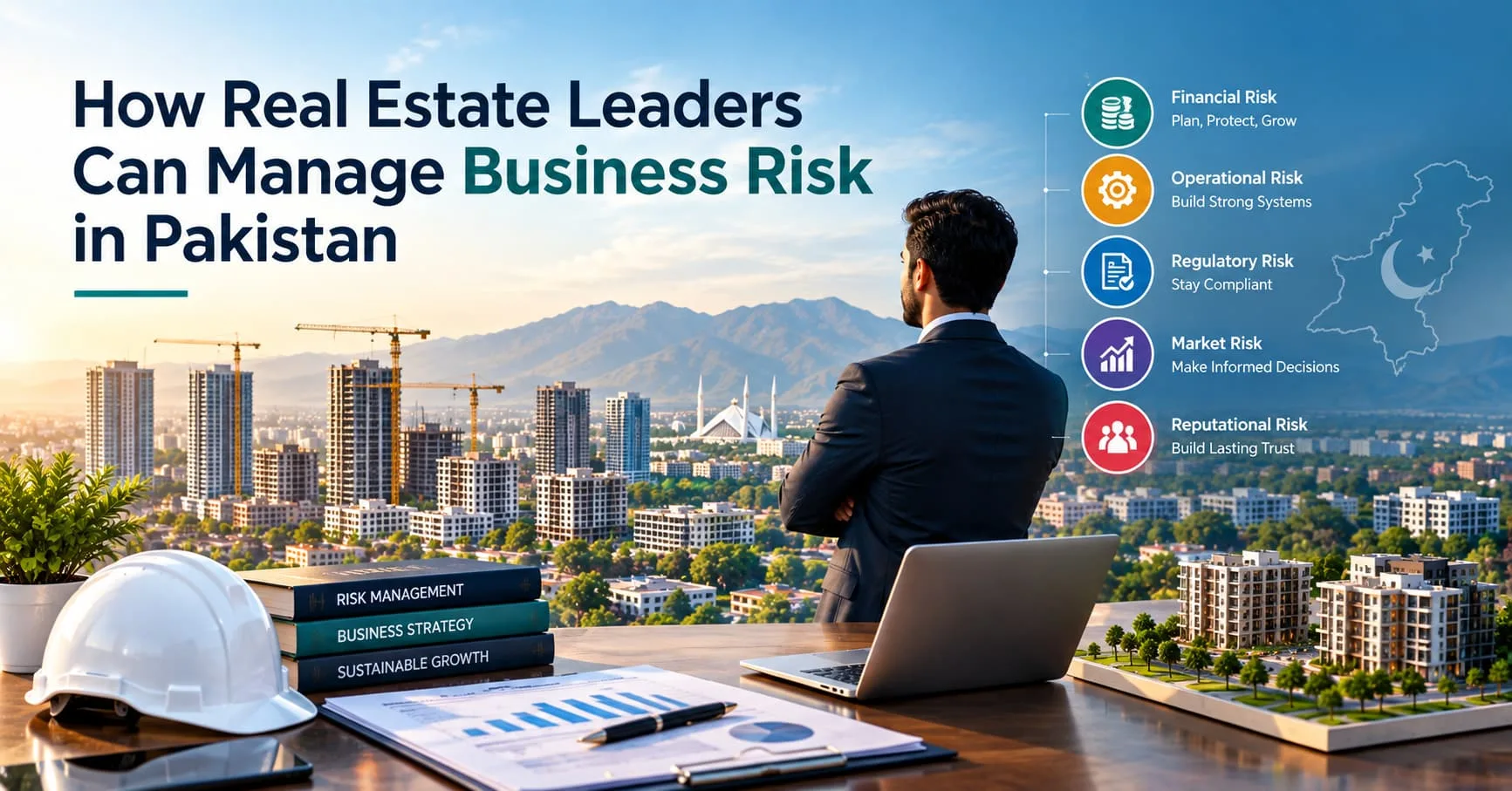
Real estate can offer significant business opportunities, but it is also a sector where decisions often involve large capital commitments, long development cycles, regulatory requirements, changing buyer expectations, and market uncertainty. For developers, investors, and property businesses, managing risk is therefore not simply about avoiding problems. It is about building systems that help identify problems early and make better decisions.
This is where leadership becomes particularly important. Effective risk management connects financial discipline, market research, legal due diligence, project management, customer communication, and organizational decision-making.
For anyone studying syed sadat hussain shah and his published work around real estate and entrepreneurship, risk management also provides a useful lens for understanding how leadership principles can be applied to long-cycle businesses. The broader lesson is relevant beyond any one individual or development: real estate companies need processes that can perform even when market conditions change.
1. Identify Risks Before Making Major Decisions
The first step in business risk management is knowing what can go wrong.
A real estate company may face several categories of risk:
- Market and demand risk
- Financing and cash-flow risk
- Regulatory and documentation risk
- Construction and development risk
- Operational risk
- Reputation and customer-service risk
- Partner and supplier risk
These risks should be identified before a project, investment, expansion, or major marketing campaign is approved.
A simple risk register can help management record each potential risk, its probability, possible financial impact, responsible team member, and mitigation plan. This turns risk management from a general concern into an operational process.
2. Protect Cash Flow, Not Just Revenue
Revenue growth does not automatically mean a real estate business is financially healthy.
Property businesses often deal with long payment cycles, development expenses, construction costs, marketing budgets, taxes, financing obligations, and unexpected delays. A company may therefore need strong cash-flow forecasting even when sales appear healthy.
Leaders should regularly review:
- Expected collections
- Project expenditure
- Outstanding receivables
- Construction commitments
- Financing costs
- Emergency reserves
- Best- and worst-case cash-flow scenarios
Financial discipline gives businesses more room to respond when market conditions or project timelines change.
3. Make Due Diligence a Standard Process
Documentation and compliance are among the areas where preventable risks can become expensive.
Real estate businesses should establish clear procedures for verifying ownership, contractual obligations, approvals, counterparties, payment records, and other relevant documentation before proceeding with major transactions.
Risk-based due diligence is also an established principle in Pakistan's regulated financial environment. The Securities and Exchange Commission of Pakistan, for example, describes customer due diligence and ongoing monitoring as risk-based processes, with greater scrutiny applied where risk is higher.
The exact requirements vary according to the transaction and business structure, so professional legal and financial advice should be obtained where appropriate.
4. Do Not Depend on One Market Assumption
Real estate decisions can become vulnerable when businesses assume that prices, demand, financing conditions, or buyer preferences will remain unchanged.
Strong management therefore uses multiple scenarios.
For example, before launching a project, leadership can ask:
What happens if sales are slower than expected?
What happens if construction costs increase?
What happens if the project timeline changes?
What happens if buyer preferences shift?
Scenario planning does not predict the future. Instead, it prepares the organization to respond to different possibilities.
5. Build Systems That Reduce Operational Risk
A growing property business can become difficult to manage when every decision depends on one founder or senior executive.
Standard operating procedures can reduce this dependency. Sales, customer support, documentation, procurement, project monitoring, finance, and reporting should have defined workflows and responsibilities.
Technology can support these systems through CRM platforms, accounting software, project-management tools, document management, dashboards, and automated reporting.
The objective is not technology for its own sake. The objective is better visibility and fewer avoidable errors.
6. Treat Reputation as a Business Asset
Real estate is highly relationship-driven. Buyers often make decisions based not only on property characteristics but also on their perception of the developer, sales team, documentation, communication, and after-sales support.
For a Pakistani business leader, reputation management should therefore be treated as part of risk management rather than simply marketing.
Businesses can protect trust by communicating terms clearly, avoiding exaggerated promises, responding to customer concerns, documenting commitments, and correcting mistakes transparently.
A strong reputation cannot eliminate business risk, but poor communication can turn a manageable operational issue into a much larger credibility problem.
7. Leadership Must Connect Different Functions
Business risk rarely belongs to one department.
A financial decision can affect construction. A construction delay can affect customer satisfaction. A documentation issue can affect reputation. A marketing promise can create operational pressure.
This is why business leadership in Pakistan increasingly requires cross-functional thinking. Leaders need enough understanding of finance, operations, marketing, compliance, customer experience, and project management to see how decisions interact.
The goal is not for one person to perform every function. It is to make sure senior leadership understands how the functions depend on one another.
8. Create a Practical Risk Review Cycle
Risk management becomes more effective when it is reviewed regularly rather than only when a crisis appears.
A monthly or quarterly review can examine:
- New market developments
- Project progress
- Financial performance
- Regulatory changes
- Customer complaints
- Supplier and contractor performance
- Outstanding legal or documentation issues
- Emerging operational risks
This creates an early-warning system for management.
For Pakistan real estate leadership, this type of structured approach is particularly relevant because real estate businesses operate across multiple interconnected areas rather than in a single functional environment.
Building a More Resilient Real Estate Business
Risk management should not be viewed as an obstacle to growth. Properly designed, it can support sustainable growth by helping businesses make decisions based on evidence rather than assumptions.
The strongest approach combines market intelligence, financial discipline, due diligence, operational systems, technology, transparent communication, and accountable leadership.
For real estate entrepreneurs in Pakistan, the practical question is not whether every risk can be eliminated. It cannot. The more useful question is whether the organization has the people, processes, information, and financial discipline needed to recognize risks early and respond responsibly.
That is ultimately what turns risk management from a defensive business activity into a foundation for long-term resilience.