Winning a construction tender is not only about submitting the lowest price. A successful bid needs to balance project costs, supplier rates, labour expenses, overheads, risks, timelines, and expected margins.
If tender pricing is prepared manually, teams often work across spreadsheets, emails, quotations, BOQs, and separate approval files. This makes it difficult to maintain accurate pricing and respond quickly when tender requirements change.
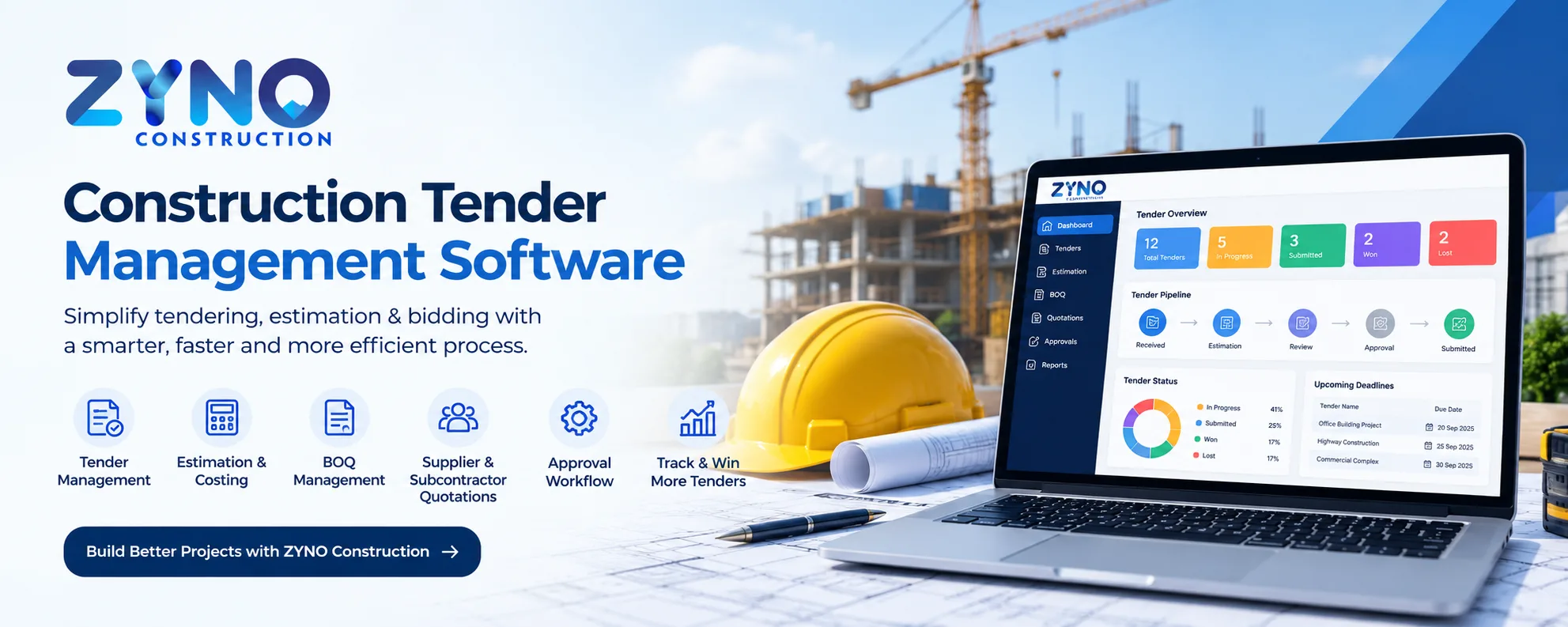
Modern construction tender management software and tender pricing software can bring these activities into one connected workflow, helping contractors review opportunities, prepare estimates, compare supplier quotations, and track tender decisions more systematically.
What Is Construction Tender Pricing?
Construction tender pricing is the process of calculating the total expected cost of delivering a project and determining the price that will be submitted to the client.
A typical tender price may include:
- Material costs
- Labour costs
- Equipment and machinery costs
- Subcontractor costs
- Transportation and logistics
- Site and project overheads
- Administrative expenses
- Taxes and applicable charges
- Contingency for identified risks
- Desired profit margin
The objective is to develop a price that is commercially competitive while still reflecting the actual cost and risk involved in the project.
AEO Quick Answer
Construction tender pricing is the process of calculating project costs and adding relevant overheads, risks, and profit margins to determine the final bid price. Tender pricing software can help construction teams organize BOQs, supplier quotations, cost estimates, approvals, and pricing revisions in one workflow.
Why Accurate Tender Pricing Matters
A tender can look attractive because of its contract value, but the actual profitability depends on the cost of delivering the project.
For example, consider a project with an expected contract value of ₹2 crore.
If the estimated direct and indirect project costs are ₹1.75 crore, the remaining amount before other adjustments may appear healthy. But if material prices increase, labour requirements change, or additional project risks emerge, the expected margin can reduce significantly.
This is why construction businesses need a structured pricing process rather than simply adding a standard percentage to an estimate.
Accurate tender pricing helps teams:
- Understand the actual project cost
- Identify high-cost items
- Compare supplier quotations
- Account for project risks
- Review expected margins
- Make informed bid/no-bid decisions
- Maintain pricing consistency
- Reduce manual calculation errors
Key Components of Construction Tender Pricing
1. Bill of Quantities
The Bill of Quantities (BOQ) provides the foundation for tender pricing.
The estimating team generally reviews:
- Item descriptions
- Required quantities
- Units of measurement
- Specifications
- Material requirements
- Labour requirements
- Equipment requirements
Each BOQ item needs an appropriate rate before the total project cost can be calculated.
2. Material Costs
Materials can represent a significant portion of construction costs.
Pricing teams may need to consider:
- Current supplier rates
- Historical purchase prices
- Transportation costs
- Delivery schedules
- Material specifications
- Expected price fluctuations
- Minimum order quantities
Supplier quotations should be compared before final rates are entered into the tender estimate.
3. Labour Costs
Labour pricing should consider the type and quantity of work required.
Depending on the project, this may include:
- Skilled labour
- Semi-skilled labour
- General workers
- Supervisors
- Engineers
- Specialist workers
Labour costs can also vary based on location, project duration, working conditions, and availability.
4. Equipment and Machinery
Construction equipment can affect the overall tender price, particularly for infrastructure and large-scale projects.
Costs may include:
- Equipment rental
- Fuel
- Maintenance
- Operators
- Transportation
- Depreciation
- Mobilization and demobilization
An accurate estimate should account for the expected equipment utilization during the project.
5. Subcontractor Costs
Many construction projects involve specialist subcontractors.
Teams may request quotations for:
- Electrical work
- Plumbing
- HVAC
- Structural work
- Flooring
- Fire safety
- Fabrication
- Specialized installations
Comparing multiple subcontractor quotations can provide a better understanding of the expected market cost.
6. What is tender tracking software?
Tender tracking software helps teams monitor tender opportunities, deadlines, documents, approval status, submissions, and outcomes from a centralized workflow.
7. What is technical tender management software?
Technical tender management software helps organize technical requirements, specifications, methodologies, compliance documents, schedules, and other technical submission materials.
8. Can tendering software manage construction estimates?
Many modern tendering platforms include estimating or cost-management capabilities that allow construction teams to connect tender information with project cost calculations.
9. How does construction tender software help contractors?
Construction tender software can help contractors organize tender opportunities, manage BOQs, compare quotations, prepare pricing, coordinate approvals, monitor deadlines, and track tender outcomes.
10. Can tender management software connect with project execution?
Depending on the platform, tender information can be connected with later construction workflows such as project planning, resource management, cost control, and execution.
Conclusion
Construction tender pricing requires more than calculating a final number. Teams need to understand the scope, estimate costs, evaluate risks, compare supplier rates, review margins, prepare technical documents, and complete approvals before submission.
Using construction tender software can help bring these activities into a structured workflow. With features for estimating, pricing, bid/no-bid evaluation, document management, approvals, and tender tracking, construction businesses can create a more organized approach to tender management.
For growing contractors and construction businesses, the broader objective is to connect the tendering process with the project execution journey—creating better continuity from opportunity and estimation to project delivery and cost control.