Introduction
Employee training is no longer limited to classroom sessions or online courses. Organizations are combining different learning methods to make training more flexible, accessible, and practical.
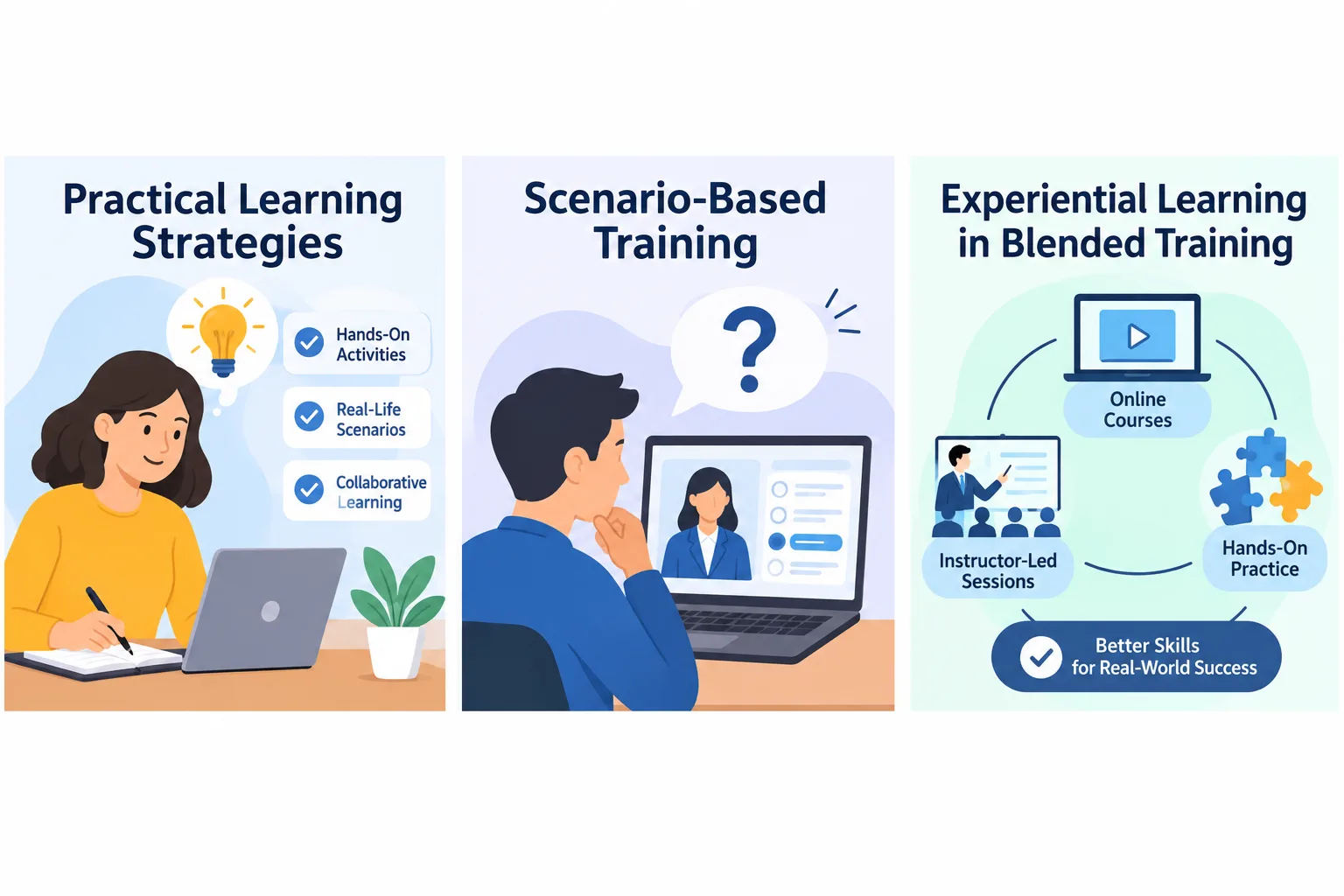
Blended learning brings together digital resources and instructor-led training. When experiential learning is added to this approach, employees get opportunities to understand concepts, practice skills, and apply knowledge in realistic situations.
This combination helps organizations create learning experiences that go beyond completing training modules.
1. Start With Digital Learning Foundations
Online learning is a useful starting point for introducing new concepts and providing foundational knowledge.
Employees can access recorded lessons, presentations, reading materials, and self-paced courses before participating in practical training.
For example, employees preparing for a customer service workshop can first complete an online module covering communication techniques and customer interaction guidelines.
This allows classroom time to focus more on practice and discussion rather than explaining basic concepts.
2. Add Instructor-Led Practice Sessions
Instructor-led training provides opportunities for employees to interact with trainers, ask questions, and practice what they have learned.
Workshops can include:
- Role-playing exercises.
- Group problem-solving activities.
- Practical demonstrations.
- Team discussions.
- Case study analysis.
For example, a leadership training program can introduce management principles through online courses and use live workshops for practicing employee feedback conversations.
3. Introduce Real-World Projects
Projects help employees apply their learning to meaningful tasks.
Instead of completing only theoretical exercises, learners can work on assignments connected to their actual responsibilities.
Examples include:
- Creating a customer onboarding plan.
- Developing a workplace safety checklist.
- Preparing a business presentation.
- Solving a simulated technical problem.
- Designing a process improvement proposal.
These activities help employees connect training concepts with their everyday work.
4. Use Virtual Classrooms for Collaborative Learning
Virtual classrooms make it possible for distributed teams to participate in instructor-led learning without being physically present in the same location.
Trainers can use live sessions for demonstrations, discussions, group exercises, and knowledge-sharing activities.
Breakout discussions and collaborative assignments can make remote sessions more interactive.
This is particularly useful for organizations that manage employees across different offices, locations, or time zones.
5. Provide Continuous Feedback and Assessment
Feedback plays an important role in experiential learning.
Employees should understand how well they performed an activity and what they can do differently next time.
Organizations can combine different assessment methods, such as:
- Knowledge checks after online modules.
- Practical demonstrations during workshops.
- Peer feedback during group activities.
- Trainer evaluations.
- Follow-up assignments.
Using different assessment methods helps organizations evaluate both theoretical understanding and practical application.
6. Track Learning Progress Across Different Activities
A blended training program may include multiple courses, workshops, assignments, and assessments.
Managing these activities separately can make it difficult to understand overall learner progress.
A centralized learning management system can help organizations organize learning content, manage enrolments, monitor course completion, and track assessment results.
For instructor-led programs, a training management system can also support scheduling, trainer coordination, and training administration.
Together, these capabilities help organizations manage different parts of their training programs more efficiently.
7. Evaluate the Impact on Workplace Performance
The success of blended experiential learning should not be measured only through course completion rates.
Organizations should also consider whether employees can apply their skills effectively.
Useful evaluation methods include:
- Practical skill demonstrations.
- Workplace performance reviews.
- Manager feedback.
- Project outcomes.
- Follow-up assessments.
- Employee feedback surveys.
Reviewing these indicators helps L&D teams understand which training activities are effective and where improvements are needed.
Conclusion
Combining experiential learning with blended training programs gives employees opportunities to learn concepts, practice skills, and apply knowledge in realistic situations.
Digital courses provide flexibility, instructor-led sessions offer guidance, and practical activities help learners develop workplace capabilities.
With the right combination of learning methods and centralized training management, organizations can create more engaging and effective employee development programs.
FAQs
1. What is blended experiential learning?
Blended experiential learning combines digital courses, instructor-led sessions, and practical activities to help employees develop and apply skills.
2. What are the benefits of combining blended and experiential learning?
It provides flexible learning access while creating opportunities for practice, collaboration, feedback, and real-world application.
3. Can experiential learning be delivered virtually?
Yes. Virtual classrooms, online simulations, group assignments, and interactive exercises can support experiential learning remotely.
4. How can an LMS support blended training?
An LMS helps organizations manage digital courses, learner enrolments, assessments, progress tracking, and learning resources in one place.
5. How can organizations measure blended learning effectiveness?
They can review course completion, assessment performance, practical demonstrations, employee feedback, and workplace performance improvements.