India Packaged Sweets Market Outlook
This research report by IMARC Group on the India Packaged Sweets Market provides a forecast of market size, share, and emerging trends for 2026–2034. The report covers segmentation by product type, ingredient type, packaging type, distribution channel, and region, with regional coverage across North India, West and Central India, South India, and East India.
Market Snapshot
- Market Name: India Packaged Sweets Market
- Region: India
- Base Year and Market Size: INR 8,431 Crore (2025)
- Forecast Year and Market Value: INR 30,505.74 Crore (2034)
- CAGR: 15.36%
- Forecast Period: 2026–2034
- Segmentation Covered: Product type, ingredient type, packaging type, distribution channel, and region
Current Market Size of the India Packaged Sweets Industry
The India packaged sweets market size was valued at INR 8,431 Crore in 2025 and is projected to reach INR 30,505.74 Crore by 2034, growing at a CAGR of 15.36% during 2026–2034. Expanding cold chain infrastructure, federal food processing incentives, rising organised retail penetration, and stronger consumer preference for hygienic, branded festive confections drive this rapid expansion.
How Changing Consumer Preferences and Supply Chains Are Shaping the India Packaged Sweets Market
- Dairy cooperatives recorded 690.90 lakh kg per day of milk procurement as of 31 October 2026 per the Press Information Bureau, securing steady khoya and paneer supply.
- Public dairy programmes created 168 lakh litres per day of milk chilling capacity by October 2026 according to the Press Information Bureau, preserving raw milk quality before processing.
- Blinkit operated 2,443 dark stores by June 2026 while Swiggy Instamart covered 131 cities per retail trackers, shifting festive sweet purchases toward rapid doorstep delivery.
- Legacy sweetmakers such as Bikanervala retail sugar-free dry fruit burfi and fusion baklava assortments online per company catalogues, capturing younger and health-conscious Indian buyers.
- National dairy output reached about 247.87 million tonnes per the Department of Animal Husbandry and Dairying, ensuring consistent domestic raw material availability for packaged mithai producers.
Emerging Trends in the India Packaged Sweets Market
Capital Market Readiness Among Legacy Sweetmakers
Institutional investors are accelerating the formalisation of family-run Indian mithai businesses into listed consumer staples companies. Haldiram Snacks Food formally commenced its USD 1 billion initial public offering process in November 2026 after attracting roughly USD 1,700 million from global investors in 2025 per The Economic Times, raising governance standards.
Dairy Cooperatives Scaling Branded Sweet Portfolios
State dairy federations are using vertically integrated milk collection networks to expand affordable packaged mithai lines nationwide. The Gujarat Cooperative Milk Marketing Federation raised its turnover to INR 73,450 crore in FY2025–26 as the Amul brand crossed INR 1 lakh crore per The Economic Times, intensifying competition against private sweetmakers.
Export Expansion of Indian Ethnic Sweets
Domestic packaged food producers are tapping diaspora demand across the Middle East, North America, and Europe using extended shelf-life packaging. India exported 97,524.82 metric tonnes of dairy products worth USD 407.12 million during FY2025–26 according to the Press Information Bureau, supporting higher overseas shipments of Indian milk-based confections.
Stricter Packaging Safety and Labelling Compliance
Regulators are tightening packaging hygiene norms to protect consumers from contamination and misleading freshness claims. Under Food Safety and Standards Authority of India rules, pre-packaged sweet labels must display manufacturing and expiry dates, while misbranding attracts penalties up to INR 3 lakh under Section 52 of the FSS Act.
Request Sample Report with Datasheet – TOC, Charts & Key Insights: https://www.imarcgroup.com/india-packaged-sweets-market/requestsample
Growth Drivers of the India Packaged Sweets Market
Cold Chain Expansion Under PMKSY
Federal infrastructure grants directly lower preservation and logistics costs for perishable milk-based confections. Under the Pradhan Mantri Kisan Sampada Yojana, 1,256 projects were operational as of 30 June 2026, creating 294.21 lakh metric tonnes per annum of food processing and preservation capacity according to the Press Information Bureau.
Production Linked Incentives for Branded Food Processing
Targeted fiscal support encourages packaged food companies to scale automated sweet manufacturing and international branding. The Ministry of Food Processing Industries operates the Production Linked Incentive Scheme for Food Processing Industry from FY2021–22 to FY2026–27 with an outlay of INR 10,900 crore according to a February 2026 Press Information Bureau reply.
Micro Enterprise Formalisation Under PMFME Scheme
Credit-linked subsidies are helping regional sweetmakers upgrade hygiene, machinery, and modern packaging lines. Under the Pradhan Mantri Formalisation of Micro Food Processing Enterprises scheme carrying an INR 10,000 crore outlay, 1,72,707 micro food processing units were approved as of 31 December 2025 according to the Ministry of Food Processing Industries.
Uniform Low GST Rate Supporting Organised Retail
A predictable, low indirect tax structure narrows the price gap between unorganised local sweet shops and packaged brands. Under Notification 9/2025-CT(Rate) effective from 22 September 2025, sweetmeats attract a uniform 5% Goods and Services Tax rate under HSN 2106 whether sold loose or packaged, encouraging formal retail adoption.
Key Market Segments in the India Packaged Sweets Market
The India packaged sweets market is segmented by product type, ingredient type, packaging type, distribution channel, and region.
Product Type Segmentation
- Rasgulla and Gulab Jamun
- Barfi
- Soan Papdi
- Peda
- Laddoo
- Others
Rasgulla and gulab jamun dominated the product type segment with a 28% share in 2025, supported by universal festive appeal, extended shelf life in syrup packs, and modern single-serve or sugar-free variants. Barfi and laddoo represent the next major demand pockets, driven by traditional gifting and everyday household consumption.
Ingredient Type Segmentation
- Milk and Milk Derivatives
- Cereal and Pulses
- Dry Fruits
- Fruits and Vegetables
- Others
Milk and milk derivatives led the ingredient type segment with a 40% share in 2025, anchored by consumer preference for khoya, paneer, and condensed milk sweets backed by India's dairy cooperative network. Cereal and pulses alongside dry fruits drive the next-largest demand through festive laddoos and premium gifting assortments.
Packaging Type Segmentation
- Boxes
- Tin Cans
- Plastic Containers
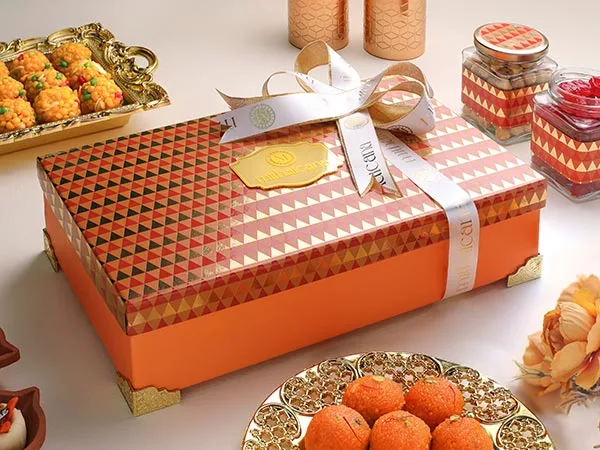
Boxes commanded the largest packaging type share at 49% in 2025 because decorative, eco-friendly, and customisable box formats suit festive and corporate gifting while protecting delicate sweets during transit. Tin cans represent the next-largest segment, widely preferred for syrup-based sweets such as rasgulla and gulab jamun requiring long shelf life.
Distribution Channel Segmentation
- Own Brand Stores
- Convenience Stores
- Supermarkets and Hypermarkets
- E-Commerce
- Milk Outlets
Supermarkets and hypermarkets led the distribution channel segment with a 30% share in 2025, supported by climate-controlled aisles, festive displays, and organised retail partnerships with regional sweetmakers. E-commerce and own brand stores form the next major growth channels, driven by doorstep convenience and direct-to-consumer gifting orders.
Regional Breakdown
- North India
- West and Central India
- South India
- East India
North India dominated the regional market with a 30% share in 2025, driven by deeply ingrained sweet consumption habits, dense urban populations, and established production hubs across key states. West and Central India stands as a major secondary market, supported by strong festive gifting demand and organised retail expansion.
Who Are the Key Players in the India Packaged Sweets Market?
Competition in the India packaged sweets market centres on shelf-life technology, brand trust, dairy procurement scale, and festive distribution reach. Leading participants include Banchharam, Bikanervala Foods Private Limited, Bikaji Food International Limited, Bihar State Co-operative Milk Producers Federation Limited (COMFED), Gujarat Co-operative Milk Marketing Federation Limited, Haldiram's, Karnataka Co-operative Milk Producers Federation Limited (KMF), KC Das Private Limited, Lal Sweets Private Limited, Orissa State Co-operative Milk Producers Federation Limited (OMFED), Parag Milk Foods Limited, and Tamil Nadu Co-operative Milk Producers Federation Limited (TCMF).
Latest Recent Developments in the India Packaged Sweets Market
- In November 2026, Bikaji Foods International reported H1 FY2026–27 revenue growth of 12.8% year-on-year to INR 16,728 million across its snacks and packaged sweets portfolio, per BSE filings.
- In June 2026, the Food Safety and Standards Authority of India issued a packaging safety advisory prohibiting metal staple pins and wires on sweet boxes, according to compliance trackers.
- In March 2026, the Food Safety and Standards Authority of India notified the First Amendment Regulations, 2026 to revise non-retail food container labelling rules effective July 2027, per regulatory records.
If you require any specific information not covered within this report's scope, we will provide it as part of the customization.
Request Report Customization: https://www.imarcgroup.com/request?type=report&id=5010&flag=E
Frequently Asked Questions (FAQs)
Q1. How big is the India packaged sweets market and what is its projected growth?
The India packaged sweets market was valued at INR 8,431 Crore in 2025. It is projected to reach INR 30,505.74 Crore by 2034, growing at a compound annual growth rate of 15.36% during 2026–2034.
Q2. Why is demand rising for packaged sweets across India?
Demand is rising due to PMKSY cold chain infrastructure creating 294.21 lakh metric tonnes of preservation capacity, the INR 10,900 crore PLISFPI scheme, PMFME micro-enterprise subsidies, and a uniform 5% GST rate on sweetmeats.
Q3. Which product type, ingredient, packaging, and distribution segments lead the market?
Rasgulla and gulab jamun led product types with a 28% share in 2025, while milk and milk derivatives held 40% of ingredients. Boxes dominated packaging at 49%, and supermarkets and hypermarkets led distribution at 30%.
Q4. Where is packaged sweets consumption most concentrated regionally in India?
North India led the regional market with a 30% share in 2025, supported by traditional sweet consumption habits, dense urban clusters, and established production hubs. West and Central India follows as a major secondary market.
Q5. How are sweetmakers and regulators reshaping the industry in 2026?
Legacy brands are preparing for public listings while dairy cooperatives scale branded mithai portfolios, exporters expand overseas shipments, and the Food Safety and Standards Authority of India enforces stricter date-marking and staple-free box packaging rules.