In today's evolving industrial landscape, maintaining product quality, improving operational efficiency, and controlling manufacturing costs are essential for businesses across different sectors. One of the most important processes contributing to these objectives is effective moisture removal. Whether processing agricultural materials, chemicals, pharmaceutical ingredients, minerals, polymers, or food products, controlling moisture content is critical to achieving the required product characteristics and maintaining consistency throughout production.
Industrial dryers play a significant role in meeting these requirements. These specialized systems are designed to remove moisture from raw materials, semi-processed substances, and finished products under controlled operating conditions. By combining suitable heating technologies, controlled airflow, material handling mechanisms, and automated process controls, industrial drying equipment helps manufacturers achieve the desired moisture levels while maintaining important physical, chemical, and functional properties of the material.
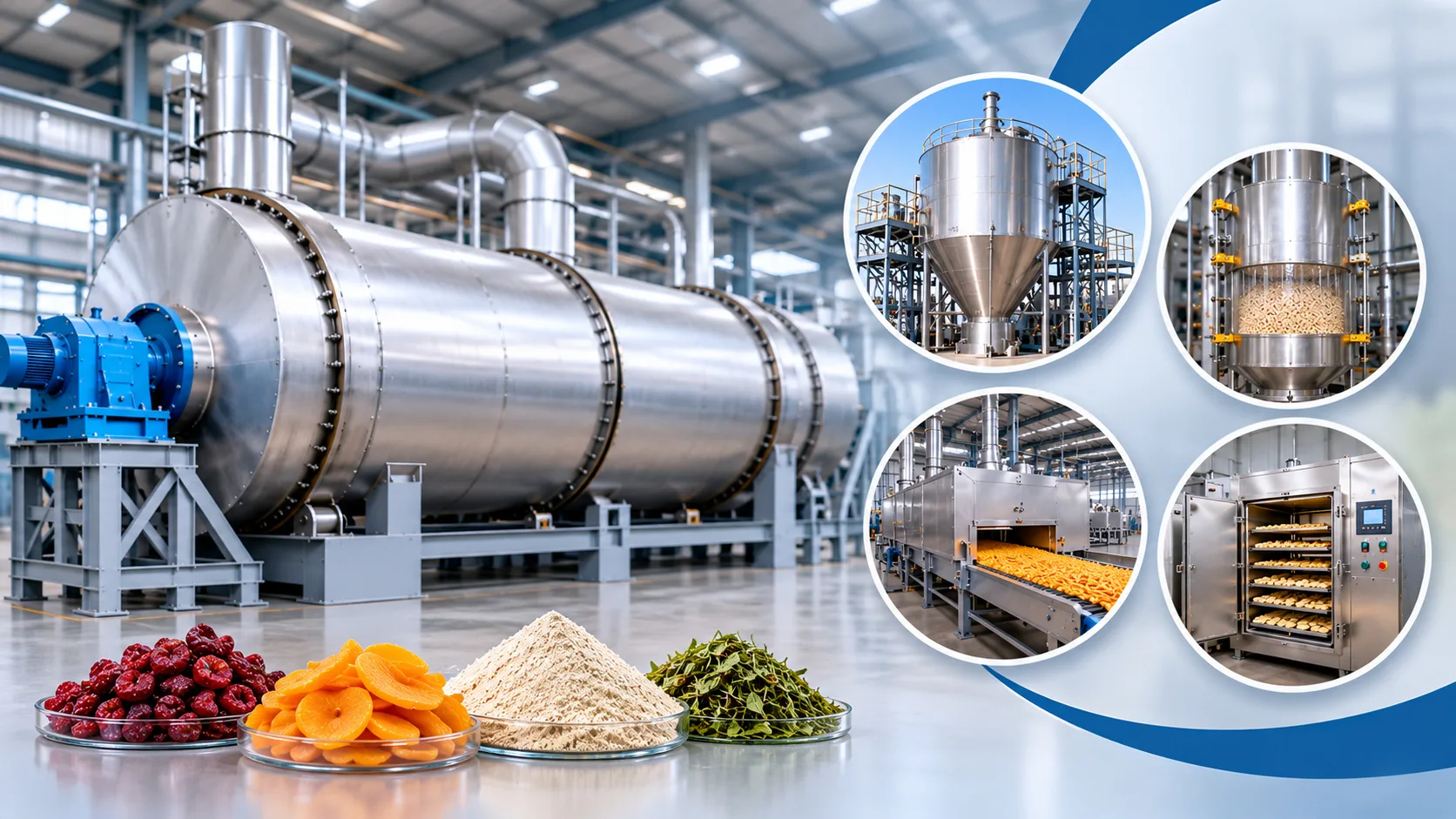
Unlike conventional drying methods, modern industrial drying systems are engineered to handle large processing volumes, different material characteristics, and continuous production requirements. Depending on the application, manufacturers can select from several drying technologies, including rotary dryers, spray dryers, fluidized bed dryers, tunnel dryers, tray dryers, and hot air dryers. Each configuration offers specific operational advantages and can be designed around the material's moisture content, thermal sensitivity, particle size, production capacity, and final product requirements.
Advanced Industrial Drying Technologies for Different Processing Requirements
Different materials respond differently to heat and moisture removal. A drying method suitable for minerals may not be appropriate for pharmaceutical powders, food ingredients, or heat-sensitive chemicals. Consequently, industrial drying equipment is available in several configurations to accommodate different processing conditions.
1. Rotary Dryers
Rotary dryers are widely used for processing bulk solids, granular materials, minerals, agricultural products, and industrial residues. These systems generally consist of a rotating cylindrical drum through which the material moves while coming into contact with a heated drying medium.
As the drum rotates, internal flights or lifting elements continuously lift and distribute the material, improving contact with the hot air. This arrangement supports moisture evaporation while allowing the material to progress through the drying chamber.
Rotary drying systems are particularly suitable for applications requiring continuous processing and relatively high material throughput. Their design can be adapted according to feed characteristics, initial moisture content, required final moisture level, and production capacity.
2. Spray Dryers
Spray dryers are primarily used to convert liquid feeds, solutions, suspensions, and emulsions into dry powders. The liquid material is atomized into fine droplets and introduced into a controlled hot-air environment. Moisture evaporates rapidly from the droplets, leaving behind dried particles that can be collected through an appropriate powder recovery arrangement.
This technology is commonly applied in food processing, dairy production, pharmaceuticals, chemicals, and specialty ingredient manufacturing.
Spray dryer performance depends on several factors, including feed concentration, viscosity, atomization characteristics, inlet and outlet air temperatures, airflow rate, and desired powder properties. Proper process design helps manufacturers control particle size, residual moisture, bulk density, and other important product characteristics.
3. Fluidized Bed Dryers
Fluidized bed dryers are designed for drying particulate materials by passing heated air upward through a perforated distribution plate. At a suitable airflow velocity, the particles become suspended and behave similarly to a fluidized mass.
This movement creates effective contact between the drying air and individual particles, supporting heat transfer and moisture removal. Fluidized bed systems are frequently used for powders, granules, pharmaceutical products, chemicals, fertilizers, and food ingredients.
Depending on the process, these systems can also be configured for cooling, granulation, and other material treatment operations. Their suitability depends on particle size distribution, density, flow characteristics, and fluidization behaviour.
4. Tunnel Dryers
Tunnel dryers are commonly used for continuous or semi-continuous drying of products that require controlled movement through different temperature and airflow zones.
Materials are generally placed on trays, racks, conveyors, or other suitable carriers and transported through an enclosed drying chamber. The arrangement allows the drying conditions to be adjusted along different sections of the tunnel.
These systems are used in food processing, ceramics, textiles, agricultural product processing, and other manufacturing operations. Depending on the material and production requirements, tunnel dryers can be designed with specific airflow patterns, heating arrangements, conveyor speeds, and temperature profiles.
5. Hot Air Dryers
Hot air dryers use heated air as the primary medium for transferring thermal energy to the material and carrying away evaporated moisture. They are available in several configurations, including tray dryers, cabinet dryers, conveyor dryers, and customized chamber-based systems.
These dryers are suitable for a broad range of industrial applications involving solid materials, components, powders, and products with different moisture-removal requirements.
Their performance depends on air temperature, air velocity, humidity, circulation pattern, material loading, and exposure time. Proper airflow distribution is particularly important to minimize variations in drying across different sections of the product load.
Essential Features of High-Performance Industrial Drying Systems
The effectiveness of an industrial dryer depends not only on its heating capacity but also on how accurately the complete drying process is controlled. A well-engineered system incorporates several important design and operational features.
- Controlled Moisture Removal
- Energy-Efficient Heating and Heat Utilization
- Reliable Construction for Industrial Operations
- Automation and Process Monitoring
- Customized Equipment Design
Industrial Applications of Drying Equipment Across Different Sectors
Industrial dryers are used in a wide variety of manufacturing and processing industries. Their applications range from removing excess moisture from raw materials to preparing finished products for storage, packaging, and further processing.
Food and Beverage Processing
In the food industry, controlled drying is used to process fruits, vegetables, spices, dairy ingredients, grains, herbs, and other food materials. Drying helps reduce moisture content, improve handling characteristics, and support product preservation.
Depending on the product, manufacturers may use hot air dryers, tray dryers, spray dryers, fluidized bed dryers, or specialized low-temperature drying technologies.
Maintaining appropriate processing conditions is important because excessive heat can affect colour, flavour, texture, and nutritional characteristics.
Pharmaceutical and Healthcare Industries
Pharmaceutical manufacturing frequently involves drying powders, granules, active ingredients, and intermediate products. Moisture levels can influence product stability, formulation characteristics, powder flowability, and subsequent manufacturing operations.
Fluidized bed dryers, tray dryers, vacuum dryers, and other application-specific systems are used depending on the material and processing requirements.
Equipment selection must consider temperature sensitivity, process repeatability, product handling, and applicable manufacturing and hygiene requirements.
Chemical and Petrochemical Industries
Chemical manufacturing involves drying different types of compounds, salts, catalysts, pigments, resins, powders, and granular materials.
The drying process may influence chemical stability, material purity, handling characteristics, and suitability for further processing. Depending on the material, rotary dryers, fluidized bed dryers, vacuum systems, and specialized thermal processing equipment may be considered.
Process safety, material compatibility, temperature control, and appropriate ventilation arrangements are important design considerations.
Textile and Fabric Processing
Drying plays an important role in textile manufacturing, particularly after washing, dyeing, coating, and other wet-processing operations.
Industrial dryers help remove residual moisture from fabrics, yarns, and textile components while maintaining the required product characteristics. Controlled temperature, airflow distribution, and material movement help minimize uneven drying and unwanted changes in fabric properties.
Minerals, Metallurgy, and Mining
Mining and mineral-processing operations frequently require the removal of moisture from ores, sand, mineral concentrates, and other bulk materials.
Rotary dryers and other heavy-duty industrial drying systems are commonly considered for these applications. Proper drying can improve material handling, support downstream processing, and help prepare materials for storage or transportation.
Equipment design must account for feed characteristics, abrasion, dust generation, processing temperature, and required throughput.
Paper, Packaging, Rubber, and Plastics
Drying is also important in paper manufacturing, coating operations, polymer processing, rubber production, and packaging industries.
These processes may require moisture removal from raw materials, coated surfaces, polymer granules, or intermediate products. Depending on the application, hot air systems, conveyor dryers, specialized chamber dryers, and other thermal processing technologies may be used.
Maintaining appropriate drying conditions helps support product consistency and the performance of subsequent manufacturing stages.
Factors to Consider When Selecting an Industrial Dryer
Choosing the correct industrial dryer involves more than comparing equipment capacity or heating temperature. A suitable selection process should begin with a detailed understanding of the material and the intended production requirements.
Important considerations include:
1. Material Characteristics: Evaluate the physical and chemical properties of the material, including particle size, bulk density, stickiness, flowability, and thermal sensitivity.
2. Initial and Final Moisture Content: Determine the moisture level of the incoming material and the required residual moisture content after drying. These values help establish the moisture removal load.
3. Production Capacity: Assess the required processing throughput, whether the operation involves batch production, continuous processing, or variable production volumes.
4. Operating Temperature: Identify the suitable temperature range based on the material's thermal stability and the desired drying performance.
5. Drying Time and Residence Time: Estimate the time required to achieve the desired moisture level without compromising product quality.
6. Energy Availability and Consumption: Consider the available heating sources, energy costs, insulation requirements, and opportunities for heat recovery.
7. Plant Layout and Integration: Evaluate installation space, material feeding arrangements, discharge systems, utilities, and compatibility with existing production equipment.
8. Environmental and Safety Requirements: Consider dust collection, exhaust treatment, ventilation, emission control, fire protection, and other application-specific safety measures.
A proper evaluation of these factors helps identify a drying technology that meets both technical and commercial requirements.
Improving Manufacturing Productivity Through Reliable Drying Solutions
An appropriately designed industrial drying system can contribute significantly to manufacturing performance. Consistent moisture removal helps reduce variations between batches, while suitable automation and process monitoring support repeatable operating conditions.
The right equipment can also reduce unnecessary processing time, minimize material handling difficulties, improve downstream process compatibility, and support better utilization of production resources.
However, achieving these benefits depends on selecting the correct drying technology and establishing suitable operating parameters. Factors such as material properties, moisture load, ambient conditions, equipment configuration, and production requirements all influence actual performance.
For manufacturers planning capacity expansion or process modernization, evaluating the complete drying operation can help identify opportunities for improved thermal efficiency, better product quality, and more reliable production.
Conclusion
Industrial dryers are essential components of modern manufacturing operations where controlled moisture removal directly affects product quality, process efficiency, and material stability. From food and pharmaceutical manufacturing to chemicals, minerals, textiles, and polymer processing, different industries require drying systems designed around their specific material and production characteristics.
Technologies such as rotary dryers, spray dryers, fluidized bed dryers, tunnel dryers, and hot air dryers provide different approaches to achieving the required drying performance. The most suitable solution depends on the material being processed, moisture removal requirements, production capacity, operating conditions, and desired product characteristics.
A systematic approach to equipment selection, process evaluation, and system design helps manufacturers establish reliable drying operations that can support consistent production and long-term industrial requirements.
Investing in an appropriately engineered industrial drying solution is therefore an important step toward building efficient, dependable, and scalable manufacturing processes.