Imagine your company has invested months in creating customer training courses , onboarding videos, product demonstrations, and educational webinars.
Hundreds of customers have participated. Course completion numbers look impressive, and feedback is generally positive.
But there's one question management still wants answered:
Is customer education contributing to business growth?
This is where many customer education programs struggle. Businesses measure learning activity but fail to connect it with customer behaviour and commercial outcomes.
To understand the real value of customer education, you need to look beyond participation numbers.
Why Measuring Customer Education ROI Is Important
Customer education requires resources. Businesses invest in content development, trainers, learning platforms, support teams, and ongoing program management.
Without meaningful measurement, it's difficult to determine whether these investments are delivering results.
A strong measurement strategy helps businesses:
- Identify which training programs are producing results.
- Understand how education influences product adoption.
- Discover learning gaps across customer segments.
- Improve customer retention strategies.
- Demonstrate the business value of customer education.
The key is connecting learning outcomes with actual customer behaviour.
7 Metrics That Help Measure Customer Education ROI
1. Time to First Value
How long does it take a new customer to achieve their first meaningful result?
For example, a customer purchasing accounting software might consider successfully generating their first financial report an important milestone.
If customers reach this milestone faster after completing onboarding training, it may indicate that your education program is removing adoption barriers.
What to measure: Average time between customer activation and the first meaningful product outcome.
2. Product Feature Adoption Rate
A customer might use your product regularly without exploring its most valuable features.
For example, customers using only basic reporting functionality may be missing advanced analytics, automation, or collaboration tools.
Track feature usage among customers who participate in relevant training programs.
What to measure: The percentage of eligible customers using specific features after receiving education.
3. Customer Retention Rate
Customer education can help users understand product value and overcome challenges that might otherwise lead to cancellation.
Compare retention patterns between customers who engage with educational programs and those who don't.
However, remember that retention is influenced by several factors, including pricing, product quality, customer service, and business needs.
What to measure: The percentage of customers who continue their subscriptions or renew their contracts over a defined period.
4. Support Ticket Reduction
When customers understand how to use a product, they may become less dependent on support for basic tasks.
Review recurring support questions before and after introducing relevant educational resources.
What to measure: Changes in the volume of repetitive product-related support requests.
5. Customer Satisfaction and NPS
A product can have excellent features but still frustrate users if they don't understand how to use them.
Customer education can improve confidence and make product experiences easier.
Use surveys to understand whether trained customers feel more comfortable navigating the platform.
What to measure: Customer satisfaction scores, Net Promoter Score (NPS), and feedback about learning experiences.
6. Upsell and Cross-Sell Revenue
Customer education can introduce users to advanced features and additional solutions that address their evolving needs.
For example, customers who initially use basic functionality may discover premium capabilities through advanced product training.
What to measure: Expansion revenue and upgrades among educated customer segments, while accounting for other sales and marketing influences.
7. Customer Education Cost Per Learner
Understanding the cost of delivering education is just as important as measuring its outcomes.
Consider the resources required to develop, deliver, and maintain each training program.
What to measure: Total program costs divided by the number of participating customers or learners.
This helps identify whether programs can be delivered more efficiently without compromising learning quality.
How to Connect Learning Metrics With Business Outcomes
Looking at individual metrics can provide useful information, but the real value comes from examining their relationships.
For example:
- Did customers who completed onboarding adopt more key features?
- Did customers who attended advanced training generate more expansion revenue?
- Did customers who accessed self-service tutorials submit fewer repetitive support requests?
- Did customers who followed structured learning paths demonstrate stronger retention?
Segment your customers based on training participation, product usage, and account characteristics.
Compare similar groups over consistent time periods. Where possible, use controlled experiments to understand whether education contributed to the observed changes rather than assuming that correlation proves causation.
A Simple Framework for Calculating Customer Education ROI
A basic financial ROI calculation can help communicate program performance.
Customer Education ROI (%) =
[
\frac{\text{Financial Benefits - Program Costs}}{\text{Program Costs}}\times100
]
For example, suppose a company spends $10,000 on customer education and estimates $15,000 in attributable financial benefits through reduced support costs and additional revenue.
The calculation would be:
[
\frac{15,000-10,000}{10,000}\times100=50%
]
This represents a 50% estimated ROI.
The important part is calculating attributable benefits carefully. Avoid counting the same financial benefit twice or treating every renewal or upgrade as a direct result of training.
Make Customer Education Measurable, Not Just Available
A successful customer education program should do more than provide information. It should help customers make progress, use products effectively, and achieve meaningful outcomes.
That requires a combination of relevant learning content, structured delivery, learner engagement, and performance measurement.
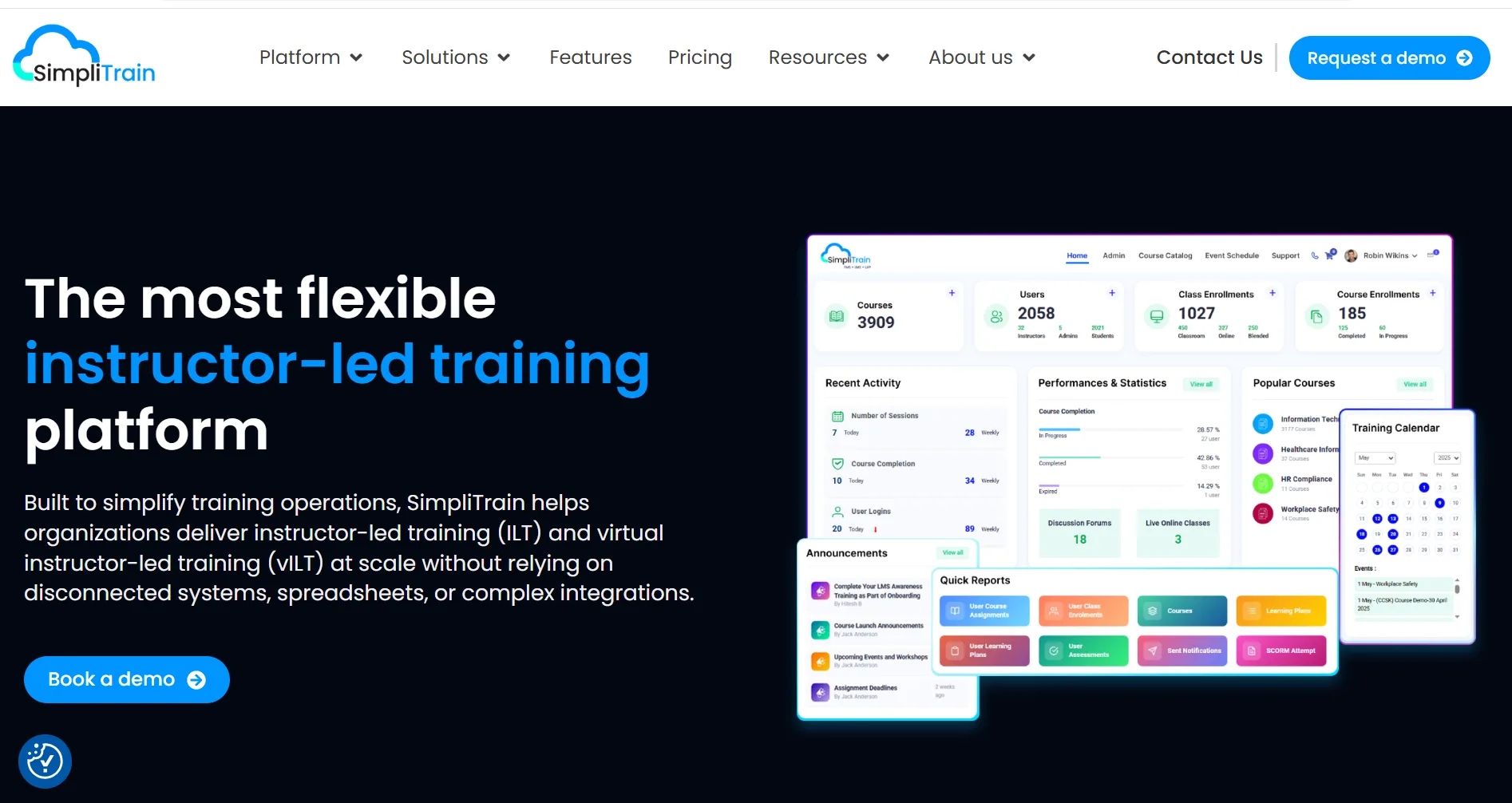
Platforms like SimpliTrain can support this process by centralizing customer training, managing learners, delivering assessments, and tracking course progress.
Ultimately, the strongest customer education programs don't measure success by how many courses they publish.
They measure how effectively customers turn what they learn into real-world results.