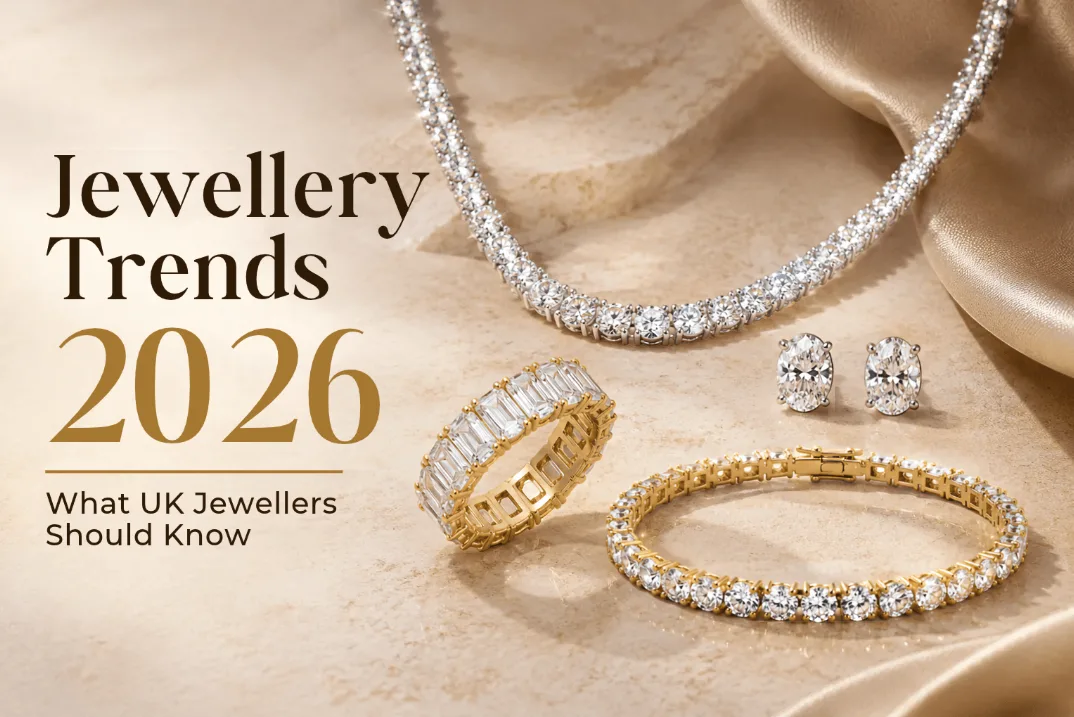
Jewellery trends rarely affect just one product category. They can influence how collections are developed, which colours and stones are prioritised, how new designs are styled and what customers expect to see when they shop.
For UK jewellers, retailers and designers, understanding jewellery trends 2026 is less about copying every new look and more about recognising the directions that are shaping demand. Current UK coverage points towards stronger individuality, bolder forms, expressive colour, mixed materials and pieces that feel more personal rather than trend-led for a single season.
This guide looks at the jewellery trends gaining attention in 2026 and what they could mean for collection planning, design decisions, stone selection and sourcing across the UK market.
What Is Driving Jewellery Trends in 2026?
The biggest shift behind currently is that customers are choosing pieces that feel more personal, expressive and distinctive rather than simply following one seasonal look.
Several forces are shaping that change:
- Personalisation: Buyers are increasingly drawn to jewellery that feels connected to identity, sentiment or individual style.
- Distinctive design: Bold silhouettes, unusual stones and less conventional forms are gaining attention as shoppers look beyond repeated mainstream styles.
- Social media influence: Platforms continue to shape discovery and expectations, particularly around rings, styling and statement pieces.
- Bespoke interest: Customisation gives customers more control over shape, colour, metal and overall composition.
- Colour experimentation: Softer tones, coloured stones and warmer palettes are becoming more visible in UK jewellery coverage.
- Flexible styling: Mixed metals, layered collections and pieces that can be worn in different ways are broadening design possibilities.
These jewellery design trends point towards a market where individuality matters more than simply following one dominant aesthetic.
Colour Is Becoming a Stronger Design Tool
Colour is playing a more deliberate role in jewellery design in 2026. Current UK coverage shows stronger interest in vivid gemstones, warmer diamond tones and combinations that use contrast or tonal variation to give a piece more character. British Vogue has highlighted everything from champagne, yellow and brown diamonds to brighter gemstone-led collections and colour-rich high jewellery.
Why Colour Matters for Jewellery Collections
For jewellers and designers, colour can influence more than the appearance of a single piece. It can help shape:
- Collection identity: A consistent palette can give a range a stronger visual signature.
- Visual differentiation: Colour helps distinguish one design direction from another.
- Customer choice: Softer tones and stronger shades can appeal to very different preferences.
- Design impact: Colour can support both understated pieces and more expressive statement jewellery.
- Stone combinations: Mixing complementary or contrasting tones can create more distinctive layouts.
For buyers exploring this direction, coloured lab grown diamonds offer another way to bring colour into design without repeating the same traditional look.
Distinctive Diamond Shapes Are Creating More Design Variety
Jewellery designers are using shape more intentionally in 2026, moving beyond the idea that a round stone should automatically be the default. Oval, pear, emerald, marquise, cushion and radiant cuts can each change the proportion, movement and visual character of a piece.
The trend is less about one shape becoming dominant and more about using different outlines to create more individual designs. Elongated cuts can introduce a sleeker profile, while geometric forms can give a collection a cleaner, more architectural feel.
Shape as a Collection Signature
Distinctive shapes can help jewellers create:
- Stronger visual identity: Repeated use of a particular silhouette can make a collection more recognisable.
- More design variation: Different proportions allow one concept to evolve across rings, pendants and earrings.
- Bespoke flexibility: Unusual outlines can support more personal, made-to-order designs.
- A clearer point of difference: Shape can become part of the design language rather than just a stone choice.
For a deeper look at shape selection, see our guide to fancy-shaped loose lab grown diamonds.
Statement Jewellery and More Expressive Designs
In 2026, trending jewellery is moving towards stronger visual impact. Instead of relying only on layered styling, designers are giving individual pieces more presence through larger proportions, sculptural forms and distinctive silhouettes. British Vogue has highlighted substantial statement pieces, while current earring trends point towards oversized, expressive designs taking a more central role.
Key directions include:
- Larger centre stones: Creating a stronger focal point within rings and statement pieces.
- Sculptural silhouettes: Curved, organic and architectural forms are giving jewellery more dimension.
- Bold earrings: Oversized drops, fluid metalwork and statement forms are becoming more prominent.
- Stronger proportions: Wider bands, larger settings and more substantial shapes can make a design feel more intentional.
- Distinctive settings: Unusual placement and structure can turn the setting itself into part of the visual identity.
These trending jewellery designs show a broader shift towards pieces that feel expressive, memorable and strong enough to stand on their own.
Vintage Influences Meet Contemporary Jewellery
Vintage influence in 2026 is less about recreating old jewellery exactly and more about reworking heritage details for a modern customer. Antique-style cuts, softer faceting, decorative settings and Art Deco-inspired geometry are being used in cleaner, more wearable designs.
Specialist cuts such as Rose Cut, Old European and Old Miner Cushion can support this direction because they bring a different visual character from modern brilliant-style stones.
Jewellers can use vintage influence through:
- Heritage silhouettes: Shapes and proportions inspired by earlier jewellery periods.
- Modern settings: Traditional-looking stones paired with cleaner or more contemporary metalwork.
- Old-world detailing: Engraving, milgrain-style finishes or architectural influences used selectively.
- Reinterpretation: Taking the mood of vintage jewellery without copying a historical design exactly.
For designers, this creates a useful balance: familiar heritage references with enough flexibility to make the finished piece feel current rather than nostalgic.
Mixed Metals and Contrast Are Expanding Design Options
Mixed-metal jewellery is giving designers more freedom to play with contrast in 2026. Combining warmer and cooler tones can change how a stone is perceived, adding depth to the overall piece without relying on a single metal colour throughout.
This approach can influence the design in several ways:
- Stronger contrast: A cooler stone against a warmer metal can stand out more clearly.
- Softer transitions: Similar tones can create a more blended, understated effect.
- More visual depth: Using two metal colours can make the setting feel more dimensional.
- Greater styling flexibility: Mixed-metal pieces can work more easily with different jewellery already owned by the customer.
- More distinctive finishes: Contrasting polished, brushed or textured surfaces can add another layer of character.
For jewellers, the value of mixed metals is not just variety. It gives the design more control over how the stone, setting and overall silhouette work together.
What These Jewellery Trends Mean for UK Jewellers
For UK jewellers, trends matter most when they influence what customers ask for, what collections need to offer and how easily those requirements can be sourced.
Collection Planning
Retailers may need more variety across:
- stone shapes
- colour options
- size combinations
- mixed-stone designs
- statement and understated pieces
A broader collection structure gives businesses more flexibility without relying too heavily on one dominant style.
Sourcing
Changing design preferences can create more specific sourcing requirements. Jewellers may need access to unusual shapes, coloured stones, matched pairs, repeat specifications and combinations that are not always available through standard stock.
Dependable sourcing becomes more important when the design brief is specific or when consistency needs to be maintained across multiple pieces.
Customer Conversations
Sales teams should understand why a style is gaining attention, not simply label it as trending. Explaining how colour, shape, proportion or personalisation changes the look of a piece can make customer conversations more useful and help buyers choose designs that suit them rather than follow a trend blindly.
How Jewellers Can Respond to Jewellery Trends Without Chasing Every Trend
Trends can create useful opportunities, but they should not force a jewellery business to change direction every few months. The stronger approach is to identify which ideas fit the customer base and test them in a controlled way.
- Protect core products: Keep proven designs that continue to sell while introducing trend-led pieces around them.
- Test before scaling: Launch smaller edits, capsules or limited variations first.
- Use colour and shape selectively: Add distinctive elements where they support the collection rather than forcing them into every design.
- Choose trends that fit your audience: Not every popular style will suit every retailer or customer profile.
- Source flexible inventory: Work with stones and specifications that can support multiple design directions.
- Track customer response: Use enquiries, sales and repeat demand to decide which trends deserve more investment.
The goal is not to follow every trend. It is to recognise which ones strengthen the collection and can be supported commercially over time.
How Lab Grown Diamonds Fit Into Evolving Jewellery Design
As jewellery design becomes more varied, businesses need sourcing options that can adapt to different creative directions. Access to a broader range of shapes, colours and loose stones can make it easier to respond to changing design preferences without rebuilding an entire collection around one look.
For jewellers, that flexibility can include:
- More shape options: Supporting classic, elongated and less conventional silhouettes.
- Greater colour choice: Giving designers more freedom to build colour-led pieces and collections.
- Loose stone flexibility: Allowing the setting and final design to be developed around the diamond.
- Certified options: Providing documented stone information where required.
- Matching requirements: Helping with pairs, layouts and multi-stone designs.
- Varied specifications: Making it easier to work across different sizes, proportions and design briefs.
For Lab Diamonds UK, this kind of inventory flexibility can support jewellers who want to respond to evolving design trends without being restricted to a narrow set of stone options.