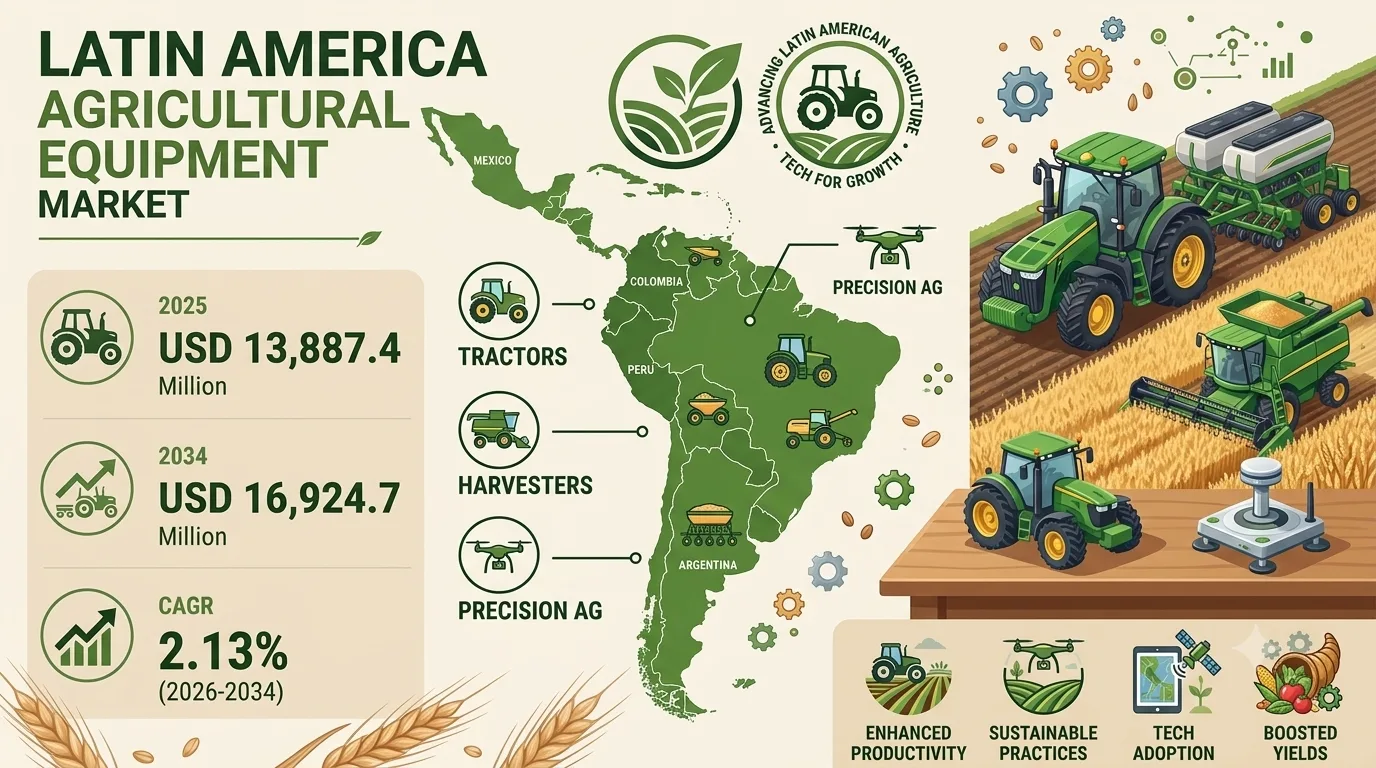
The Latin America agricultural equipment market is experiencing steady growth, driven by the increasing demand for food production, technological advancements in farming, and government initiatives to promote agricultural modernization. The market size reached USD 13,887.4 Million in 2025 and is projected to reach USD 16,924.7 Million by 2034, exhibiting a compound annual growth rate (CAGR) of 2.13% during 2026-2034. The region's agricultural sector is a cornerstone of its economy, and the adoption of advanced machinery is becoming crucial for enhancing productivity and meeting global food demand. This market is strategically important as it supports the region's role as a major global food supplier.
The Latin America agricultural equipment market is poised for sustained, albeit moderate, expansion driven by government-backed credit programs, the pressing need for operational efficiency in response to rising labor costs, and the accelerating adoption of precision agriculture technologies. As the region seeks to consolidate its position as a sustainable agricultural powerhouse, the market offers significant opportunities for manufacturers providing technologically advanced and efficient equipment solutions.
LATIN AMERICA AGRICULTURAL EQUIPMENT MARKET SUMMARY
- The Latin America agricultural equipment market encompasses a broad range of machinery designed to enhance efficiency, reduce manual labor, and improve yields across the crop production cycle.
- The ecosystem includes global original equipment manufacturers (OEMs) like John Deere, AGCO, and CNH Industrial, regional and local manufacturers, distributors, and end-users ranging from small family farms to large commercial agribusinesses.
- Major segments identified in the market include equipment type (tractors, harvesters, planting equipment, irrigation and crop processing equipment, spraying equipment, hay and forage equipment, and others) and application (land development and seed bed preparation, sowing and planting, weed cultivation, plant protection, harvesting and threshing, and post-harvest and agro processing).
- Brazil is the dominant regional market, accounting for more than 40% of the market share, followed by Mexico and Argentina. This is driven by Brazil's large agricultural sector and strong government support for mechanization.
PORTER'S FIVE FORCES ANALYSIS -- LATIN AMERICA AGRICULTURAL EQUIPMENT MARKET
The competitive dynamics of the Latin America agricultural equipment market can be analyzed using Porter's Five Forces framework.
Porter's Five Forces Analysis -- Latin America Agricultural Equipment Market
- Competitive Rivalry: High. The market is highly concentrated, with a few multinational giants like John Deere, CNH Industrial, AGCO Corporation, and Kubota holding a dominant share of over 60%. Competition centers on product innovation, local manufacturing capabilities, breadth of dealer networks, access to government-subsidized credit for farmers, and integration of precision agriculture platforms. Business implication: Competitors must invest heavily in R&D, localize their offerings, and build strong dealer relationships to maintain or grow their market position.
- Supplier Power (Target Companies): Moderate. While large OEMs have significant bargaining power over component suppliers, local manufacturers and assemblers exist. The presence of government-backed credit programs also influences buyer decisions, giving manufacturers aligned with these programs an advantage. Business implication: Companies can differentiate through financing solutions and partnership models with financial institutions.
- Buyer Power (Farmers): Moderate to High. Large commercial farms have considerable bargaining power, demanding advanced technology, robust after-sales service, and competitive pricing. However, smaller farms' choices are often constrained by credit access, making government programs like Brazil's Plano Safra a key influencer of demand. Business implication: Offering flexible financing options and equipment tailored to different farm sizes is crucial.
- Threat of Substitutes: Low. There is no direct substitute for mechanized agricultural equipment for large-scale farming. However, in some contexts, contractors offering "Equipment-as-a-Service" or rental models act as a substitute for outright ownership, particularly for medium-sized farms seeking to access advanced technology without significant capital expenditure. Business implication: Companies need to explore and expand their service and rental models to capture this growing segment.
- Threat of New Entrants: Moderate. The high capital intensity, established dealer networks, and brand loyalty of existing players create significant barriers to entry. However, there is growing presence from Chinese manufacturers like YTO and Lovol, which compete on price, particularly in the accessible mid-range segment, and new entrants are possible in niche or specialized equipment areas. Business implication: Incumbents should defend their position through continuous innovation and a strong value proposition.
Request for Sample Report: https://www.imarcgroup.com/latin-america-agricultural-equipment-market/requestsample
MARKET GROWTH DRIVERS:
Several key factors are propelling the expansion of the Latin America agricultural equipment market. Government Support and Subsidies are a primary driver, providing farmers with essential financial means to invest in new machinery. In Brazil, the 2023/2024 Crop Plan set aside BRL 364.22 billion for agricultural production, a 27% increase from the previous cycle, with specific programs like Moderfrota offering reduced interest rates for machinery purchases. These initiatives, including credit programs like Pronamp, are crucial for stimulating demand across various farm sizes. Additionally, the Increasing Demand for Mechanization and Efficiency is driving market growth. Rising labor costs, a growing need to enhance farm productivity, and the urgency to minimize environmental impact are leading farmers to adopt mechanized solutions. This is particularly vital as the region faces a labor shortage and seeks to optimize resource use.
MARKET GROWTH DRIVERS:
The Latin America agricultural equipment market is also benefiting from Accelerating Technology Adoption. There is a widespread adoption of precision agriculture technologies, including GPS, drones, and IoT-enabled equipment, which enhances productivity and efficiency by optimizing resource use and improving crop yields. For instance, Hydrosat signed agreements to bring advanced data-driven solutions to Mexican and Guatemalan growers to help optimize water utilization, demonstrating the value of data-driven agriculture. This trend toward digitalization is transforming the market from simple mechanization to intelligent farming. Furthermore, the Rising Focus on Sustainable Agriculture is fuelling demand for more efficient and precise equipment. Technologies that minimize environmental impact, like precision irrigation systems and variable-rate application tools, are becoming increasingly popular as farmers and governments prioritize sustainability. The market is also seeing growth from infrastructure investments and the need to recover from economic fluctuations, with Argentina's market showing a 22% year-on-year sales growth in Q1 2025.
LATIN AMERICA AGRICULTURAL EQUIPMENT MARKET SEGMENTATION
Segmentation analysis provides a detailed view of the Latin America agricultural equipment market by category:
- Equipment Insights: Tractors, Trailers, Harvesters, Planting Equipment, Irrigation and Crop Processing Equipment, Spraying Equipment, Hay and Forage Equipment, Others.
- Application Insights: Land Development and Seed Bed Preparation, Sowing and Planting, Weed Cultivation, Plant Protection, Harvesting and Threshing, Post-Harvest and Agro Processing.
- Regional Insights: Brazil, Mexico, Argentina, Colombia, Chile, Peru, Others.
COMPETITIVE LANDSCAPE
The Latin America agricultural equipment market features a highly concentrated competitive landscape dominated by a few global players. Key companies operating in the market include:
- Deere & Company (John Deere)
- AGCO Corporation
- CNH Industrial N.V.
- Kubota Corporation
- Mahindra & Mahindra Ltd.
- CLAAS KGaA mbH
- SDF Group
- Yanmar Co., Ltd.
Strategic developments are shaping the competitive arena, notably John Deere's USD 33.5 million investment in a precision farming Technology Centre in Brazil (January 2025), AGCO's expansion of its operations in Argentina, and Mahindra's market entry into Argentina targeting small and medium farmers. These moves reflect a focus on localization, technology leadership, and capturing growth in key regional markets.
REGIONAL ANALYSIS: [Required this section in bullet points]
Regional dynamics within the Latin America agricultural equipment market are shaped by varying levels of agricultural activity and government support.
- Brazil emerges as the undisputed market leader, accounting for more than 40% of the market share. Its dominant position is driven by its vast agricultural sector, robust government support through credit programs (e.g., Plano Safra), and significant investments from international OEMs. The adoption of precision agriculture is high in major grain-producing regions like the Center-West.
- Mexico and Argentina are also major markets, with high adoption of advanced farming practices. The Mexican government supports the sector through programs like the Planting Life Program and Fertilizer Program. Argentina is experiencing a market recovery, with growth in sales driven by changes in tax policy and a growing interest in service-based agricultural models.
- Colombia, Chile, and Peru, while smaller, are seeing growth driven by mechanization in high-value specialty crops and a focus on improving agricultural efficiency in their diverse terrains.
RECENT INDUSTRY DEVELOPMENTS
August 2024: FPT Industrial announced a partnership with Pauny in Argentina to produce 100% national tractors, aiming to boost local production and farmer confidence.
August 2023: New Holland Agriculture commercially launched the TL5 'Acessível', the world's first tractor designed for individuals with lower limb disabilities, supported by the Brazilian government's 'Rota 2030' program.
January 2025: John Deere invested USD 33.5 million in its Indaiatuba Operations Technology Centre in Brazil, focusing on developing precision farming equipment and software, solidifying its market leadership.
November 2025: Mahindra & Mahindra entered the Argentine market to compete in the mid-range tractor segment, targeting small and medium farmers.
Key Aspects Required for the Latin America Agricultural Equipment Market
- Market Performance: The market size was valued at USD 13,887.4 Million in 2025 and is projected to reach USD 16,924.7 Million by 2034.
- Market Outlook: A 2.13% CAGR through 2034 indicates a steady growth trajectory, supported by government programs, technological adoption, and rising food demand.
- Growth Drivers: Significant government subsidies and credit programs; the increasing need for efficiency and mechanization due to rising labor costs; the accelerating adoption of precision agriculture technologies; the growing focus on sustainable farming practices; and a recovery in key markets like Argentina.
- Competitive Landscape: Highly concentrated, dominated by global giants like John Deere, AGCO Corporation, CNH Industrial, and Kubota, which together control over 60% of the market. Competition is based on technology, dealer networks, and access to government credit schemes.
- Value Chain Analysis: From research and development and manufacturing of agricultural equipment by OEMs to distribution through established dealer networks, and finally to end-use farmers. Government credit programs and financiers play a crucial intermediary role.
- Industry Trends: Rapid digitalization of farming with precision agriculture tools; introduction of drones for crop protection; the emergence of "Equipment-as-a-Service" or rental models for farmers; increasing presence of Chinese brands competing on price; and a focus on developing fuel-efficient and compact tractors suited for diverse farm sizes.
- Strategic Recommendations: Focus on developing and integrating advanced precision agriculture technologies; strengthen local manufacturing capabilities and dealer networks to gain a competitive edge; align product offerings with government credit programs to make them more accessible to farmers; and explore innovative business models like equipment rental and service-based offerings to capture a broader customer base.
Note: If you need any specific information that is not covered currently within the scope of the report, we will provide the same as a part of customization.
Request Customization: https://www.imarcgroup.com/request?type=report&id=30009&flag=E
Write this before about us -
- Report Format, Delivery, and Customization Details
- Report Format Mode: PPT, PDF, and Excel
- Report Delivery Mode: Online Delivery, Physical Delivery
- Report Delivery Time: Report Delivered Over Email within 24 to 48 hours. If requested by the client, a physical copy will be delivered within three to ten days.
- Report Confirmation Mode: Yes via Email
- Report Customization Mode: Yes via Email / Call
- Report Table of Content: Yes
- Report List of Figures: Yes
- Report Methodology Mode: Yes
- Request For Sample Report: Yes