Why Mining Operations Need Better Cost Visibility
Mining is a business where costs can change quickly. Ore quality varies, energy prices move, recovery rates fluctuate, equipment performance affects output, and statutory charges add complexity to every tonne produced. This is why SAP for mining industry operations needs to do more than record transactions. It needs to help finance and operations understand what is happening to costs while there is still time to act.
For Indian mining and steel companies, the challenge is often not a shortage of information. Production teams may have daily data on grades, tonnes, energy consumption, and recovery, while finance works with aggregated numbers during periodic closing.
The result is a timing gap.
By the time management sees a cost variance, the operational event that caused it may already be several weeks behind them. A well-designed SAP environment can help close that gap by connecting operational conditions with actual costing and profitability.
SAP for Mining Industry Needs Granular Costing
SAP for mining industry becomes significantly more valuable when costing reflects how mining actually works.
A single plant-level average cost can hide important differences between pits, ore grades, production shifts, processing routes, and material lots. A higher-grade ore body may behave very differently from a lower-grade one. Similarly, a change in recovery at a beneficiation stage can affect the economics of everything that follows.
The reference source highlights several mining-specific cost drivers, including variable ore grades, energy intensity, yield variance, and royalty-related charges.
A practical costing model therefore needs to preserve these differences rather than averaging them away too early.
This is one of the biggest distinctions between generic ERP configuration and a properly designed mining environment.
The Costing Challenges Mining Companies Face
Mining organizations deal with a combination of operational and financial variables that make traditional costing difficult.
Ore quality changes the economics
A shift in iron content or mineral concentration can affect processing requirements, recovery, fuel consumption, and downstream production economics.
Energy costs can move quickly
Power and fuel are significant components of many mining and processing operations. Changes in tariffs, diesel prices, or equipment consumption can therefore affect unit costs rapidly.
Yield losses affect downstream costs
Material moves through several stages, from extraction and crushing to beneficiation and further processing. Losses at one stage can influence the cost of the resulting material.
Statutory charges add complexity
Royalty, DMF, NMET, and other applicable charges need to be considered within the broader cost structure and valuation process.
These factors make it difficult to rely solely on static standard costs. The reference article emphasizes the need to track costs at more granular levels, such as pit, bench, ROM lot, beneficiation circuit, and shift.
Moving Beyond Month-End Cost Reporting
Traditional reporting often tells management what happened after the period has ended. That information is important, but it may arrive too late for operational decisions.
Consider a mine where recovery begins declining because of changes in ore characteristics. Production may identify the problem quickly, but if the financial impact is only visible after month-end, management has limited opportunity to respond immediately.
This creates a familiar disconnect between departments.
Finance sees aggregated costs. Operations sees tonnes and grades. Maintenance sees equipment performance. Procurement sees energy and material prices. Commercial teams see product and customer margins.
The challenge is connecting these views.
An effective SAP mining software environment can bring operational and financial information into a common structure, helping teams understand not just the size of a cost movement but what caused it. This connected approach is central to the costing model described in the reference source.
Actual Costing Makes Production Costs Clearer
One of the most useful capabilities for mining businesses is Actual Costing.
Instead of relying entirely on planned or standard costs, Actual Costing helps calculate material costs using the costs actually incurred during the period. This can provide a more realistic picture of inventory value and production economics.
For mining and steel operations, the benefit increases when the costing structure follows the physical production chain.
A configured system can support multi-level cost roll-ups from ROM material through concentrate, pellets, hot metal, and crude steel. It can also help account for yield losses, rework, energy, fuel, reagents, and relevant mining costs.
That matters because material from different pits does not necessarily have the same economic value.
If all material is blended into one broad average too early, finance can lose visibility into the actual economics of individual sources and processing routes.
Connecting Costs With Profitability
Knowing the actual cost of production is only half the picture. Leadership also needs to understand where that cost creates or reduces margin.
This is where CO-PA can complement Actual Costing.
A properly configured model can help analyze profitability across dimensions relevant to the business, including product form, market, region, pit, beneficiation route, logistics corridor, and applicable cost structures.
That can change the nature of management discussions.
Instead of asking, “What is our average cost per tonne?” leaders can ask more commercially useful questions.
Which product is delivering the strongest margin? Which market is becoming less attractive because logistics costs have increased? Which production route is generating higher costs? How would a change in product mix affect profitability?
This is where an SAP mining industry solution can become a decision-support layer rather than simply an ERP record-keeping system.
Designing SAP Around Mine-to-Plant Operations
The success of SAP implementation in mining industry operations depends heavily on how well the system reflects the company's actual processes.
A mine is not simply another manufacturing plant. Material originates from different locations, grades can vary, processing routes may differ, and production outcomes depend on several interconnected operational factors.
That means implementation teams need to understand the physical flow of material as well as the financial flow.
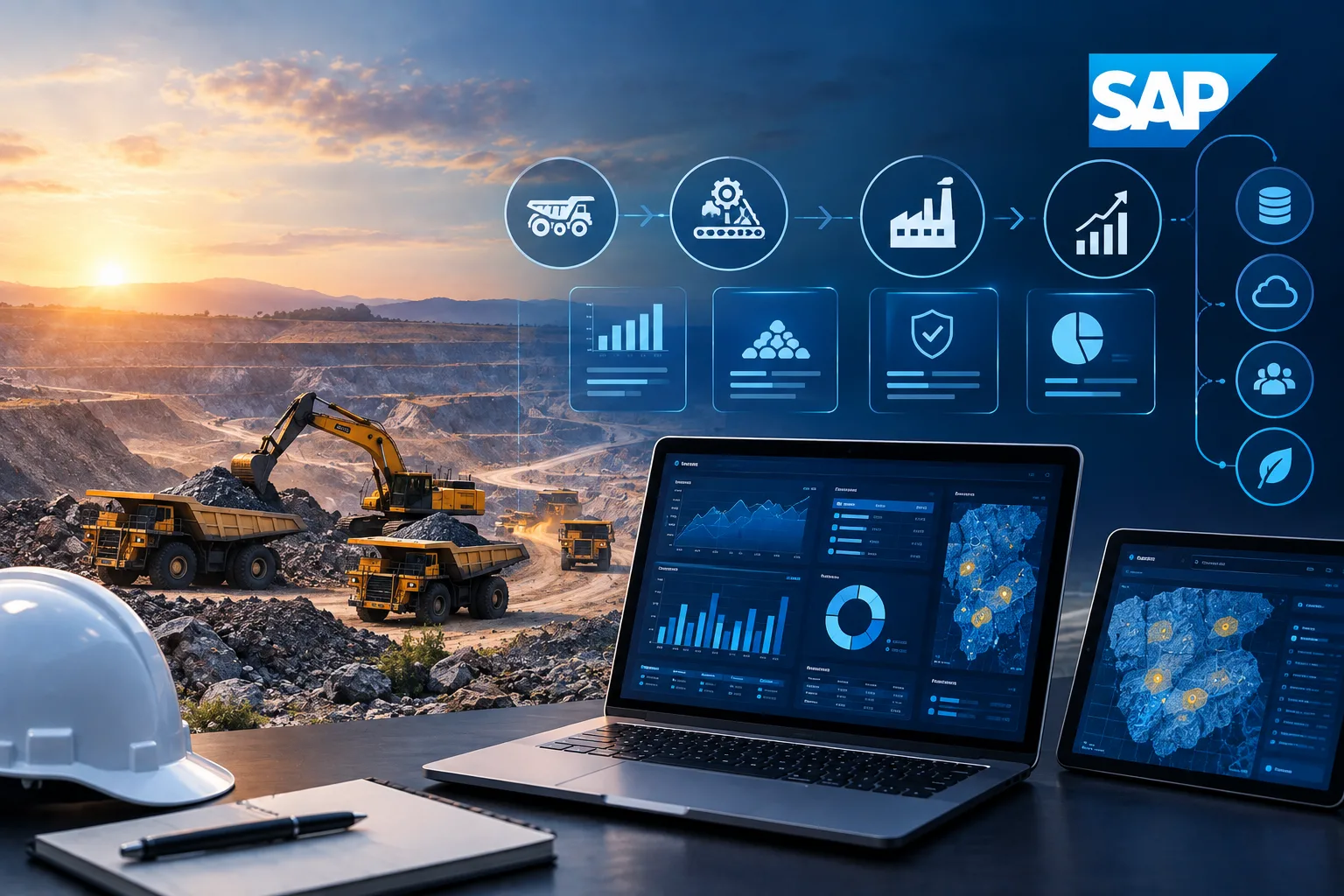
Data from weighbridges, laboratory or grade-assay systems, energy meters, production systems, and other operational sources may need to feed the costing model. The objective is to ensure that important operational events can ultimately be reflected in financial and profitability reporting.
The technology matters, but the process design matters just as much.
Using SAP Mining Software for Better Decisions
The real value of SAP mining software appears when teams can use cost information to make practical decisions.
For example, if one processing circuit consistently shows higher energy consumption per tonne, operations can investigate whether maintenance, equipment settings, material characteristics, or process conditions are contributing to the variance.
If a particular product-market combination has weaker margins because of transportation costs, commercial teams can reassess pricing or logistics options.
The goal is not to create more reports. It is to make the information already being generated more actionable.
A stronger system can help organizations move toward:
- Faster visibility into cost per tonne, grade, pit, and process; better pricing decisions; tighter margin control; more targeted energy and maintenance improvements; and stronger inventory valuation.
These outcomes depend on configuration quality. Simply implementing an ERP platform does not automatically create granular cost intelligence.
Building a Practical Mining Implementation Strategy
A successful SAP implementation in mining industry environments should begin with business processes rather than software features.
The first step is understanding how material, costs, and operational data move through the organization. From there, implementation teams can determine which mining-specific cost drivers need to be represented in the SAP model.
Data quality also deserves attention. If grade information, production quantities, energy readings, or inventory movements are inconsistent, even a sophisticated costing model will produce unreliable results.
Change management is equally important. Finance teams need to understand the new costing logic, while operations teams need to see how their data affects financial outcomes.
The implementation should therefore create a shared language between operations, finance, commercial teams, and leadership.
From Cost Reporting to Cost Intelligence
The difference between reporting and intelligence is timing.
A report can tell management what happened. Cost intelligence helps explain why it happened and what can be done next.
For mining organizations, this distinction can have significant commercial implications. A change in ore quality can affect recovery. Recovery can affect output. Output can affect inventory. Inventory and production costs can affect margins. Margins can influence pricing and product-mix decisions.
A connected SAP mining industry solution can help bring these relationships into a more visible structure.
The reference source specifically positions Actual Costing and CO-PA together as a way to connect actual production costs with profitability across relevant mining and steel dimensions.
That connection is what allows ERP data to become more useful for day-to-day decision-making.
Measuring the Business Impact
The success of a mining ERP initiative should not be judged only by whether the system went live on schedule.
Leadership should also ask whether the organization has better visibility into unit costs, inventory valuation, production variances, profitability, and operational drivers.
For example, finance may be able to identify cost movements earlier. Operations may be able to pinpoint high-cost processes. Commercial teams may have better information for pricing. Leadership may gain a clearer view of which products, markets, or routes are creating value.
These improvements can make a meaningful difference because mining margins are influenced by variables that can change throughout the production cycle.
The objective is ultimately to reduce the distance between an operational event and the financial insight needed to respond to it.
Final Thoughts
SAP for mining industry operations should not be viewed simply as a way to digitize existing finance and production processes. Its greater opportunity lies in connecting operational realities with financial outcomes.
With the right configuration, sap mining software can help organizations understand costs by pit, grade, process, and production stage. Actual Costing can provide a stronger view of incurred material costs, while CO-PA can connect those costs with profitability.
For companies considering an SAP mining industry solution, the focus should therefore be on business fit rather than software alone.
The strongest SAP implementation in mining industry environments starts with how the mine and plant actually operate, then builds the costing, data, reporting, and profitability structures around those realities.
When that connection is made effectively, cost information stops being something reviewed after the fact and becomes a tool for better operational and commercial decisions.
FAQs
1. What is SAP for mining industry used for?
SAP for mining industry can connect processes such as procurement, inventory, production, maintenance, finance, costing, and profitability. When configured around mining-specific processes, it can provide a more connected view of operational and financial performance.
2. How does SAP mining software help control costs?
SAP mining software can bring operational and financial information into a common environment. This can help organizations identify cost variances, understand their operational causes, and evaluate their impact on inventory and profitability.
3. What makes SAP implementation in mining industry different?
Mining involves variable ore quality, complex material movements, recovery rates, beneficiation processes, energy consumption, and mining-specific statutory charges. An implementation therefore needs to reflect these operational and costing realities rather than simply replicate generic manufacturing processes.
4. What should companies look for in an SAP mining industry solution?
Companies should evaluate how well the solution handles mine-to-plant material flows, granular costing, operational data integration, inventory valuation, profitability analysis, reporting, and mining-specific business requirements.
5. Can SAP improve profitability analysis for mining companies?
Yes. When Actual Costing and CO-PA are configured appropriately, organizations can connect production costs with products, markets, logistics routes, and other relevant dimensions to gain a stronger understanding of where margins are being created or lost.