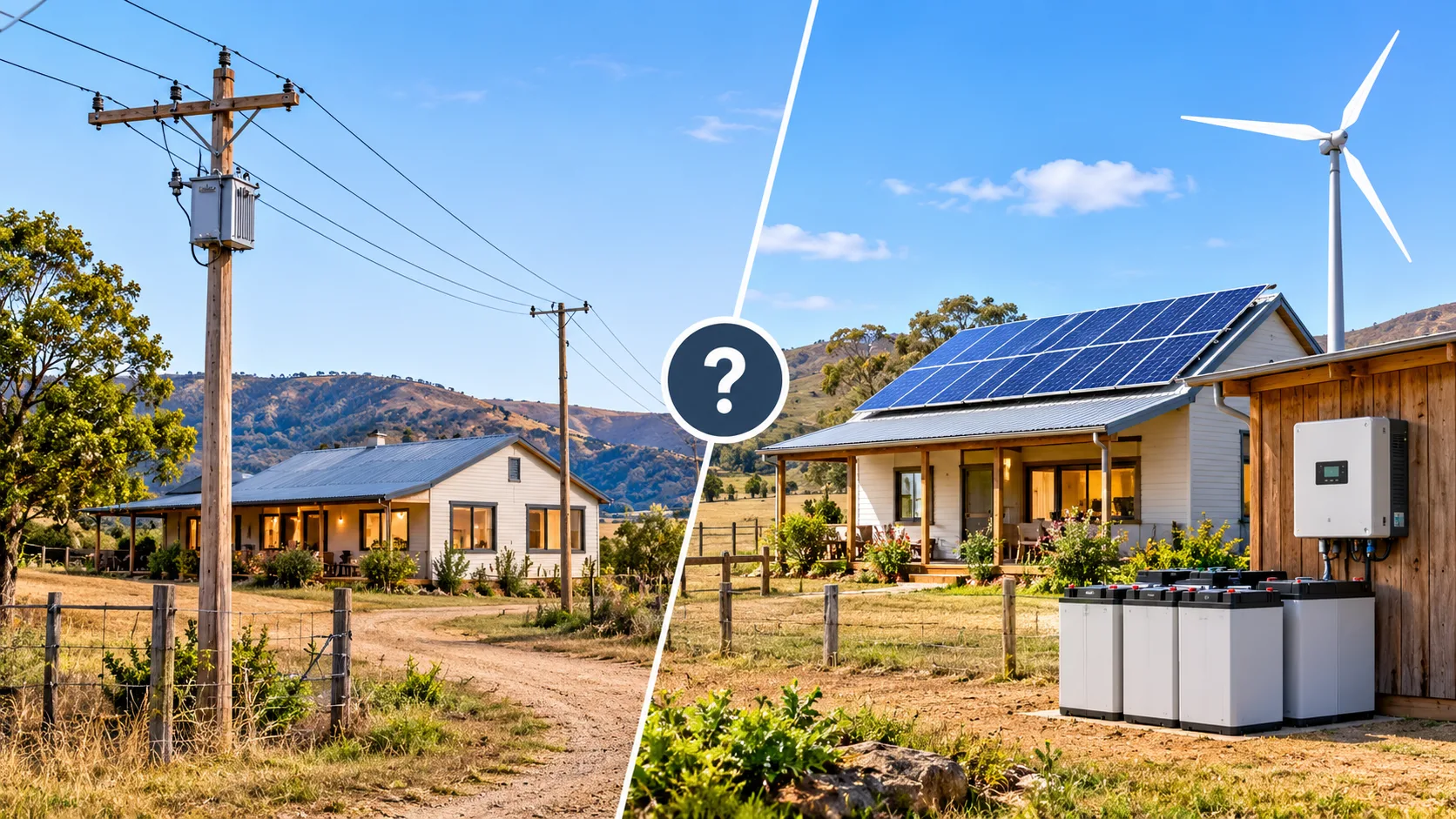
Buying or building on remote land raises one big question very early. Do you pay to extend a mains connection to your block, or do you generate your own electricity with off grid power? Both options can work well, but the right answer depends on distance, budget, how much electricity you use and how much independence you want. This article walks through each choice in plain terms so you can weigh them up before you commit any money.
How a Mains Connection Works on Remote Land
A mains connection means your property draws electricity from the public network through poles, wires and a transformer. In a town this is simple and cheap. On remote land it is a different story. The network operator usually expects you to pay for the poles, cable, trenching and transformer needed to reach your meter, and the cost climbs with every extra metre of distance.
The big advantage is convenience. Once the connection is made, power is simply there. You flick a switch and the lights come on, with no need to think about battery levels, cloudy weather or system size. You pay a daily supply charge plus usage on every bill, and that is the end of it.
The downside is that you are tied to the network. Storms, bushfires and fallen trees can damage long rural lines, and the further you are from town, the longer repairs can take. You also have little say over price rises.
What Off Grid Power Looks Like in Practice
Off grid power means producing and storing your own electricity on the property. A typical system has four main parts.
- Solar panels that turn sunlight into electricity during the day.
- A battery bank that stores spare energy for night time and cloudy days.
- An inverter that converts stored energy into the power your appliances use.
- A backup source, usually a generator, for long stretches of poor weather.
Modern systems are far more capable than they were ten years ago. Lithium batteries last longer, inverters handle heavy loads such as pumps and power tools, and monitoring apps show exactly how much energy you are using. A well designed system can run a full home, a workshop and a water supply without fuss.
Comparing the Upfront Costs
Cost is where most people start, so it deserves a close look. These are the factors that decide which option is cheaper at the start.
- Distance to the nearest line. A short extension may cost less than a good battery system, while a long one can cost far more because every pole and length of cable adds to the bill.
- Terrain and soil. Rocky ground, creek crossings and thick bush make trenching and pole installation more expensive.
- System size. Off grid power is priced by how much energy you need, so a small cabin with basic lighting needs far less equipment than a family home with air conditioning and a workshop.
- Approvals and waiting time. Network extensions often involve design work, quotes and long waits before anything is built, while an off grid system can usually be installed within weeks once the design is settled.
As a general rule, a site close to existing lines often favours a mains connection. As the distance grows, off grid power becomes more competitive, and on remote blocks it is frequently the cheaper choice.
Looking at Running Costs Over Time
Upfront cost is only half the picture. A mains connection comes with bills for as long as you own the property. Supply charges apply every day whether you use electricity or not, and usage rates tend to climb over the years.
With off grid power, the sunshine is free. Your ongoing costs are mostly routine maintenance, the occasional inspection, fuel if you run a generator, and eventually battery replacement after many years of service. Households that use a lot of electricity during daylight hours, such as running pumps, cool rooms and tools, tend to see the biggest savings.
Over fifteen to twenty years, many owners find the two options end up closer in cost than they first expected, and sometimes the system comes out ahead. It pays to compare total cost over time, not just the first invoice.
Reliability and Peace of Mind
Mains power is dependable in towns but less so at the end of a long rural line. A single fault anywhere along the line can leave you without power until a crew can reach it, and that can take hours or days after a major storm.
Off grid power puts you in control because network outages do not affect you. That said, reliability depends entirely on design. An undersized system will struggle through a run of wet weeks, and a poorly installed one will cause constant frustration. The key is to size the panels and batteries for your worst weather rather than your average day, and to include a backup generator for the longest cloudy spells.
Lifestyle and Independence
Many landowners choose to go their own way for reasons beyond cost. These are the benefits people mention most.
- Freedom to build on the best part of the block rather than where the lines happen to run.
- No monthly electricity bills once the system is paid off.
- A clearer picture of how much energy you really use.
- A smaller environmental footprint from clean solar generation.
A mains connection suits people who want to plug in and forget about it. Living with a system means paying attention to your usage, especially on cloudy days, and being comfortable with a little routine care. Be honest about which of those suits you.
Questions to Ask Before You Choose Off Grid Power
Work through these questions honestly. The answers usually point clearly in one direction.
- How far is the nearest power line, and what is the written quote to connect?
- How much electricity will you use, and at what times of day?
- Does the site get good sun, with clear space for panels?
- Will you run heavy equipment such as welders, large pumps or several air conditioners?
- How long do you plan to keep the property?
- Are you comfortable with a little routine care and monitoring?
A Middle Path With Hybrid Systems
You do not always have to choose one or the other. Some owners connect to the mains and add solar panels with a battery, cutting their bills while keeping the network as a safety net. Others start with a standalone solar system and keep a small generator as backup. The best fit depends on your site, your loads and how much risk you are willing to carry.
Staging is another smart option. Many owners begin with a modest system to power the build, then expand later as their needs grow, which spreads the cost over several years instead of demanding everything on day one.
Making the Final Decision
Before you commit, get proper numbers for both paths. Ask the network operator for a formal quote to extend the line, and ask a licensed electrician with remote system experience for a load assessment and a design. A good designer will look at your appliances, your site and your worst weather, then explain the trade offs in plain language. Be wary of anyone who quotes a system without asking how you actually live. Please take your time with this important step. That clarity is worth far more than a rushed decision.
In short, a mains connection wins on convenience when the lines are close, while off grid power wins on independence and often on cost when the lines are far away. Neither is right for everyone, but with real quotes and an honest look at your needs, the better choice for your remote land usually becomes clear.