
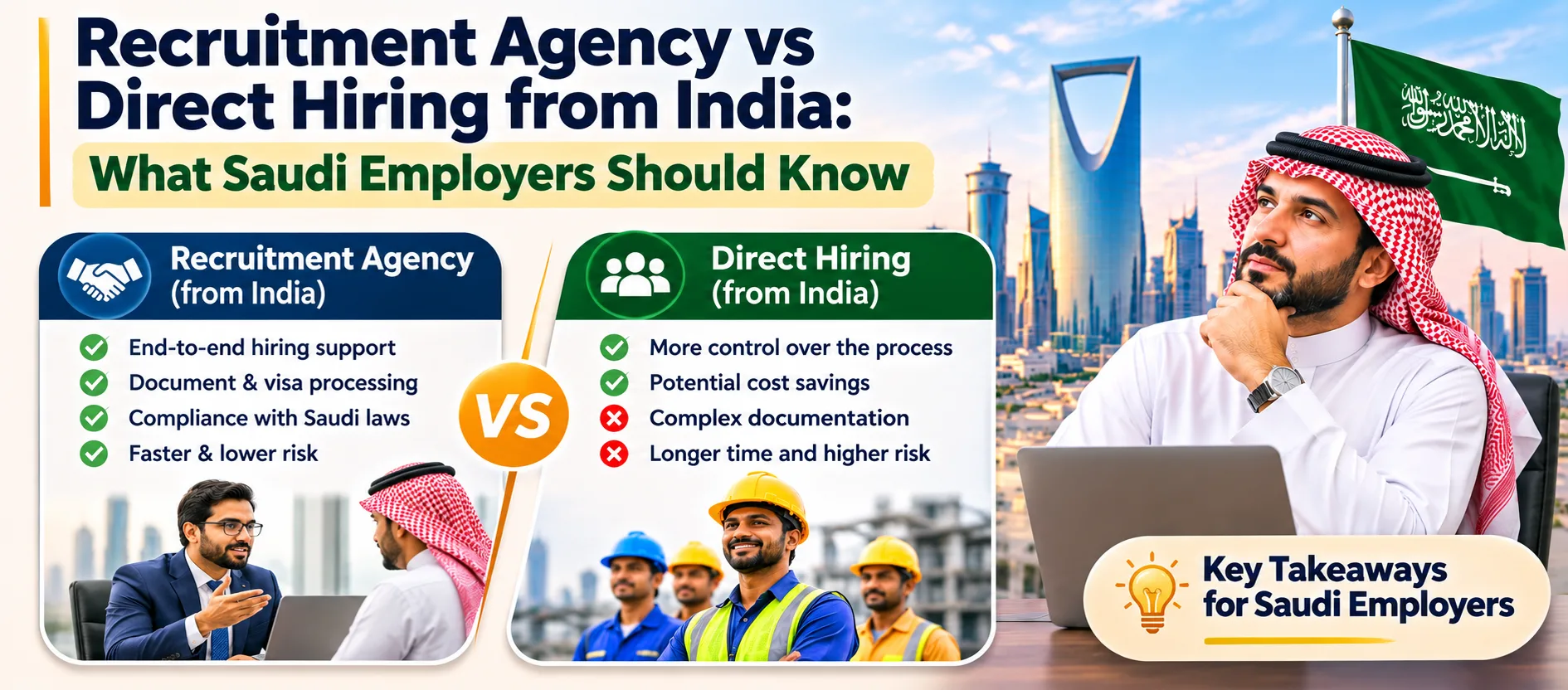
Every Saudi employer planning to hire workers from India eventually faces the same question: should we work with a recruitment agency or hire directly? Both routes are possible, and neither is right for every company. The better choice depends on how many workers you need, how much experience your team has with overseas hiring and how much time you can give to the process.
What direct hiring involves
Direct hiring means your company handles the process itself. That includes finding candidates, reviewing their profiles, arranging interviews or trade tests, preparing contracts, coordinating documents and managing travel. Indian rules allow foreign employers to recruit directly where the applicable requirements are met, and Saudi rules still apply on your side, including the required work permit. Requirements vary by role and can change, so check the latest position before you plan.
What an agency handles
A recruitment agency takes on much of the coordination. Depending on the service, that can include sourcing candidates, screening against your requirement, trade testing, arranging interviews, supporting contracts and documentation, sharing progress updates and arranging handover. You keep control of the final selection, while the agency carries much of the day-to-day work.
Control
Direct hiring gives you full control over every step and every candidate. The trade-off is that you carry all of the responsibility. With an agency, you share the workload, but you must choose a partner you trust and stay involved in selection. A good agency welcomes your questions and lets you interview or test candidates yourself.
Cost
Direct hiring can look cheaper on paper because there is no agency fee. In practice, it brings its own costs: staff time, travel for interviews, document handling, and the cost of mistakes when someone on your team is handling overseas recruitment for the first time. Agency fees should be compared with the full cost of doing the work in-house, not just the headline price.
Speed
Speed depends on preparation more than on the route you choose. Agencies that already have an active candidate network can often shortlist faster. Direct hiring can be quick for a very small number of workers, but timelines tend to stretch when you are managing candidates, documents and approvals across two countries at once.
Paperwork
Paperwork is where many employers feel the difference. Names must match across passports and certificates, medicals must be completed, contracts must be signed and permits must be in place. Agencies handle these steps regularly and know where files tend to get stuck. If your team has never done this before, expect a learning curve.
Risk
Every route carries risk. In direct hiring, the risk is mostly operational: missed steps, delays and rework. With an agency, the risk is choosing the wrong partner. That is why checking the registration number, asking for references and getting terms in writing matter so much.
Which route suits which employer?
Direct hiring can make sense when you need only a few workers, have staff who understand the process and have time to manage it. An agency is usually more practical when you need larger batches, have tight project deadlines, need trade-tested workers or do not have a team dedicated to overseas recruitment.
Questions to ask yourself before deciding
- How many workers do we need, and by when?
- Who in our team will handle recruitment day to day?
- Do we have experience with both sets of paperwork?
- What happens to our project if a medical fails or a date slips?
- Can we verify and trust the agency we are considering?
Final thoughts
There is no single right answer. What matters is being honest about your resources and your timeline. Whichever route you choose, write down a clear job brief, agree the terms in writing and keep communication open at every stage.