RERA Registration: Complete Guide to Process, Certificate and Compliance
RERA Registration is the mandatory process for real estate promoters, builders, developers and agents to register with their state’s Real Estate Regulatory Authority. It is required under the Real Estate (Regulation and Development) Act, 2016.
The registration is required before a promoter can advertise, market, book, sell or offer a qualifying real-estate project for sale. Real-estate agents must also register before facilitating transactions in RERA-registered projects.
What Is RERA Registration in India?
RERA registration, commonly referred to as a RERA license, is the mandatory process for real estate promoters and agents to register with their state’s Real Estate Regulatory Authority.
Promoters must complete this registration before they can advertise, market, book, sell or offer a property for sale. The requirement comes from the Real Estate (Regulation and Development) Act, 2016.
The Act aims to bring transparency, accountability and financial discipline to the real estate sector while protecting homebuyers from delays and fund diversion.
Who Needs RERA Registration in India?
RERA registration mainly applies to promoters of qualifying real estate projects and real estate agents dealing in registered projects. The exact requirements can vary under the applicable state or UT RERA rules.
RERA Registration for Promoters
Promoters must register a real estate project with the applicable RERA authority before advertising, marketing, booking, selling or offering it for sale.
The requirement generally applies when the project exceeds the exemption threshold under Section 3 of the RERA Act. A promoter can include a builder, developer, colonizer, contractor, development authority or another person developing a building, apartments or land for sale.
Where a project is developed in phases, each phase is treated as a separate project for registration purposes.
RERA Registration for Real Estate Agents
Real estate agents must obtain RERA registration, often called a RERA license or agent license, before facilitating the sale or purchase of a plot, apartment or building in a project registered under RERA.
This requirement covers property dealers, brokers and other intermediaries who negotiate or facilitate these transactions for a fee or other remuneration.
A registered agent must mention their RERA registration number in every sale transaction. They cannot facilitate the sale of a property in a project that requires RERA registration but is not registered.
When RERA Registration Is Not Required?
Section 3(2) of the RERA Act provides exemptions from project registration in certain situations.
- Small projects: Projects where the land area does not exceed 500 square meters or the number of apartments does not exceed eight, including all phases.
- Projects completed before RERA: Projects for which the promoter had received a completion certificate before the Act came into force.
- Certain renovation or redevelopment: Projects involving renovation, repair or redevelopment that do not involve marketing, advertising, selling or new allotment of an apartment, plot or building.
State governments may prescribe different thresholds within the framework permitted by the Act. Therefore, promoters should check the rules of the relevant state RERA authority before treating a project as exempt.
Eligibility Criteria for RERA Registration
RERA registration eligibility depends on whether you are registering a real estate project or acting as a real estate agent. For projects, Section 3 of the RERA Act sets the main registration requirements, subject to applicable state rules.
| Applicant | RERA Registration Eligibility |
|---|---|
| Promoter or builder | Registration is required for a real estate project before advertising, marketing, booking, selling or offering units for sale when the project falls within Section 3. |
| Real estate developer | Must register a qualifying project with the relevant state or UT RERA authority before offering it for sale. |
| Phased project | Each phase is treated as a separate real estate project and generally requires separate registration. |
| Real estate agent | Must obtain RERA registration before facilitating the sale or purchase of a plot, apartment or building in a RERA-registered project. |
| Small project | A project does not require registration under the central exemption when the land area does not exceed 500 sq. m. or the number of apartments does not exceed eight, including all phases, subject to state-specific rules. |
A promoter should check the following before applying for RERA project registration:
- Whether the project falls within the applicable registration threshold.
- Whether the project involves apartments, buildings or plots offered for sale.
- Whether the project has the required land, title, approvals and commencement documents.
- Whether separate registration applies to each project phase.
- Whether the relevant state has prescribed additional or different requirements.
Documents Required for RERA Registration
The documents required for RERA registration vary by applicant type and state. Promoters generally submit project, land, approval and financial documents, while agents submit identity and business details.
Documents for Promoters
Promoters must provide documents that establish their identity, legal authority over the project, project approvals, financial details and proposed development.
| RERA Registration Document | Purpose |
|---|---|
| PAN Card and identity proof | Verifies the promoter’s identity |
| Title deed and land documents | Establishes rights over the project land |
| Encumbrance details | Discloses existing charges on the land |
| Approved layout and building plans | Provides details of the approved project |
| Commencement Certificate | Confirms permission to begin construction, where applicable |
| Form B affidavit/declaration | Provides the promoter’s required declaration |
| Architect, engineer and CA certificates | Supports project, construction and financial details |
| Proforma of allotment letter and agreement for sale | Provides the proposed sale documents |
Companies and LLPs may also need incorporation documents, constitutional documents, authorization documents and details of their directors or partners. The exact RERA project registration documents depend on the applicable state authority.
Documents for Real Estate Agents
Real estate agents must submit documents that establish their identity, business structure, address and registration details.
| RERA Registration Document | Individual Agent | Company/Firm/LLP |
|---|---|---|
| PAN Card | Required | Entity PAN |
| Identity and address proof | Required | Authorized person’s details |
| Photograph | Required | Authorized person’s photograph |
| Business address proof | Where applicable | Required |
| Incorporation or partnership documents | Not applicable | As applicable |
| Authorization document | Not applicable | Where applicable |
| Previous RERA registration details | If applicable | If applicable |
The exact RERA registration documents for real estate agents depend on the state and type of applicant. For example, UP-RERA requires additional details such as previous RERA registrations and certain business documents from agents.
RERA Registration Process
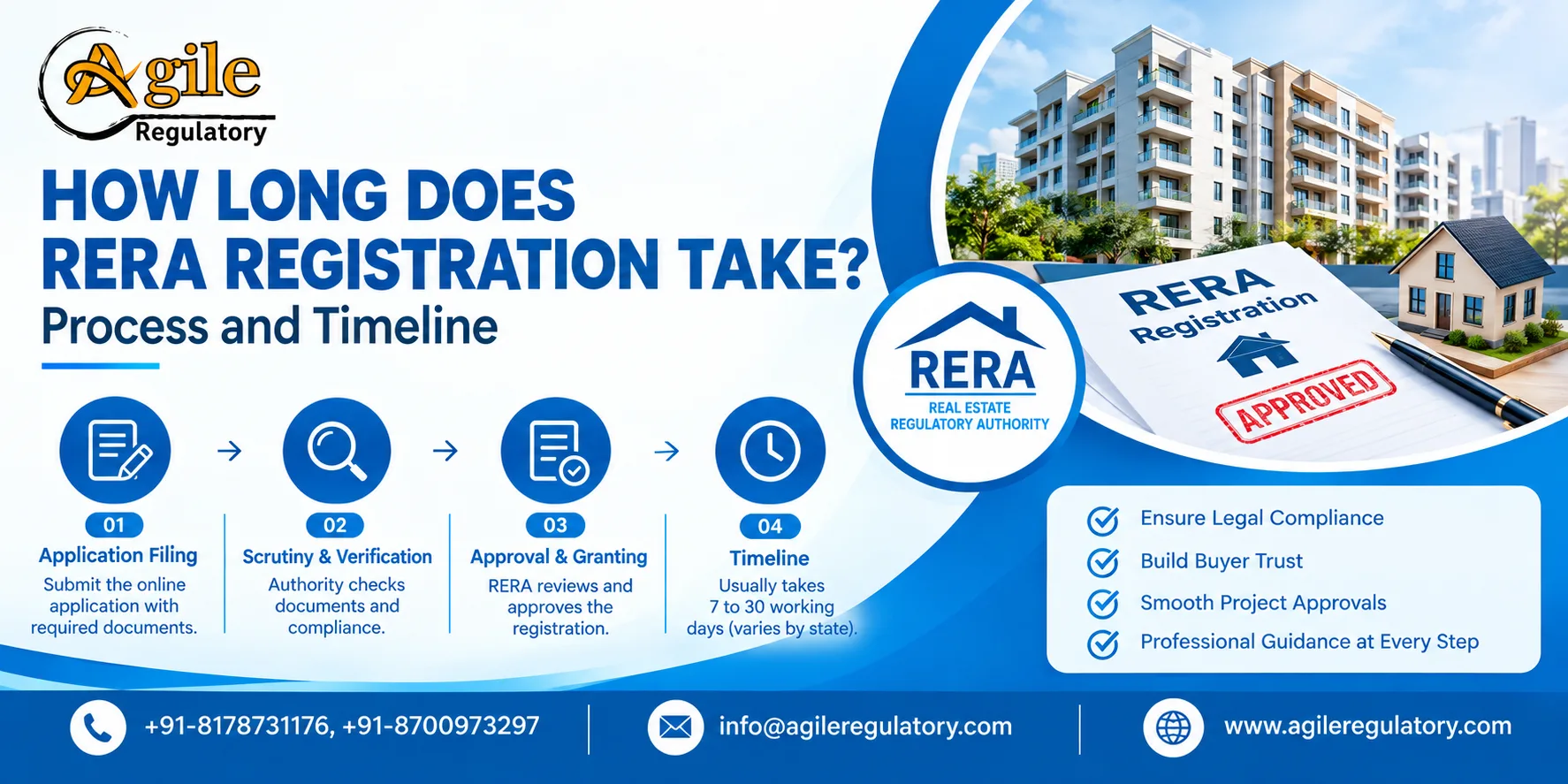
The RERA registration process is largely state-specific and completed online through the respective state’s RERA portal. Whether you are a promoter or a real estate agent, the procedure follows a clear sequence from account creation to receiving your certificate.
Step 1: Visit the State RERA Portal
Access the official RERA portal of the state or UT where your project or business operates, since each state runs its own authority.
Step 2: Create an Account
Sign up as a new user by selecting your role and providing basic details to create login credentials.
Choose your category as Promoter or Real Estate Agent. Provide your mobile number and email ID for verification.
Step 3: Fill the Application (Form A)
Log in and complete the application form, usually Form A for promoters, entering accurate details.
Promoters enter project information, type, size, location, land ownership, legal title, experience, financials and timeline. Agents enter personal or company details, business address and professional particulars.
Step 4: Upload the Required Documents
Attach all mandatory documents based on your applicant type, ensuring each file meets the portal’s prescribed format and size limits.
Incomplete or invalid documents are the most common cause of delays.
Step 5: Pay the Registration Fee
Pay the applicable fee online through net banking, debit/credit card or challan.
Promoters pay a fee, usually based on the project’s area. Agents pay a fixed fee that varies by state and entity type.
Step 6: Submit the Application
Review every field for accuracy and completeness, then submit the application. Note the acknowledgment or application number, which you will use to track your status.
Step 7: Verification and Approval by the Authority
The RERA authority reviews your application and documents. If everything is correct, registration is usually granted within 30 days.
Under Section 5 of the RERA Act, if no decision is given within this period, the project is automatically considered “deemed registered.”
Step 8: Receive Your Registration Certificate
On approval, you receive a unique RERA registration number, a registration certificate and login credentials.
The registration number follows a state-specific format and may include the state code, project type, district, year and a serial number. Promoters must display this RERA number in all advertisements, brochures and marketing materials.
The RERA registration process usually takes 30 days as per law. However, in practice, it may take 30 to 60 days depending on state rules, document completeness and project complexity.
State-Wise RERA Registration Fees
State-wise RERA registration fees vary because the RERA framework is implemented at the state level. Fees generally fall between ₹10,000 and ₹25,000, and corporate firm fees go up to ₹2,50,000 depending on where you register.
Project Registration Fees (Per Square Meter of Land Area)
| State | Residential | Commercial | Notes / Caps |
|---|---|---|---|
| Maharashtra | ₹10/sqm | ₹10/sqm | Minimum ₹10,000, maximum ₹10 lakh |
| Karnataka | ₹5/sqm (≤1,000 sqm), ₹10/sqm (>1,000) | ₹20/sqm | Residential capped at ₹5 lakh |
| Uttar Pradesh | ₹10/sqm (≤1,000 sqm), ₹500 per 100 sqm (>1,000) | ₹20/sqm (≤1,000), ₹1,000 per 100 sqm (>1,000) | Higher slab for larger projects; no fixed cap |
| Haryana | ₹10/sqm (high-potential), ₹5/sqm (low/medium) | ₹20/sqm and ₹10/sqm | Zone-based rates |
| Madhya Pradesh | ₹40/sqm × FAR (plotted); ₹40/sqm × carpet area (constructed) | ₹40/sqm basis | Linked to the carpet area |
| Kerala | ₹50/sqm of floor area (new); ₹10/sqm (plotted) | Not specified | Floor-area basis |
| Goa | ₹10/sqm or ₹50,000, whichever is higher | Not specified | The minimum-fee rule applies |
| Tamil Nadu / Andhra Pradesh | Calculated on built-up area | Not specified | Different calculation basis |
RERA fees are generally calculated based on land area, although some states, such as Tamil Nadu and Andhra Pradesh, use a different calculation basis. Separately, Section 2(k) of the RERA Act defines “carpet area” as the net usable floor area of an apartment, excluding external walls, service shafts, exclusive balconies or verandahs, and exclusive open terraces. Section 4 requires promoters to disclose the carpet area of apartments offered for sale.
Agent Registration Fees (Fixed)
| State | Individual | Company / Firm / Other |
|---|---|---|
| Maharashtra (MahaRERA) | ₹10,590 | ₹1,00,590 |
| Karnataka | ₹25,000 | ₹2,50,000 |
| Uttar Pradesh | ₹25,000 | ₹2,50,000 |
| Telangana | ₹10,000 | ₹50,000 |
| Most other states | ₹10,000 – ₹25,000 | ₹50,000 – ₹2,50,000 |
RERA registration fees are fixed by each state’s own rules and are revised from time to time. Since authorities can change their rates or slabs with little notice, always confirm the current fee on your state’s official RERA portal before applying.
State RERA Authorities and Portals
RERA is implemented state-wise, and each state or Union Territory has its own regulatory authority and online portal where promoters and agents register. Since procedures, fees and thresholds vary by state, you must apply through the portal of the state where your project or business operates.
| State/UT | Authority | Official Portal |
|---|---|---|
| Maharashtra | MahaRERA | maharera.maharashtra.gov.in |
| Uttar Pradesh | UP-RERA | up-rera.in |
| Karnataka | RERA Karnataka (K-RERA) | rera.karnataka.gov.in |
| Delhi | Delhi RERA | rera.delhi.gov.in |
| Haryana | HARERA | haryanarera.gov.in |
| Tamil Nadu | TNRERA | rera.tn.gov.in |
| Gujarat | GUJRERA | gujrera.gujarat.gov.in |
| Rajasthan | RERA Rajasthan | rera.rajasthan.gov.in |
How Do RERA Rules Differ Across States?
RERA is implemented at the state level; the rules are not identical everywhere. Key differences include:
- Registration fees: Per-square-meter project fees and fixed agent fees vary widely by state.
- Fee calculation basis: Most states charge based on land area, while Tamil Nadu and Andhra Pradesh use built-up area.
- Registration thresholds: The central Act exempts projects where the land area does not exceed 500 square meters or the number of apartments does not exceed eight. Maharashtra has clarified that either condition can independently qualify a project for exemption.
- Agent validity and renewal: The five-year validity and renewal rules can differ slightly between states.
- Jurisdiction splits: Some states have multiple authorities, such as Haryana (Gurugram and Panchkula) and Uttar Pradesh (separate zones).
Key RERA Registration Forms
RERA uses standard forms at different stages of registration, compliance and dispute resolution. These forms make the process consistent and help keep project and agent details clear and transparent.
| Form | Official Name | Purpose |
|---|---|---|
| Form A | Application for Registration of Project | The primary application that a promoter files to register a real estate project. |
| Form B | Declaration Supported by Affidavit | The promoter’s declaration, including the commitment to deposit 70% of funds in a separate account. |
| Form C | Registration Certificate of Project | Issued by the authority to the promoter on successful project registration. |
| Form D | Intimation of Rejection/Revocation | Used by the authority to reject an application or revoke a project’s registration. |
| Form E | Application for Extension of Registration | Filed by a promoter to extend a project’s registration period. |
| Form F | Certificate for Extension of Registration | Issued when a project’s registration is successfully extended. |
| Form G | Draft Agreement for Sale | The standard draft agreement for the sale or allotment of a unit. |
| Form H | Registration Certificate of Real Estate Agent | Issued to an agent on successful registration. |
| Form I | Intimation of Rejection/Revocation of Agent | Used to reject or revoke an agent’s registration. |
| Form J | Application for Renewal of Agent Registration | Filed by an agent to renew their registration. |
| Form K | Certificate for Renewal of Agent Registration | Issued to an agent on successful renewal. |
| Form L | Appeal to the Appellate Tribunal | Used to file an appeal with the Real Estate Appellate Tribunal. |
| Form M | Complaint to Regulatory Authority | Used by homebuyers or stakeholders to file a complaint with the authority. |
| Form N | Application to Adjudicating Officer | Used to seek compensation before the Adjudicating Officer under the applicable provisions of RERA. |
| Form 1 | Architect’s Certificate | Certifies the percentage of physical construction progress, enabling proportionate withdrawal from the escrow account. |
| Form 2 | Engineer’s Certificate | Certifies the actual cost incurred on the project so far, supporting the withdrawal calculation. |
| Form 3 | Chartered Accountant’s Certificate | Certifies the proportionate amount the promoter may withdraw from the 70% account based on completion. |
| Form 4 | Architect’s Certificate on Completion | Issued by the architect on completion of the registered project. |
| Form 5 | Annual Statement of Accounts | The promoter’s annual audited statement of the project account. |
These are the model forms prescribed under the central RERA Rules. Some states use slightly different form names or numbering, so always refer to your state RERA portal for the exact forms that apply to you.
Validity and Renewal of RERA Registration
RERA registration is not a one-time approval and comes with a validity period. Both projects and agents must renew or extend their registration before it expires to stay compliant and continue operations smoothly.
Validity for Promoters and Projects
A project’s RERA registration is valid for the completion timeline declared by the promoter at the time of registration, rather than a fixed number of years. Once this period ends, the registration must be extended to remain valid.
Section 6 provides for extension in the following circumstances:
- Force majeure events: The authority may extend the project registration when force majeure events, such as floods, fires, earthquakes or war, affect the regular development of the project.
- Other reasonable circumstances: The authority may extend the registration in reasonable circumstances, provided there is no default by the promoter. The extension must be based on the facts of the case and reasons recorded in writing, and the total extension cannot exceed one year in aggregate.
How to Extend a Project Registration?
- Apply through your state RERA portal before the current validity expires.
- Submit a justification letter, updated project timelines and supporting documents.
- Pay the prescribed extension fee.
- The authority reviews and grants the extension if the reasons are genuine.
Validity for Real Estate Agents
An agent’s registration is typically valid for five years, after which it must be renewed to continue operating legally.
How to Renew an Agent Registration?
- Log in to your state RERA portal and open the renewal application (Form J).
- Update your personal and business details.
- Upload the required documents, including proof of active business and your previous RERA certificate.
- Pay the prescribed renewal fee online.
- Download your renewed certificate (Form K) once approved.
Project validity is tied to the declared completion date, with extensions only for valid reasons. This helps prevent delays and ensures timely delivery.
RERA Penalties for Non-Compliance
Disputes under RERA are first heard by the State RERA Authority, with appeals going to the Real Estate Appellate Tribunal. To enforce compliance, the Act prescribes strict penalties for promoters, agents and buyers, which can include fines or imprisonment.
Even after registration, promoters must file quarterly project updates on the RERA portal, and failure to do so can lead to penalties.
Penalties for Promoters
- Not registering a project: A penalty of up to 10% of the estimated project cost.
- Continued non-registration: If the violation continues despite orders, the promoter may face imprisonment of up to 3 years, an additional fine of up to 10% of the project cost, or both.
- Providing false information during registration: Giving incorrect or misleading details in the application can lead to a penalty of up to 5% of the estimated project cost.
- Violating other provisions of the Act: Not following RERA rules or authority directions can also result in a penalty of up to 5% of the estimated project cost.
- Not complying with Appellate Tribunal orders: Imprisonment of up to 3 years, a fine of up to 10% of the project cost, or both.
Penalties for Real Estate Agents
- Not registering as an agent: A penalty of ₹10,000 for each day the default continues, extending up to 5% of the cost of the property involved.
- Not complying with the authority’s orders: A penalty for each day the default continues, which may cumulatively extend up to 5% of the estimated cost of the plot, apartment or building involved.
- Not complying with Appellate Tribunal orders: Imprisonment of up to 1 year, a fine of up to 10% of the cost of the plot, apartment or building involved.
Penalties for Buyers (Allottees)
- Not complying with the authority’s orders: A penalty of up to 5% of the property cost.
- Not complying with Appellate Tribunal orders: An allottee who fails to comply with an Appellate Tribunal order may be liable to a penalty of up to 10% of the plot, apartment or building cost, as provided under Section 68 of RERA.
RERA Registration Certificate (RERA License)
A RERA registration certificate is the official document issued by the respective State RERA authority once a project or agent is successfully registered. It serves as proof of compliance with the Real Estate (Regulation and Development) Act, 2016, and includes key details such as:
- Registration number
- Project or agent name
- Promoter information
- Validity period
- Address
How to Download the RERA Registration Certificate?
For promoters and agents:
- Log in to your account on your state’s RERA portal.
- Go to a section like “My Registrations” or “My Applications.”
- Locate your approved registration and download the certificate.
For homebuyers and investors:
- Most state portals allow open access to project details without a login.
- Use the project or agent search tool to view registration details.
- If a direct download is not available, you can take a screenshot or request a copy from the developer.
How to Track Your RERA Application Status?
- Visit your state’s official RERA portal.
- Open the “Application Status” or “Track Application” section.
- Enter your application number or the unique ID provided at submission.
- The portal displays the current status, such as “Under Scrutiny,” “Approved,” “Rejected” or “Clarification Required.”
How to Check or Verify a RERA Registration Number Online?
Buyers and investors can verify any project or agent on the relevant state RERA portal without logging in:
- Open your state’s RERA portal.
- Go to the “Registered Projects” or “Registered Agents” search.
- Enter the RERA registration number, project name, promoter or agent name.
- Confirm the registration status, validity, promoter details and approved project information.
- Match the RERA number quoted in an advertisement or agreement with the details shown on the official portal before booking a property.
What Are the Compliance Requirements After RERA Registration?
After RERA registration, promoters must continue to meet the compliance requirements prescribed under the RERA Act and applicable state rules. Key RERA compliance requirements after registration include:
- Update project details: Keep the required project information and progress details updated on the state RERA portal.
- Maintain a separate bank account: Deposit 70% of the amounts collected from allottees into the separate account and use the funds for the permitted land and construction costs.
- Provide project information: Make sanctioned plans, specifications, project timelines and other required information available to allottees.
- Use the RERA registration number: Mention the registration number and required RERA details in project advertisements and promotional material.
- Follow approved plans: Do not make changes to sanctioned plans or project specifications except as permitted under RERA.
- Maintain financial records: Maintain the prescribed project accounts and complete the required audit and certification.
- Meet possession and handover obligations: Complete the project according to the applicable commitments and follow the requirements for possession, conveyance and handover.
State RERA authorities may prescribe additional project updates, filings and compliance requirements. Promoters should therefore follow the requirements of the relevant state RERA portal throughout the project lifecycle.
Frequently Asked Questions
Who is eligible for RERA registration?
Builders, developers and other promoters must register qualifying real estate projects under RERA before offering them for sale. Real estate agents must also obtain registration before facilitating property transactions in registered projects.
Is RERA registration mandatory for small projects?
RERA registration is generally not required when the proposed project does not exceed 500 square meters or eight apartments, including all phases. However, the appropriate government can reduce these exemption thresholds.
What documents are required for RERA registration?
Promoters generally need land ownership documents, approvals, commencement certificates, project details, financial information and prescribed declarations. Agents generally provide PAN, address proof, photographs and business or entity documents.
How much does RERA registration cost?
RERA registration fees vary by state, project type, project area and applicant category. Promoters generally pay fees based on the applicable state fee structure, while agents usually pay prescribed registration fees.
Is RERA registration required for real estate agents?
Yes, a real estate agent must obtain RERA registration before facilitating the sale or purchase of a plot, apartment or building in a RERA-registered project. The agent receives a registration number and must quote that number in every sale facilitated under RERA.
How long is RERA registration valid?
The validity of RERA registration depends on whether you register a project or act as an agent. A project’s registration generally runs according to its declared completion period, subject to applicable extension provisions. Agent registration remains valid for the period prescribed by the applicable state rules and requires renewal afterward.
Can I sell a property without RERA registration?
A promoter cannot advertise, market, book, sell or offer for sale a plot, apartment or building in a project that requires RERA registration without registering that project. Certain projects receive statutory exemptions, including specified small projects and qualifying renovation or redevelopment projects.
What happens if a promoter does not register under RERA?
A promoter who violates the project registration requirement can face a penalty of up to 10% of the estimated project cost. Continued violation can attract additional penalties and, in specified circumstances, imprisonment.