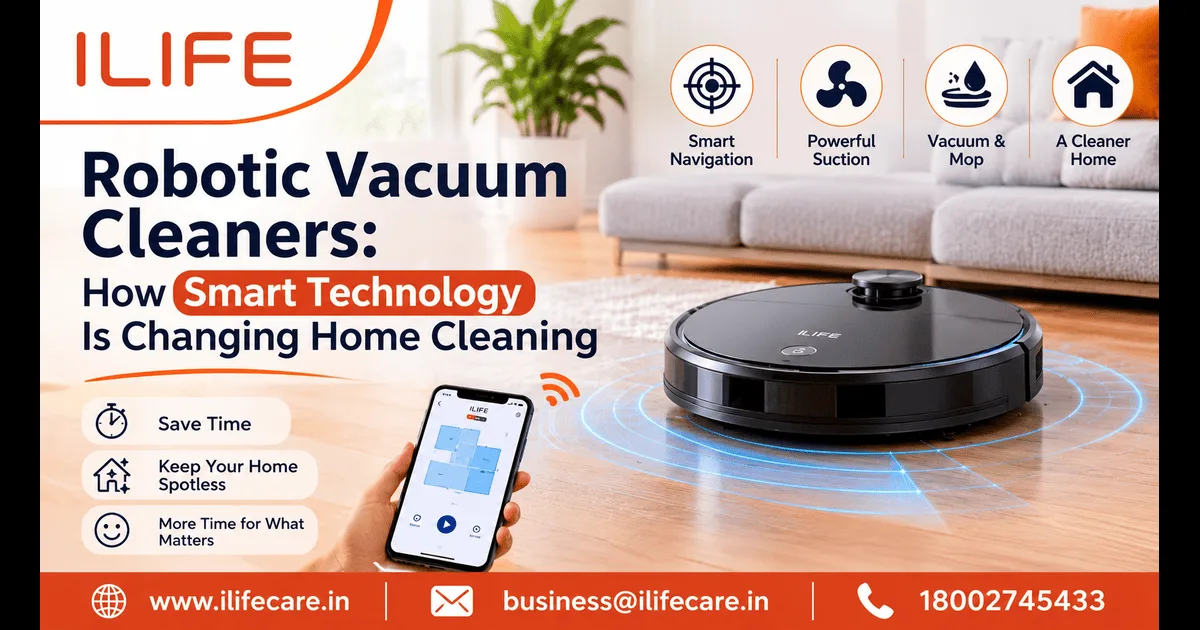
Not long ago, cleaning the house meant a broom, a mop and a good part of your Sunday. Now a small round machine can do much of that work while you are at the office. Robotic Vacuum Cleaners have gone from a rich person’s gadget to something many Indian families talk about at the dinner table. But what changed? The machines did not just get cheaper. They got smarter. Here is a simple look at the technology behind them and what it means for your home.
From Bumping Around to Cleaning with a Plan
The first robot vacuums were not very clever. They moved in random lines, hit the wall, turned, and tried again. If the room got cleaned, it was mostly luck. They missed some spots, went over others five times, and often got stuck under a chair.
Today’s machines clean with a plan. They know where they are, where they have already been, and what is left. That one change, from random to planned, is the biggest jump in this whole category. It also explains why people who tried an early model years ago and gave up are now surprised.
How Robotic Vacuum Cleaners Find Their Way
Most modern machines use one of a few ways to see the room.
Some use simple sensors and a gyroscope. They sense walls and keep a rough track of direction, which is better than random but not perfect. Others use a camera that looks at the ceiling or the room. Cameras can work well, but they depend on light, so a dark room can confuse them.
The most popular choice right now is laser navigation, often called LiDAR. A small laser measures the distance to walls and furniture again and again, many times a second. The robot uses this to draw a map of your home and plan neat, straight rows. Because it makes its own light, it does not care if the room is dark. Some models use a fixed laser instead of a spinning one, which keeps the body slim enough to slide under low furniture. ILIFE’s V20, for example, uses this fixed laser, while the A30 Pro uses LiDAR.
Once the map is ready, the useful part begins. You can save it in the app, tell the robot to clean only the kitchen, or mark a corner as a no-go zone so it stays away from the pet’s water bowl. If your home has more than one floor, many models can store a separate map for each. The A30 Pro, for instance, can save up to five.
Suction Power: What Those Big Numbers Mean
Every brand now shows a suction number in Pascals, or Pa. Higher means stronger, but the number alone does not tell the whole story. The brush design, how well the robot seals against the floor, and how it moves all change how much dust actually gets picked up.
Pa figures can also be measured in different ways, so comparing two brands on numbers alone can mislead you. Comparing models from the same brand is fairer. In ILIFE’s range, the figure goes from 5,000Pa on the V20 to 13,000Pa on the A30 Pro and 25,000Pa on the T20s Ultra. A bigger number helps in homes with carpets and pet hair. For smooth tiles and daily dust, a lower one is often enough.
A handy extra is auto carpet boost. The robot senses when it moves from a hard floor to a carpet, raises suction by itself, and lowers it again on tiles.
Vacuum and Mop in One Go
Many families in India want both dry and wet cleaning, because dust settles fast and floors get sticky. A 2-in-1 robot does both. It usually has one tank that holds a small dustbin on one side and water on the other, with a damp cloth at the back. The robot vacuums first and wipes right after, in a single trip.
Some models mop in a “Y” shape path, moving back and forth to cover more floor. It works well for daily upkeep. Just be realistic, though. A robot mop handles light dirt and dust film, but it will not scrub dried stains the way you would by hand. Keep it away from rugs and carpets too. Most apps let you mark no-mop areas for exactly this reason.
Apps, Schedules and Voice Control
Smart cleaning is not just about the robot. It is also about how you talk to it. Through a phone app, you can start a clean from the sofa, or from your office. You can set a schedule, like every day at 11 am after everyone has left, and watch the robot’s path live on a map.
Voice control is the other piece. Many models work with Alexa and Google Assistant, so a few words get the robot going. And not everyone wants an app for everything, which is why most models still come with a simple remote. Parents or grandparents can use it with no trouble.
Self-Emptying Stations: Less Work for You
A small dustbin on the robot means you have to empty it often, sometimes after every run. Self-emptying stations fix this. After each clean, the robot goes back to its dock, which pulls the dust out of the bin into a larger bag. You only change the bag now and then.
How long a bag lasts depends on the model and your home. The iLife A30 Pro, with a 2.5 litre bag, is listed for up to seven weeks. The T20s Ultra has a 3.5 litre bag, listed for up to 70 days. Homes with pets will fill them faster, so treat these as best-case numbers. Still, going from emptying a bin every day to changing a bag every month or two is a real change in daily life.
What a Robot Vacuum Cleaner Can’t Do
It is worth being honest here. A robot vacuum cleaner is a helper, not a full replacement for you.
It cannot climb stairs, so a multi-storey home means carrying it up. It can get tangled in loose cables, socks and curtain edges, so a quick tidy before it starts helps a lot. It may not reach deep into tight corners. It needs a little care too. Brushes need cleaning every week or so, because hair wraps around them fast, and filters and mop cloths need washing or changing now and then.
Think of it as the machine that handles daily dust, so your weekly deep clean becomes much lighter. That is a realistic promise, and still a very useful one.
What to Look for Before You Buy
If you are thinking about getting a robot vacuum cleaner, a few checks can save you from regret. Start with your floors. A home with mostly tile and marble needs different features from one full of carpets. Think about size too, because a bigger home needs a longer battery, or a robot that can recharge and carry on by itself. Decide whether the built-in dustbin is enough, or whether a self-emptying dock is worth the extra cost for you. If you want room-wise cleaning and saved maps, look at the navigation type. And before you pay, find out how easy it is to get service and spare parts, since brushes, filters and clothes wear out over time.
Be honest about how you will use it, too. If all you want is simple daily dust control, you do not need every feature on the list.
Final Thoughts
Robotic vacuum cleaners have come a long way from the bump-and-turn machines of ten years ago. Better navigation, stronger suction, mopping, apps and self-emptying docks have turned them into something that really fits Indian homes and busy routines. They will not do everything, but they take the most repetitive job off your list. If you are curious, compare a few models, including ILIFE’s range, and pick the one that suits your floors and your budget.