In heavy engineering, industrial components are expected to withstand significant mechanical loads, pressure, temperature variations, and continuous operating conditions. For applications where strength, dimensional accuracy, and reliability are essential, seamless rolled rings play an important role.
From power generation and aerospace to oil and gas, mining, and heavy machinery, rolled rings are widely used in applications that demand high-performance forged components.
Unlike fabricated rings made by joining separate metal sections, seamless rolled rings are produced through a forging and ring-rolling process. This manufacturing method helps develop favourable grain flow, improve material utilisation, and achieve the dimensions required for demanding industrial applications.
But how are rolled rings manufactured, what makes them beneficial, and where are they used?
Let's understand the process.
What Are Rolled Rings?
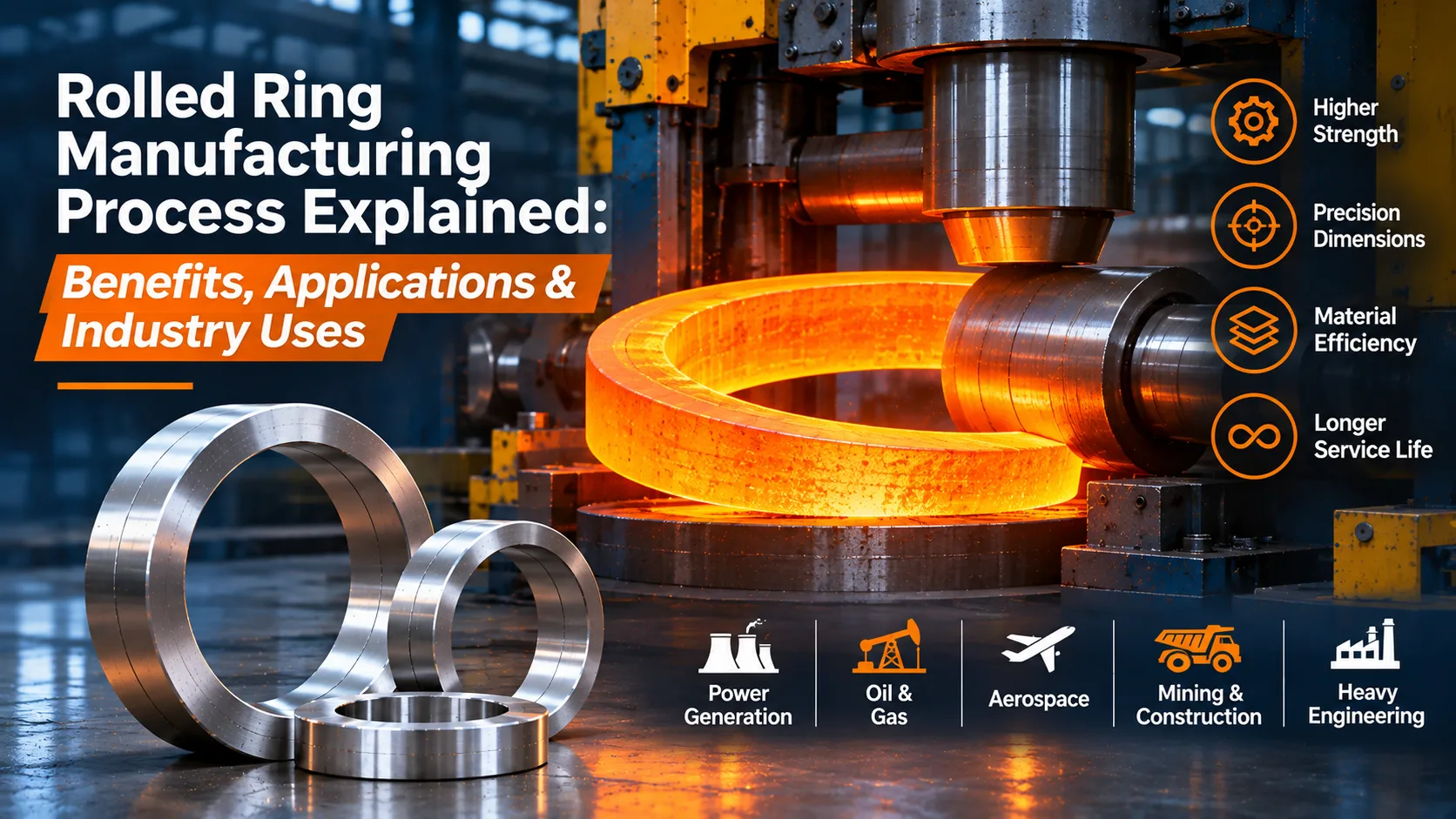
Rolled rings are seamless, circular metal components manufactured by expanding a forged ring-shaped blank through a specialised ring-rolling process.
The process reduces the wall thickness of the ring while increasing its diameter. Depending on the equipment and component design, the ring's height and cross-sectional profile can also be controlled.
These components are commonly manufactured from carbon steel, alloy steel, stainless steel, and specialised alloys.
Rolled rings are used in applications where strength, structural integrity, dimensional accuracy, and consistent material properties are important.
Common examples include:
- Bearing rings and slewing rings
- Gear rings
- Turbine rings
- Pressure vessel rings
- Industrial flanges
- Aerospace structural rings
- Large machinery components
How Does the Rolled Ring Manufacturing Process Work?
The rolled ring manufacturing process involves several controlled stages. Each stage contributes to the final component's geometry, material properties, and quality.
1. Raw Material Selection
The manufacturing process begins with selecting a suitable metal billet or ingot.
Material selection depends on the component's intended application, operating conditions, mechanical requirements, and customer specifications.
Common materials include:
- Carbon steel
- Alloy steel
- Stainless steel
- Duplex stainless steel
- Nickel-based superalloys
- Titanium alloys
- Aluminium alloys
The incoming material is checked against the required specifications to ensure its suitability for forging.
2. Heating the Material
The selected billet is heated in a controlled furnace to reach the appropriate forging temperature.
Proper heating is important because it allows the material to deform without excessive resistance while helping maintain suitable metallurgical conditions.
Manufacturers control heating temperature, heating time, and temperature uniformity according to the material grade and component requirements.
3. Upsetting and Piercing
After heating, the material undergoes forging operations to prepare the ring blank.
During upsetting, the billet is compressed to increase its cross-sectional dimensions. A central hole is then created through piercing, producing a preliminary ring-shaped component.
This initial component is commonly known as a ring blank or preform.
The quality of the preform influences the efficiency and consistency of the subsequent ring-rolling operation.
4. Radial-Axial Ring Rolling
This is the most important stage of the rolled ring manufacturing process.
The heated ring blank is placed between specialised rolls inside a ring-rolling machine.
The radial rolls reduce the wall thickness of the ring, allowing its diameter to expand. Axial rolls control the height and cross-sectional profile.
Through controlled deformation, the initial ring blank gradually develops into a larger seamless rolled ring.
Modern CNC-controlled radial-axial ring-rolling machines help manufacturers maintain process repeatability, dimensional control, and consistent production quality.
5. Heat Treatment
After ring rolling, the component may undergo heat treatment to achieve the mechanical properties required for its application.
Depending on the material and specification, heat-treatment processes may include:
- Normalising
- Annealing
- Quenching
- Tempering
- Solution treatment
- Ageing
The appropriate process helps achieve the required combination of hardness, strength, toughness, and microstructure.
6. Machining and Final Inspection
The rolled ring is then machined to meet the specified dimensions, tolerances, and surface-finish requirements.
Depending on the application, machining may involve turning the inner and outer diameters, facing the surfaces, and producing specific profiles.
Final inspection can include dimensional verification, material testing, hardness testing, mechanical testing, and non-destructive testing where required.
The finished ring is checked against the customer's technical specifications before dispatch.
What Are the Major Benefits of Seamless Rolled Rings?
The ring-rolling process offers several advantages for industrial applications when the component design, material, and manufacturing conditions are properly selected.
1. Improved Grain Flow and Mechanical Properties
One of the key advantages of ring rolling is the development of grain flow that follows the general circular profile of the component.
This can support favourable mechanical properties and structural integrity, depending on the material and process conditions.
It makes seamless rolled rings suitable for applications where components must withstand significant mechanical stresses.
2. Better Material Utilisation
Ring rolling expands a preformed ring blank rather than producing the entire component by removing material from a solid block.
This can reduce unnecessary material removal and improve manufacturing efficiency.
For large industrial components, better material utilisation can contribute to lower material costs and reduced machining requirements.
3. High Dimensional Accuracy
Modern radial-axial ring-rolling machines allow manufacturers to control important dimensions during production.
These include:
- Outer diameter
- Inner diameter
- Ring height
- Wall thickness
- Cross-sectional profile
Improved dimensional control can reduce subsequent machining allowances and support more efficient production.
4. Flexibility in Component Design
Rolled rings can be manufactured in different diameters, heights, thicknesses, and profiles.
Depending on the equipment and manufacturing capability, manufacturers can produce customised rings for specialised industrial requirements.
This flexibility is particularly valuable for OEMs developing large or complex machinery.
5. Suitability for Demanding Applications
Seamless rolled rings are used in applications where mechanical strength, reliability, and structural integrity are important.
With appropriate material selection, heat treatment, machining, and inspection, they can meet the requirements of demanding industrial environments.
Where Are Rolled Rings Used?
Rolled rings support a wide range of industries. Their applications depend on component geometry, material properties, and operating requirements.
Power Generation
Power-generation equipment uses large forged and rolled components in turbines, generators, and other critical assemblies.
Rolled rings can be used in turbine-related components, housings, and other engineered applications where strength and dimensional accuracy are important.
Oil and Gas
The oil and gas industry requires components capable of operating under demanding mechanical and environmental conditions.
Rolled rings and forged flanges are used in selected pressure-related equipment, process systems, and industrial assemblies.
Aerospace
Aerospace applications require carefully controlled materials, manufacturing processes, and inspection procedures.
Rolled rings can be used in selected engine, structural, and other aerospace components where strict engineering requirements apply.
Mining and Construction
Heavy equipment used in mining and construction operates under significant loads and repeated mechanical stresses.
Large-diameter rings, slewing bearing rings, and gear rings are used in equipment such as excavators, cranes, and material-handling machinery.
Heavy Engineering
Industrial machinery and specialised equipment require components that combine strength, dimensional accuracy, and reliable performance.
Rolled rings are used in bearing systems, gear assemblies, flanges, and other large engineered components.
Wind Energy and Marine Applications
Large industrial rings can also be used in selected wind-energy, marine, and defence applications.
These components may form part of bearing systems, rotating assemblies, structural arrangements, and specialised machinery.
Which Materials Are Used in Rolled Ring Manufacturing?
Material selection depends on the component's operating environment, load requirements, temperature, corrosion exposure, and applicable engineering standards.
Common material categories include:
Carbon Steel: Used in applications requiring general mechanical strength and suitable machinability.
Alloy Steel: Selected for applications requiring specific combinations of strength, toughness, hardenability, and wear resistance.
Stainless Steel: Used where corrosion resistance and mechanical performance are important.
Duplex Stainless Steel: Considered for applications requiring a combination of strength and corrosion resistance.
Nickel-Based Alloys: Used in selected high-temperature and demanding environments.
Titanium Alloys: Used in specialised applications where high strength-to-weight ratio and corrosion resistance are important.
The material should always be selected according to the engineering specification rather than based on general assumptions about performance.
Why the Choice of Rolled Ring Manufacturer Matters
The quality of a rolled ring depends on more than the ring-rolling machine itself.
Raw material quality, preform design, forging temperature, deformation control, heat treatment, machining, and inspection all influence the finished component.
OEMs should therefore evaluate a manufacturer's complete production capabilities before selecting a supplier.
Important considerations include:
- Ring-rolling machine capacity
- Maximum component diameter and weight
- Material processing capabilities
- Heat-treatment facilities
- CNC machining capabilities
- Inspection and testing systems
- Quality certifications
- Product traceability
- Experience with customised industrial components
A manufacturer with integrated forging, ring rolling, heat treatment, machining, and testing capabilities can help simplify sourcing and maintain better control over the production process.
CHW Forge: Seamless Rolled Ring Manufacturing Capabilities
CHW Forge is an Indian forging manufacturer with specialised capabilities in seamless rolled ring manufacturing.
The company uses an advanced radial-axial ring-rolling machine from SMS Group, Germany, to manufacture rolled rings and flanges with or without profiles on their inner and outer diameters.
According to its official website, CHW Forge manufactures rolled rings weighing between 100 kg and 5,000 kg and offers processing capabilities for carbon and alloy steels, austenitic steels, superalloys such as Inconel and Hastelloy, titanium, aluminium, and copper alloys.
Its manufacturing process includes controlled upsetting and piercing to prepare ring blanks, followed by radial-axial rolling. The company also provides heat treatment, machining, destructive testing, and non-destructive testing facilities.
These capabilities support applications across power generation, oil and gas, aerospace, heavy engineering, construction, and other industrial sectors.
For OEMs sourcing seamless rolled rings, CHW Forge's integrated manufacturing approach offers a combination of forging expertise, ring-rolling technology, and supporting quality processes.
More details are available on the CHW Forge Seamless Rolled Rings .
Frequently Asked Questions About Rolled Ring Manufacturing
What is the rolled ring manufacturing process?
Rolled ring manufacturing is a forging process in which a heated, pierced ring blank is expanded using radial and axial rolls. The process increases the ring's diameter while controlling its wall thickness and height to achieve the required dimensions.
What is the difference between a seamless rolled ring and a welded ring?
A seamless rolled ring is manufactured from a forged ring blank and expanded through ring rolling without joining separate ends. A welded ring is formed by joining material sections through a welding process. Their manufacturing routes, material structures, and qualification requirements differ.
What materials are used to manufacture rolled rings?
Rolled rings can be manufactured from carbon steel, alloy steel, stainless steel, duplex stainless steel, nickel-based superalloys, titanium, and other suitable alloys.
What are the main advantages of ring rolling?
The main advantages include favourable grain flow, efficient material utilisation, reduced machining requirements, dimensional flexibility, and the ability to manufacture large seamless ring-shaped components.
Which industries use seamless rolled rings?
Seamless rolled rings are used in power generation, aerospace, oil and gas, mining, construction, wind energy, marine applications, and heavy engineering.
How are rolled rings inspected?
Inspection may include dimensional measurement, chemical analysis, hardness testing, mechanical testing, ultrasonic testing, and other non-destructive testing methods depending on the material, component specification, and application.
What should OEMs consider when selecting a rolled ring manufacturer?
OEMs should evaluate machine capacity, material expertise, ring dimensions, heat-treatment capabilities, machining, inspection facilities, traceability, certifications, and the manufacturer's experience with similar industrial applications.
Final Thoughts
Rolled ring manufacturing is an important forging process for producing seamless, high-performance components used across modern heavy industries.
By combining controlled forging, piercing, radial-axial rolling, heat treatment, machining, and inspection, manufacturers can produce rings with the required geometry and mechanical properties for demanding applications.
For OEMs, selecting the right rolled ring manufacturer is equally important. Manufacturing technology, material expertise, quality control, and production capability all contribute to the reliability of the finished component.
As industrial equipment becomes larger and more specialised, seamless rolled rings will continue to play an important role in applications where strength, precision, material efficiency, and manufacturing reliability matter.