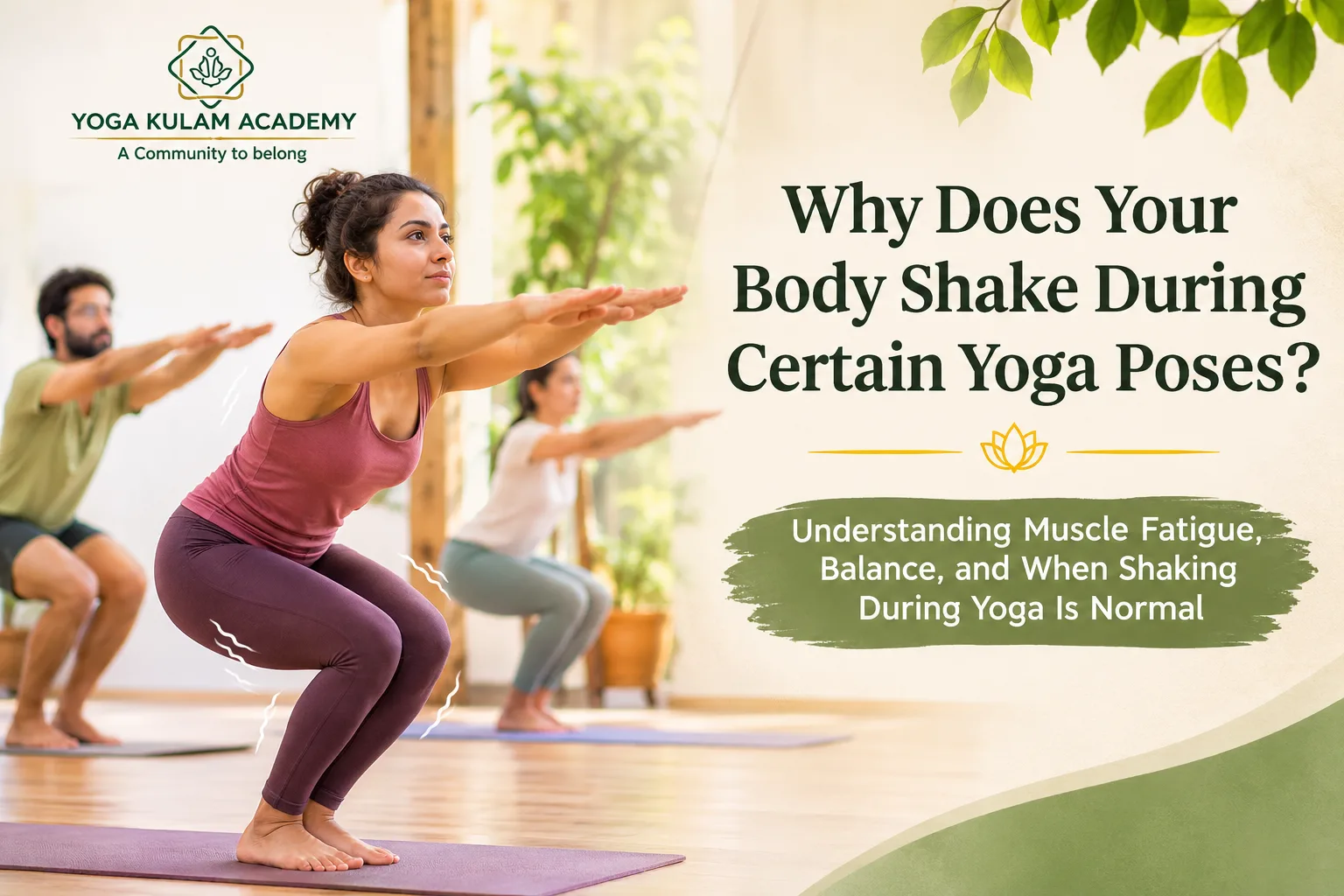
Understanding Muscle Fatigue, Balance, and What Shaking During Yoga Really Means
You're halfway through Utkatasana, or Chair Pose. Your thighs are working hard, your breathing is becoming more noticeable, and suddenly your legs begin to shake.
You try to remain steady, but the trembling continues.
A similar thing might happen during Plank Pose, Warrior III, or even a standing balance you've practised many times before.
Does shaking mean your muscles are weak? Is it a sign that you're building strength? Or is your body telling you to stop?
The answer isn't always straightforward.
Shaking during yoga is often a normal response to muscular effort, fatigue, or the challenge of maintaining balance. However, it can also indicate that you need to reduce the intensity of your practice.
Understanding why it happens can help you practise more comfortably and recognise when your body needs additional support.
1. Your Muscles Are Working Harder Than You Realise
Some yoga postures appear relatively simple from the outside.
Chair Pose, for example, involves bending your knees and maintaining a position that resembles sitting on an invisible chair.
But your thighs, hips, and other supporting muscles must continue producing force to hold the position.
Unlike exercises involving repeated movements, many yoga postures require sustained muscular contractions.
As muscles become fatigued, maintaining steady force can become more difficult.
The resulting changes in muscular activity may produce visible trembling.
This is especially noticeable when you're holding a challenging position for longer than usual.
The shaking doesn't automatically mean something is wrong, but it can indicate that the muscles are approaching their current capacity.
2. Your Nervous System Is Involved Too
Muscles don't work independently.
They receive instructions from the nervous system, which coordinates when different muscle fibres contract and how much force they produce.
During demanding postures, the body continually adjusts muscular activity to maintain the required position.
As fatigue develops, these adjustments may become less steady.
Small fluctuations in muscular force can become visible as shaking.
This is one reason trembling often appears during sustained holds rather than only during movement.
Students exploring yoga teacher training bengaluru may encounter these principles while studying anatomy and movement.
Understanding basic neuromuscular coordination can help practitioners recognise that shaking is a physical response, not necessarily evidence of poor technique.
3. Balancing Poses Challenge Your Stability
Have you ever noticed your standing leg shaking during Tree Pose?
Balancing on one leg requires continuous adjustments.
Your ankles, feet, hips, and core work together to keep your body stable.
Even when you appear motionless, small muscular corrections are taking place.
If you're unfamiliar with a balancing posture, these adjustments may feel difficult to coordinate.
Your leg might tremble while your body tries to maintain stability.
This doesn't necessarily mean you lack strength.
Balance depends on several factors, including coordination, sensory information, concentration, and previous movement experience.
With regular, appropriate practice, some people become more comfortable controlling these movements.
However, improvement takes time.
4. Muscle Fatigue Is Different From Muscle Weakness
People often assume that shaking means their muscles are weak.
Sometimes the posture is challenging because the muscles involved are not accustomed to that level of effort.
But even physically strong individuals can experience shaking during unfamiliar or demanding exercises.
A person who regularly lifts weights may still struggle with a sustained yoga balance.
Likewise, an experienced yoga practitioner may tremble when introduced to a new movement requiring different muscular coordination.
Muscle strength, endurance, and movement control are related but distinct abilities.
A comprehensive Bengaluru Yoga Teacher Training program should help students understand these differences rather than treating every instance of trembling as a strength deficiency.
The question isn't simply whether your body shakes.
It's whether you can maintain appropriate movement, control, and comfort.
5. Holding a Pose Longer Isn't Always Better
Imagine holding Plank Pose.
For the first twenty seconds, you feel stable.
As time passes, your arms begin trembling and your body gradually loses its original position.
You might believe that continuing for another minute will make the exercise more effective.
But longer isn't always better.
When fatigue begins significantly affecting your technique, continuing may place unnecessary demands on your body.
A shorter, controlled hold can be more appropriate than a prolonged hold with deteriorating form.
The same principle applies to standing postures.
A yoga teacher should encourage students to recognise their limits rather than making endurance the only measure of progress.
6. Your Breathing Can Influence the Experience
Breathing patterns often change during demanding physical activity.
Some people unconsciously hold their breath while concentrating on balance.
Others begin breathing more rapidly as muscular effort increases.
Breath-holding can contribute to a feeling of strain and may make it harder to maintain a comfortable practice.
However, shaking cannot always be explained by breathing alone.
If you notice yourself holding your breath, consider reducing the difficulty of the posture.
Allow your breathing to return to a comfortable, natural rhythm.
Avoid forcing deep breaths or attempting prolonged breath retention while your body is already working hard.
Breathing awareness can support practice, but it shouldn't become another source of pressure.
7. Fatigue, Hydration, and Food Intake May Also Matter
Not every episode of shaking comes from the posture itself.
Your overall physical condition can influence how you respond to exercise.
Poor sleep, accumulated fatigue, inadequate hydration, or insufficient food intake may make a session feel more demanding.
In some circumstances, low blood glucose can contribute to shakiness, although trembling alone cannot establish that diagnosis.
If you feel unusually weak or unwell during practice, stop and assess how you're feeling.
Students researching the Best yoga teacher training in bangalore should consider whether a school teaches recovery, appropriate exercise intensity, and basic physical safety alongside asana.
Responsible yoga education recognises that performance is influenced by what happens outside the classroom too.
8. Why Shaking Is More Noticeable in Certain Asanas
Different yoga postures challenge the body in different ways.
In Chair Pose, trembling may develop as the thighs work to maintain a sustained position.
During Plank Pose, the arms, shoulders, and trunk must contribute to stability.
In Warrior III, the standing leg and hip muscles work alongside the trunk to control balance.
During Boat Pose, the abdominal and hip muscles help maintain the body's position.
These are examples of how muscular effort and stability demands can contribute to trembling.
However, the same posture may feel completely different between individuals.
One student may find it easy, while another experiences shaking almost immediately.
Neither experience should be judged without considering the person's abilities and circumstances.
9. Does Shaking Mean You're Building Strength?
Not necessarily.
Shaking may indicate that an exercise is challenging, but it isn't a reliable measurement of strength development.
Muscles can become stronger without visible trembling.
Likewise, intense shaking doesn't guarantee that a posture is producing better results.
Strength develops through appropriate training demands, gradual progression, adequate recovery, and consistency.
Trying to make your muscles shake deliberately is unnecessary.
A well-designed yoga routine should focus on suitable effort rather than treating trembling as proof of an effective workout.
10. What Should You Do When Your Body Starts Shaking?
The first step is to notice what's happening.
If the shaking is mild and you're otherwise comfortable, you may simply be experiencing muscular effort.
However, you don't need to remain in the posture until trembling becomes intense.
Consider reducing the duration of the hold.
Use a yoga block, wall, or chair when appropriate.
Move into an easier variation or take a short rest.
Pay attention to your breathing and whether you can maintain comfortable control.
If the posture becomes painful, you feel unstable, or the shaking increases significantly, stop.
Learning to adjust your practice is not a sign of failure.
It's an important part of developing physical awareness.
11. When Is Shaking a Warning Sign?
Although mild muscle trembling during demanding exercise is often harmless, certain symptoms deserve attention.
Stop exercising if shaking is accompanied by significant dizziness, unusual weakness, severe pain, confusion, or feeling faint.
Chest pain, fainting, or severe breathing difficulty require urgent medical attention.
Trembling that occurs repeatedly during very light activity, continues long after exercise, or appears without an obvious explanation should also be discussed with a healthcare professional.
Not every tremor is caused by exercise.
Medical conditions, medications, and other factors can sometimes contribute.
It's important not to dismiss persistent symptoms as ordinary muscle fatigue.
12. What Yoga Teachers Should Understand About Shaking
For yoga instructors, recognising different responses to muscular effort is an important teaching skill.
Some students may begin trembling during their first attempt at Chair Pose.
Others might struggle during a balancing sequence.
A responsible teacher shouldn't automatically encourage them to push harder.
Instead, they can observe the student's overall technique, ask about discomfort, and suggest appropriate modifications.
This is particularly important for beginners who may feel pressured to match more experienced classmates.
Students considering yoga teacher training bangalore india should look for programs that teach anatomy, movement observation, modifications, and practical instruction.
A good yoga teacher understands that each person's physical capacity is different.
13. Why Regular Practice Can Change Your Response
As you become more familiar with yoga postures, your coordination and muscular endurance may improve.
Movements that initially required considerable concentration may begin to feel easier.
You may become more comfortable balancing or maintaining controlled positions.
As a result, some postures may produce less trembling over time.
However, shaking can still occur when you encounter unfamiliar challenges or increase the intensity of your practice.
Progress isn't measured by eliminating every physical response.
It's measured through appropriate improvements in control, understanding, and the ability to practise responsibly.
Final Thoughts
Shaking during yoga can feel surprising, especially when it happens in a posture that looks simple.
In many cases, it reflects muscular fatigue, sustained effort, or the challenge of maintaining balance.
It doesn't automatically mean your muscles are weak, and it doesn't guarantee that you're building strength.
The most useful response is to observe what is happening.
Can you breathe comfortably?
Are you maintaining control?
Does the posture feel appropriately challenging, or are you pushing beyond your current ability?
Sometimes continuing briefly may be reasonable. At other times, reducing the intensity or resting is the better choice.
Yoga progress isn't about holding a posture until your body gives up. It's about learning how to challenge yourself while recognising when enough is enough.