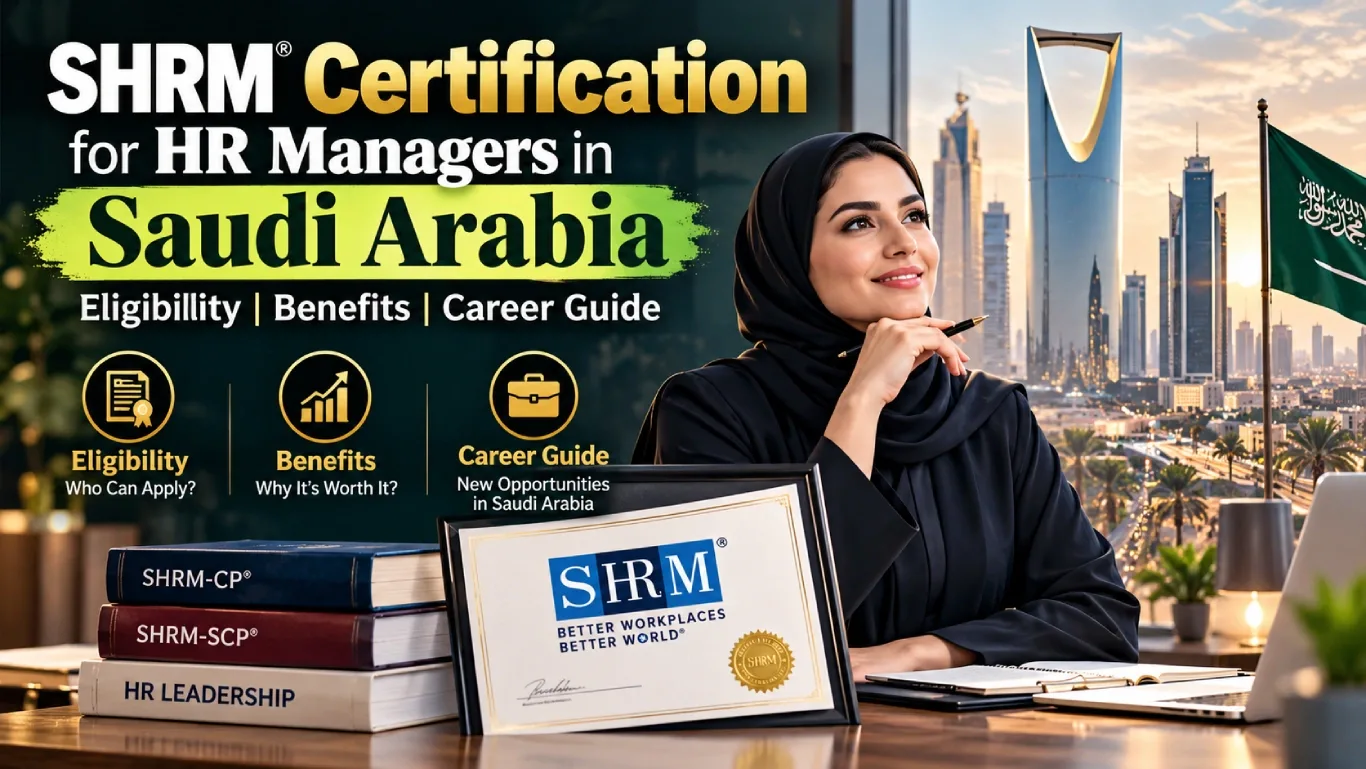
The SHRM Certification For HR Managers in Saudi Arabia is a significant tool of career and professional development that helps one improve HR skills, showcases professional skills and, besides, helps the applicant adopt a more strategic approach to managing people matters.
The SHRM certificate, which is the certification programme by the Society for Human Resource Management (SHRM), gives you the opportunity to qualify for two types of SHRM certificate programmes, which are SHRM Certified Professional (SHRM-CP) and SHRM Senior Certified Professional (SHRM-SCP).
The certifications are both competency-oriented, but there are differences in the responsibilities that are covered by these two professional titles.
HR professionals in Saudi Arabia who get to understand these two types of certifications may use that knowledge to make their decisions concerning professional development, direction of their careers and, finally, the long-term capacities of their HR departments.
This article gives us a glimpse of the certification requirements, the eligibility criteria, how to prepare for the exam, the professional advantages and the ways HR managers can apply their learning to the business culture in Saudi Arabia.
What Is SHRM Certification?
The Society for Human Resource Management (SHRM) is a global professional organisation focused on advancing human resource management and workplace practices.
SHRM offers professional certifications designed to validate the knowledge and competencies required to perform HR responsibilities effectively.
Unlike a qualification focused only on theoretical HR concepts, SHRM certification uses a competency-based approach that considers how HR professionals apply their knowledge in real workplace situations.
The programme evaluates areas such as :
- HR strategy and business alignment
- Talent acquisition and management
- Employee engagement and retention
- Learning and development
- Leadership and interpersonal effectiveness
- Organisational development
- Workforce management
- Employee and labour relations
- HR technology and workplace practices
- Total rewards and compensation
The foundation of the certification programme is the SHRM Body of Applied Skills and Knowledge (SHRM BASK).
It provides a structured framework covering the behavioural competencies and technical HR knowledge expected of effective HR professionals.
For professionals in Saudi Arabia, this framework can provide a useful foundation for developing HR capabilities that support both organisational requirements and international HR practices.
Why Is SHRM Certification Relevant for HR Managers in Saudi Arabia?
Saudi Arabia’s business environment is experiencing significant organisational and workforce transformation. Companies across healthcare, construction, financial services, manufacturing, hospitality, technology and professional services are adapting their workforce strategies to changing business requirements.
This has increased the importance of HR professionals who can connect people management with wider organisational objectives.
SHRM certification can support this professional development in several ways.
1. Develop a More Strategic Approach to HR Management
Modern HR management involves more than recruitment, employee records and policy administration.
HR leaders are increasingly expected to participate in business planning, organisational development, workforce decisions and leadership discussions.
SHRM’s competency-based framework helps professionals understand how HR activities connect with organisational objectives.
For example, an HR manager may need to :
- Align workforce planning with business expansion.
- Develop structured talent management practices.
- Evaluate leadership and management capabilities.
- Improve performance management frameworks.
- Support organisational restructuring.
- Develop people-related policies and processes.
This broader perspective can help HR professionals contribute more effectively to management decisions.
2. Strengthen Professional HR Competencies
HR managers regularly deal with complex workplace situations involving employees, managers and organisational priorities.
A structured professional development framework can help strengthen their understanding of:
- Ethical HR decision-making.
- Employee and labour relations.
- Talent management.
- HR strategy.
- Leadership effectiveness.
- Organisational development.
- Workforce management.
SHRM certification assesses both HR knowledge and the ability to apply professional judgement to workplace situations.
This makes it relevant for professionals who want to develop their practical HR capabilities alongside their theoretical understanding.
3. Understand International HR Practices
Saudi Arabia has a diverse workforce environment, with organisations employing professionals from different countries and professional backgrounds.
HR managers need to understand how to create consistent people management practices while considering local employment requirements and organisational policies.
International HR frameworks can help professionals develop a wider understanding of workplace practices, employee management and organisational effectiveness.
However, international HR certification should complement, not replace, knowledge of Saudi labour legislation and applicable local regulations.
4. Improve Leadership and Business Decision-Making
HR professionals often work with senior management on decisions involving workforce structure, employee development, performance and organisational change.
A stronger understanding of leadership and business competencies can help HR managers communicate workforce challenges more effectively.
It can also support their ability to:
- Present HR recommendations using business context.
- Evaluate workforce-related risks.
- Support leadership development.
- Contribute to organisational transformation.
- Connect talent strategies with business priorities.
5. Support Long-Term Professional Development
Professional HR development does not end after obtaining a certification.
HR managers need to continue developing their knowledge as workforce expectations, technology, organisational structures and employment practices evolve.
SHRM certification includes a recertification process that encourages continuous professional development.
This creates an ongoing learning structure rather than treating certification as a one-time achievement.
Understanding the Two Main SHRM Certifications: SHRM-CP vs SHRM-SCP
One of the most important decisions for HR professionals is selecting the certification that matches their current responsibilities and professional experience.
SHRM offers two main credentials.
SHRM-CP: SHRM Certified Professional
The SHRM-CP certification is designed for professionals performing operational HR or HR-related responsibilities.
It is also suitable for individuals pursuing a career in human resource management.
The certification focuses on the practical application of HR knowledge in areas such as:
- HR operations.
- Employee support.
- Policy implementation.
- Recruitment and talent acquisition.
- Employee relations.
- HR service delivery.
- Day-to-day people management.
Who should consider SHRM-CP?
- HR Executives.
- HR Officers.
- HR Generalists.
- HR Coordinators.
- Recruitment Specialists.
- HR professionals developing their careers.
- Professionals performing operational HR responsibilities.
According to SHRM’s published eligibility criteria, candidates do not need a degree or previous HR experience to apply for SHRM-CP. However, basic working knowledge of HR practices is recommended.
SHRM-SCP: SHRM Senior Certified Professional
The SHRM-SCP certification is designed for experienced HR professionals working at a strategic level.
It focuses on professionals who develop HR strategies, lead integrated HR operations and connect workforce decisions with organisational objectives.
Its areas of relevance include :
- Strategic HR management.
- HR policy and strategy development.
- Organisational effectiveness.
- Workforce planning.
- Leadership and organisational development.
- Strategic talent management.
- HR governance and decision-making.
Who should consider SHRM-SCP?
- HR Directors.
- HR Managers with strategic responsibilities.
- CHROs.
- Senior HR Business Partners.
- HR Consultants.
- Heads of Human Resources.
- Senior organisational development professionals.
SHRM’s standard eligibility criteria require at least three years of strategic-level HR or HR-related experience, with at least 1,000 hours of qualifying strategic work per calendar year.
Alternatively, eligible SHRM-CP holders who have held the credential for at least three years and are working in or transitioning to a strategic-level role may qualify.
SHRM-CP vs SHRM-SCP : Key Differences
| Comparison | SHRM-CP | SHRM-SCP |
| Full Form | Certified Professional | Senior Certified Professional |
| Main Focus | Operational HR | Strategic HR |
| Career Level | Early to mid-career or operational | Experienced and strategic |
| HR Responsibilities | Policy implementation and HR operations | HR strategy and organisational leadership |
| Experience Requirement | No mandatory experience requirement | Three years of strategic HR experience or qualifying SHRM-CP pathway |
| Primary Objective | Strengthen practical HR capabilities | Demonstrate strategic HR competencies |
The right certification should be selected according to actual job responsibilities rather than job title alone.
Official eligibility requirements should always be checked before applying.
SHRM Certification Eligibility Requirements for HR Professionals in Saudi Arabia
HR professionals based in Saudi Arabia can apply for SHRM certification through SHRM’s official application process, subject to the applicable eligibility criteria and examination requirements.
SHRM-CP Eligibility
Candidates applying for SHRM-CP :
- Must perform HR or HR-related duties, or be pursuing a career in HR.
- Do not need a mandatory university degree.
- Do not need a specified number of years of HR experience.
- Should have a basic understanding of HR principles and practices.
SHRM-SCP Eligibility
Candidates applying for SHRM-SCP must meet one of the recognised eligibility pathways.
These include :
- At least three years of strategic-level HR or HR-related work.
- At least 1,000 hours of qualifying strategic HR work per calendar year.
- Alternatively, holding SHRM-CP for at least three years while working in or transitioning to a strategic-level role.
SHRM may request supporting documentation as part of its application audit process.
Professionals should review the official requirements before selecting an examination.
For the latest information, refer to the SHRM Certification Eligibility Criteria.
What Is the SHRM BASK Framework?
The SHRM Body of Applied Skills and Knowledge, commonly known as SHRM BASK, is the foundation of the SHRM certification programme.
It describes the behavioural competencies and technical HR knowledge required for effective professional performance.
Understanding SHRM BASK is important because the certification examination evaluates more than the ability to remember HR definitions.
It also examines how candidates interpret workplace situations and select appropriate HR responses.
1. Behavioural Competencies
SHRM BASK includes important behavioural competencies that influence how HR professionals work with people and organisations.
These include :
Leadership: Understanding how to guide people, influence decisions and support organisational objectives.
Business: Understanding business operations, organisational strategy and the commercial environment in which HR functions operate.
Interpersonal: Building professional relationships, communicating effectively and working collaboratively.
SHRM also identifies key behavioural competencies such as :
- Ethical Practice.
- Communication.
- Relationship Management.
- Consultation.
- Critical Evaluation.
- Global Mindset.
- Leadership and Navigation.
- Business Acumen.
2. HR Technical Knowledge
The technical HR component covers three broad domains.
People
Includes HR strategy, talent acquisition, employee engagement and retention, learning and development, and total rewards.
Organisation
Includes HR function structure, organisational effectiveness and development, workforce management, employee and labour relations, and technology management.
Workplace
Includes workplace-related knowledge and practices that support effective HR operations and organisational performance.
Together, these areas help HR professionals develop a broader understanding of modern human resource management.
Candidates should use the latest official SHRM BASK as their primary examination preparation reference.
SHRM Certification Exam Process in Saudi Arabia
Understanding the certification process before applying can help candidates plan their preparation and examination schedule.
SHRM follows a structured certification journey.
Step 1: Select the Appropriate Certification
Review the eligibility criteria and understand the difference between SHRM-CP and SHRM-SCP.
Consider your current HR responsibilities, experience and professional objectives.
Step 2: Prepare Using SHRM BASK
The SHRM BASK should be the foundation of your preparation.
Candidates can explore official SHRM preparation resources, including self-study materials, instructor-led preparation and team-based learning options.
A structured study plan should cover both behavioural competencies and technical HR knowledge.
Step 3: Complete the Application
Submit the certification application during an available examination application period.
Candidates should review the current application deadlines, fees and supporting requirements on SHRM’s official website.
Step 4: Schedule the Examination
SHRM-CP and SHRM-SCP examinations are delivered in person through authorised Prometric testing centres.
Candidates receive an Authorisation to Test after completing the relevant application requirements.
They can then schedule their examination according to the available testing arrangements.
Step 5: Take the Examination
The examination includes knowledge-based questions and situational judgement questions.
Situational judgement questions present workplace scenarios and assess how candidates evaluate possible HR responses.
This makes practical understanding and professional decision-making important parts of examination preparation.
Step 6: Maintain Your Certification
After successfully obtaining the credential, professionals need to meet SHRM’s recertification requirements to maintain their certification.
The process encourages continued learning and professional development.
Is SHRM Certification Available in Arabic in Saudi Arabia?
Yes. SHRM offers Arabic-language examinations for eligible candidates residing in designated Arabic-speaking countries, including Saudi Arabia.
This is particularly relevant for HR professionals who prefer to demonstrate their HR knowledge in Arabic.
Some important points to understand:
- Arabic examinations are available only at in-person Prometric testing centres.
- SHRM has also translated the SHRM BASK into Arabic.
- Eligible candidates residing in Saudi Arabia can take the Arabic examination.
- Candidates can request the English examination instead by contacting SHRM in writing.
The availability of examination appointments and applicable testing arrangements should be confirmed with SHRM and Prometric before applying.
This language option makes SHRM certification more accessible to eligible Arabic-speaking HR professionals while retaining the same professional certification framework.
How Should HR Managers Prepare for the SHRM Certification Exam?
Preparing for SHRM certification requires a structured approach.
Rather than focusing only on memorising definitions, candidates should understand how HR concepts apply to practical organisational situations.
Here are some useful preparation practices.
1. Understand the SHRM BASK Domains
Begin by reviewing the official competency framework.
Understand the relationship between behavioural competencies and technical HR knowledge.
This will help you organise your preparation around the actual examination framework.
2. Develop a Consistent Study Schedule
Divide your preparation into manageable learning areas.
For example:
| Study Area | Preparation Focus |
| HR Strategy | Business alignment and strategic planning |
| Talent Management | Recruitment, retention and development |
| Employee Relations | Workplace issues and professional judgement |
| Leadership | Influence, decision-making and management |
| HR Analytics | Workforce data and evidence-based decisions |
| Organisational Development | Structure, culture and effectiveness |
| Total Rewards | Compensation and benefits principles |
Your schedule should reflect your existing knowledge and the requirements of your selected examination.
3. Practise Situational Judgement Questions
Situational judgement questions require candidates to evaluate workplace scenarios and select the most appropriate response.
For example, consider a situation where an organisation is experiencing repeated employee turnover in a particular department.
An HR professional may need to evaluate management practices, employee feedback, recruitment quality, workload and career development opportunities before recommending an action.
Practising this type of reasoning can help candidates develop stronger HR decision-making skills.
4. Connect HR Theory with Workplace Experience
Candidates with practical HR experience should relate their learning to actual organisational responsibilities.
Examples include:
- Developing HR policies.
- Supporting recruitment decisions.
- Managing employee relations.
- Evaluating performance management.
- Supporting leadership development.
- Reviewing workforce requirements.
This makes the learning process more meaningful and helps candidates understand how HR concepts work in practice.
5. Use Official Preparation Resources
Candidates should prioritise SHRM’s official study resources and current certification handbook.
Useful starting points include:
- SHRM Body of Applied Skills and Knowledge.
- SHRM Certification Handbook.
- SHRM Certification Exam Preview.
- Official SHRM preparation programmes.
Explore the official SHRM certification resources before finalising your preparation plan.
How Can SHRM Certification Support HR Career Development in Saudi Arabia?
SHRM certification can contribute to professional credibility and demonstrate a commitment to developing HR knowledge.
However, career progression depends on several factors, including practical experience, professional capabilities, organisational requirements and the ability to deliver business value.
Here are some areas where the credential may support professional development.
HR Managers and HR Business Partners
Professionals working in HR management or business partnering can use the SHRM competency framework to strengthen their understanding of workforce strategy, employee relations and organisational effectiveness.
Talent Acquisition and Talent Management Professionals
SHRM’s technical knowledge areas provide exposure to talent acquisition, retention, learning and development, and broader people management practices.
HR Directors and Senior HR Leaders
For senior professionals, SHRM-SCP provides a framework relevant to strategic HR responsibilities, leadership and alignment between workforce strategy and business objectives.
HR Consultants
HR consultants can use the professional knowledge framework to strengthen their understanding of HR strategy, organisational development, workforce management and people-related business challenges.
It is important to remember that certification does not guarantee employment, promotion or a particular salary. Its value depends on how professionals combine the credential with relevant experience and practical capabilities.
SHRM Certification vs Saudi HR Compliance: Understanding the Difference
An important consideration for HR professionals in Saudi Arabia is the difference between international HR certification and local employment compliance.
SHRM certification demonstrates professional HR knowledge and competencies.
However, it does not replace the need to understand Saudi labour laws, applicable Ministry of Human Resources and Social Development requirements, Saudization policies or Nitaqat-related obligations.
For example, HR managers working in Saudi Arabia may need to understand:
- Saudi Labour Law and relevant implementing regulations.
- Employment contract requirements.
- Saudization and workforce nationalisation policies.
- Nitaqat classification requirements.
- Employee documentation and HR procedures.
- Applicable workplace policies.
- Relevant employment and social insurance obligations.
These areas require country-specific knowledge and should be reviewed using current official Saudi government sources.
An effective HR professional development strategy should combine international HR frameworks with practical understanding of the local regulatory environment.
Why Continuous Professional Development Matters After SHRM Certification
Obtaining SHRM certification is an important professional milestone, but maintaining the credential requires continued learning.
SHRM requires certified professionals to recertify every three years.
There are two recognised options:
Option 1: Earn Professional Development Credits (PDCs)
Candidates must earn 60 Professional Development Credits within their three-year recertification cycle.
Eligible activities can fall into three categories:
- Advance Your Education.
- Advance Your Organization.
- Advance Your Profession.
Option 2: Retake the Certification Examination
Credential holders can also maintain their certification by retaking the examination within the permitted period during their recertification cycle.
Professionals should maintain records of qualifying development activities and check their recertification deadlines through the official SHRM certification portal.
For complete details, visit SHRM Recertification Requirements.
Building a Stronger HR Career with the Right Professional Development Strategy
SHRM certification is one part of a broader professional development journey.
For HR managers working in Saudi Arabia, long-term professional growth also depends on understanding the business environment, developing leadership capabilities and applying HR knowledge to organisational challenges.
A well-rounded HR development strategy may include:
- Strategic workforce planning.
- Performance management framework development.
- Leadership and management development.
- Succession planning.
- Employee and labour relations.
- Total rewards and compensation.
- Organisational development.
- HR analytics and digital transformation.
Combining these capabilities can help HR professionals move beyond routine administration and contribute more effectively to organisational decisions.
For organisations, investing in HR capability development can also support more consistent people management practices and stronger workforce planning.
How Rooted HR Supports Strategic HR Development in Saudi Arabia
Developing an effective HR function requires a combination of professional knowledge, practical experience and an understanding of organisational requirements.
Rooted HR focuses on strategic HR consultancy and people management capabilities that help organisations strengthen their HR practices.
Its wider HR consultancy services cover areas such as:
- Strategic workforce planning.
- Performance management.
- Total rewards.
- HR policies and procedures.
- Strategic learning and competency frameworks.
- Organisational restructuring and transformation.
- Employee satisfaction, engagement and surveys.
These areas are closely connected to the broader competencies required in modern strategic human resource management.
For organisations looking to improve their people management practices, a structured HR strategy can help connect workforce capabilities with business priorities.
Explore Rooted HR’s HR consultancy services to learn about its service areas.
You can also visit About Rooted HR to understand its approach to strategic HR consultancy.
Note: Rooted HR’s consultancy services should not be confused with official SHRM certification, examination administration or an authorised SHRM training programme. Candidates should verify any certification or training provider’s official status directly with SHRM.
Frequently Asked Questions About SHRM Certification in Saudi Arabia
1. Is SHRM certification recognised internationally?
SHRM-CP and SHRM-SCP are professional HR credentials offered by SHRM. They are used to demonstrate HR knowledge and competencies to employers and professional networks. Recognition and relevance may vary according to employer and role requirements.
2. Can HR managers in Saudi Arabia apply for SHRM certification?
Yes. Professionals residing in Saudi Arabia can apply for SHRM certification through the official application process, provided they meet the applicable eligibility requirements.
3. What is the difference between SHRM-CP and SHRM-SCP?
SHRM-CP focuses on operational HR responsibilities, while SHRM-SCP is designed for professionals performing strategic-level HR work. The appropriate choice depends on professional experience and actual job responsibilities.
4. Is a degree compulsory for SHRM-CP certification?
No. SHRM’s published eligibility criteria do not require a university degree or previous HR experience for SHRM-CP applicants. Basic knowledge of HR practices is recommended.
5. How much HR experience is required for SHRM-SCP?
The standard pathway requires at least three years of strategic-level HR or HR-related experience, including at least 1,000 hours of qualifying work per calendar year. An alternative pathway is available for qualifying SHRM-CP holders.
6. Can I take the SHRM certification exam in Arabic in Saudi Arabia?
Yes. Eligible residents of Saudi Arabia can take the Arabic-language SHRM examination at an in-person Prometric testing centre. The English examination can also be requested in writing.
7. What is SHRM BASK?
SHRM BASK stands for SHRM Body of Applied Skills and Knowledge. It is the framework that defines the behavioural competencies and technical HR knowledge assessed through SHRM certification.
8. How long is SHRM certification valid?
SHRM certification requires recertification every three years. Credential holders can earn 60 Professional Development Credits during the three-year cycle or retake the certification examination under SHRM’s applicable rules.
9. Does SHRM certification help HR managers in Saudi Arabia?
It can strengthen professional HR knowledge, demonstrate competency and support career development. However, employment opportunities and career progression also depend on practical experience, employer requirements and individual capabilities.
10. Does SHRM certification replace Saudi Labour Law knowledge?
No. SHRM certification is an international professional HR credential. It does not replace the need to understand Saudi Labour Law, Saudization requirements, Nitaqat or other applicable local regulations.
Conclusion: Take a More Strategic Approach to Your HR Career
Human Resource Management is becoming increasingly connected to business strategy, organisational effectiveness and workforce development.
For HR managers in Saudi Arabia, developing these capabilities is important for managing changing workforce expectations and contributing to long-term organisational objectives.
The SHRM-CP and SHRM-SCP certifications offer structured professional development pathways for HR practitioners at different career and responsibility levels.
Whether you are developing your HR career, managing people operations or leading strategic workforce initiatives, selecting the right certification can be a valuable step towards strengthening your professional capabilities.
However, the real value of professional certification comes from applying what you learn in the workplace.
Combine recognised HR competencies with practical experience, knowledge of Saudi employment requirements and a commitment to continuous development to build a stronger foundation for your HR career.
Looking to strengthen your organisation’s HR capabilities in Saudi Arabia? Explore Rooted HR’s strategic HR consultancy services to understand how structured HR practices can support organisational effectiveness and workforce development.