Business relationships move faster when information moves without friction. Suppliers today manage purchase orders, product details, shipping updates, invoices, and confirmations across multiple systems, and even a small data issue can slow down an entire workflow. Omega EDI provides a structured approach to electronic business communication, while AutoZone EDI helps suppliers exchange transaction information efficiently within the automotive retail environment. When these processes are integrated properly, companies can reduce repetitive work, improve accuracy, and give their teams more time to focus on meaningful operational decisions.
Why EDI Matters in Everyday Operations
Electronic Data Interchange allows businesses to exchange standardized documents directly between their systems. Instead of manually transferring information through emails, spreadsheets, or paper records, organizations can automate recurring transactions.
Consider a typical supplier workflow. A purchase order arrives, someone enters the details into an internal application, the warehouse prepares the products, shipping information is created, and an invoice is eventually sent. When each stage depends heavily on manual intervention, delays and mistakes can easily appear.
EDI helps connect these stages. Information can travel between systems according to predefined rules, creating a more organized transaction cycle.
The benefit is not just speed. A connected process also makes routine work easier to manage and gives employees a clearer view of what is happening.
Understanding Omega EDI
Suppliers and businesses often work with different platforms, customer requirements, and transaction formats. Managing those differences manually can become difficult as relationships and order volumes expand.
Omega EDI can support electronic communication by allowing relevant business documents to move between connected systems in a structured manner. Depending on the business arrangement, this may involve purchase orders, order acknowledgments, shipping notices, invoices, and other transaction records.
For an organization, the important part is how this exchange fits into its existing technology.
An EDI connection can be linked with an ERP, accounting application, warehouse-management platform, or order-processing system. This allows information to flow into the appropriate environment rather than requiring employees to repeatedly enter the same details.
A thoughtfully designed setup can therefore become part of the company’s daily workflow instead of another separate task.
How AutoZone EDI Supports Automotive Suppliers
Automotive retail requires accurate coordination between suppliers, distribution operations, and retail channels. Product information, quantities, fulfillment details, and billing records all need to remain consistent.
AutoZone EDI provides a structured electronic communication method for suppliers exchanging business information with AutoZone. Depending on the specific trading relationship, electronic transactions may include purchase orders, acknowledgments, shipment information, invoices, and related documents.
For suppliers handling frequent transactions, automation can make a noticeable difference. Instead of manually processing every document, recurring exchanges can follow established workflows.
Employees can then concentrate on exceptions, inventory concerns, customer requirements, and other situations where human involvement adds real value.
Benefits of EDI Integration
Faster Transaction Processing
Electronic communication removes many unnecessary steps from routine document handling. Information can move between connected systems quickly, helping teams respond to business activity without waiting for manual entry.
Fewer Data Entry Errors
Typing information repeatedly into separate applications creates opportunities for mistakes. Incorrect item numbers, quantities, pricing, or shipping details can result in additional work. Automated transfer reduces unnecessary duplication.
Lower Administrative Workload
Teams often spend hours managing files, spreadsheets, emails, and repetitive records. An integrated EDI workflow can handle many of these routine responsibilities automatically.
Better Visibility
A properly monitored environment can provide greater insight into transaction activity. Teams can identify failed exchanges, missing documents, or processing exceptions sooner.
Greater Scalability
As order volumes increase, manual processes can become harder to maintain. Automation provides a stronger foundation for handling additional transactions without creating the same increase in administrative pressure.
Connecting EDI with Your Existing Systems
One of the most important parts of an EDI project is integration. Businesses already have systems that contain valuable information, and the EDI environment should work alongside them.
An ERP may store customer and product information. Warehouse software may manage fulfillment. Accounting applications may handle invoices and payments. EDI connects these internal processes with external trading partners.
Data mapping plays an important role here. Information stored in one application may use a different structure from the format required by a trading partner. Proper mapping ensures that the right data reaches the right field.
Testing is equally important. Before live transactions begin, businesses should verify document structure, data accuracy, transmission, and processing behavior.
Why Cogential IT for EDI Solutions?
Cogential IT helps businesses build EDI integrations around their existing operational and technical requirements. Instead of forcing companies into a rigid setup, the integration process can consider their current software, transaction types, connectivity needs, and workflow.
Services can include EDI mapping, data transformation, connectivity, testing, monitoring, and ongoing technical assistance.
For businesses working with Omega EDI or AutoZone EDI, experienced support can simplify the technical side of electronic transaction management.
The objective is to create a reliable connection that works in the background while business teams retain the visibility and control they need.
Making the Order Cycle More Connected
EDI becomes especially useful when multiple transaction stages work together.
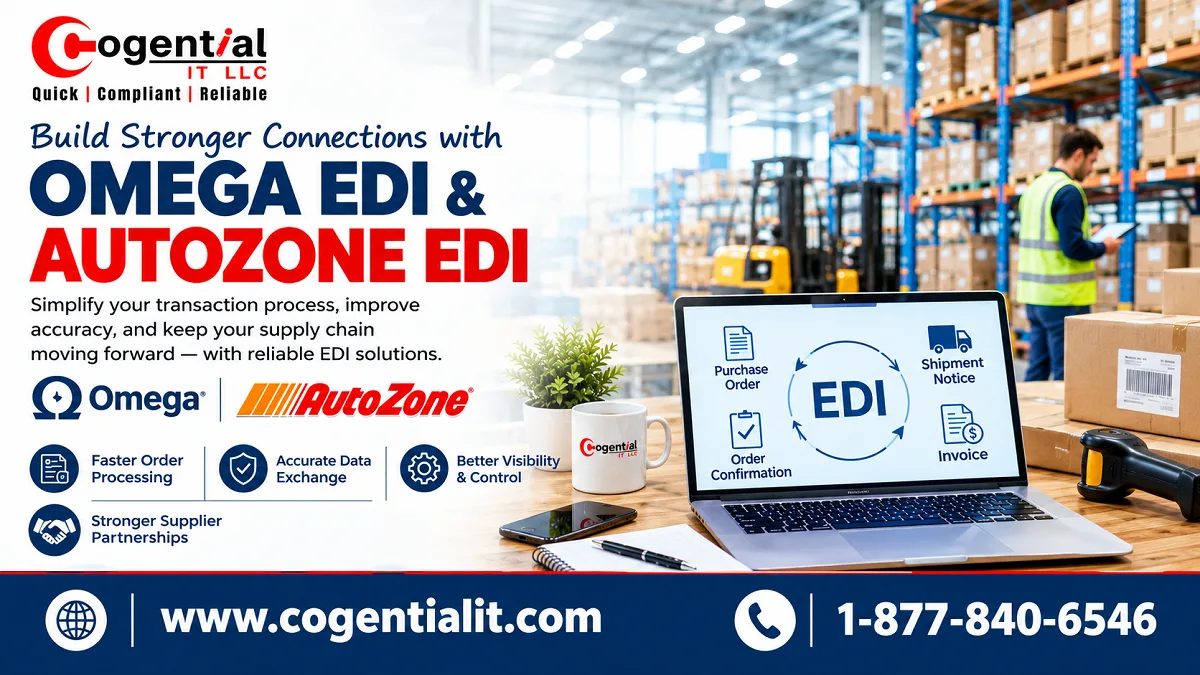
A purchase order can enter the internal system, an acknowledgment can be generated, fulfillment can begin, shipment information can be communicated, and billing can continue through the appropriate workflow.
Without integration, employees may have to move information manually between applications at every stage. Each additional touchpoint creates another opportunity for delay.
A connected environment creates a repeatable process. Routine transactions follow established rules, while unusual situations can be directed to the appropriate employee.
This combination of automation and human oversight creates a practical balance for modern businesses.
What to Consider Before Implementing EDI
Choosing an EDI solution is only the beginning. Businesses should understand their trading-partner requirements, document types, data fields, validation rules, connectivity methods, and internal applications.
Testing should be completed before production activity starts. This helps confirm that information is mapped correctly and documents are being exchanged as expected.
Ongoing monitoring is also valuable. Software updates, changing business requirements, and unexpected transaction conditions can affect an established connection. Consistent oversight helps identify potential problems early.
Frequently Asked Questions
1. What is Omega EDI?
Omega EDI refers to the electronic exchange of standardized business information through an EDI environment. Depending on the business relationship, this can include orders, acknowledgments, shipment details, invoices, and other transaction documents.
2. What does AutoZone EDI help suppliers with?
AutoZone EDI helps suppliers exchange business transaction information electronically with AutoZone. It can support different stages of the order and fulfillment process based on applicable trading requirements.
3. Can EDI connect to an existing ERP?
Yes. EDI can integrate with many ERP, accounting, warehouse, and order-management platforms. The appropriate configuration depends on the company’s existing technology and transaction requirements.
Conclusion
Efficient business communication is about more than sending documents from one system to another. It is about creating a dependable process where information reaches the right place at the right stage with minimal unnecessary intervention. Omega EDI and AutoZone EDI can help suppliers build that kind of connected workflow while reducing repetitive administrative responsibilities.
With Cogential IT, businesses can approach EDI as a practical part of their technology ecosystem rather than a complicated standalone project. When systems, data, and people work together effectively, routine transactions become easier to manage—and the business gains a stronger foundation for handling whatever comes next.