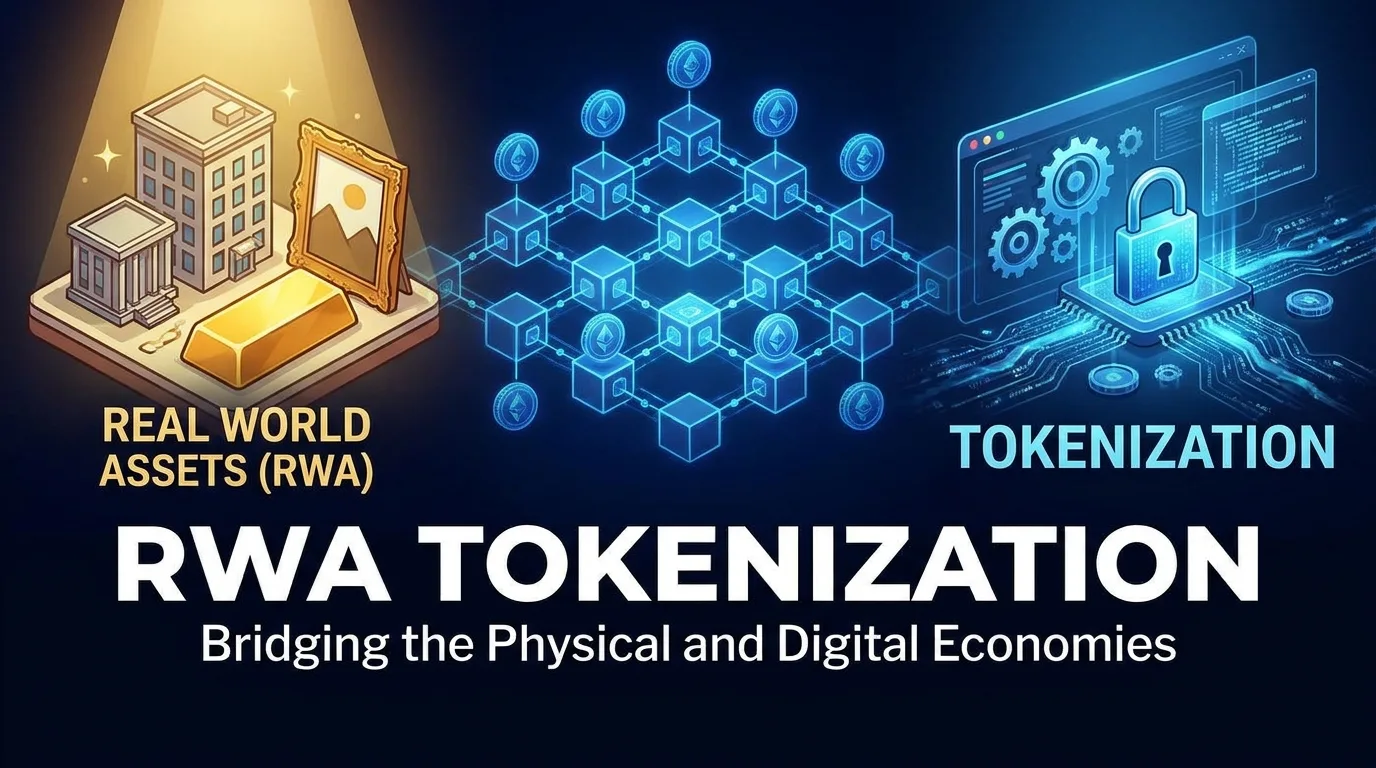
Real-world asset tokenization has moved from an experimental blockchain concept to one of the most closely watched developments in global finance. In simple terms, RWA tokenization is the process of representing ownership rights, income rights, or economic exposure to physical or traditional financial assets through blockchain-based tokens. These assets can include real estate, private credit, government bonds, commodities, invoices, funds, carbon credits, art, infrastructure assets, and other instruments that historically depended on paper-based records, centralized intermediaries, and slow settlement cycles.
The momentum behind tokenization is not only coming from crypto-native firms. Major financial institutions are now testing or deploying tokenized products because blockchain infrastructure can make asset issuance, ownership transfer, compliance tracking, settlement, and investor reporting more efficient. McKinsey has projected that tokenized financial assets could reach about $2 trillion by 2030 under its base-case outlook, while emphasizing that adoption will likely concentrate first in asset classes where tokenization solves real operational problems rather than merely adding a digital wrapper.
Why RWA Tokenization Matters in 2026
The strongest argument for RWA tokenization is not that every asset should immediately move on-chain. The real value lies in making assets more programmable, transparent, divisible, and accessible. Traditional assets are often difficult to trade because ownership records are fragmented across custodians, transfer agents, registries, banks, brokers, and legal documents. Tokenization can bring many of these processes into a shared digital environment where smart contracts automate investor eligibility, transfer restrictions, dividend distribution, redemption workflows, and audit trails.
This is where businesses often begin searching for an experienced RWA tokenization development company that can translate legal, financial, and operational requirements into a working blockchain product. A serious tokenization project needs more than a token contract. It requires asset structuring, compliance logic, investor onboarding, custody integration, token standards, wallet infrastructure, admin dashboards, secondary-market planning, and lifecycle management. Enterprises that choose professional RWA tokenization development services can reduce development risk because the technical system must align with securities laws, asset ownership rules, investor rights, and jurisdiction-specific compliance requirements. Similarly, rwa tokenization platform development should be approached as a full-stack financial infrastructure project rather than a simple Web3 launch.
The market is already showing signs of institutional validation. RWA.xyz reported a distributed asset value of about $27.65 billion and represented asset value of more than $441 billion in its global market overview, highlighting the growing scale of tokenized real-world assets and related ecosystems. BlackRock’s BUIDL fund, launched in 2024 as its first tokenized fund on a public blockchain, gave qualified investors exposure to U.S. dollar yields through a tokenized institutional liquidity product. Franklin Templeton’s OnChain U.S. Government Money Fund also demonstrates how fund recordkeeping and share ownership can be integrated with blockchain-based systems; the fund reported total net assets of $813.50 million as of May 31, 2026.
Step 1: Selecting the Right Asset for Tokenization
Asset selection is the foundation of any RWA tokenization project. Not every asset benefits equally from being tokenized. The best candidates usually share several characteristics: they have recognizable value, legal ownership can be clearly documented, they generate cash flow or have credible market demand, and they suffer from inefficiencies in traditional transfer or settlement processes.
Real estate is one of the most popular examples because it is valuable, familiar, and traditionally illiquid. Tokenization can divide a property or real estate fund into smaller digital units, allowing qualified investors to participate with lower minimum investment thresholds. Deloitte has predicted that tokenized real estate could grow from less than $0.3 trillion in 2024 to $4 trillion by 2035, showing how large the opportunity could become if regulatory and market infrastructure mature.
Private credit is another strong use case because loan portfolios, trade finance instruments, and receivables can benefit from improved transparency, automated servicing, and broader investor distribution. Tokenized U.S. Treasuries and money market funds have grown quickly because they offer a bridge between conservative financial products and blockchain-native settlement. Commodities such as gold are also suitable because the underlying asset can be stored with a custodian while tokens represent claims against reserves.
However, asset selection must be realistic. A rare painting, a luxury villa, or a private company share can be tokenized technically, but that does not guarantee investor demand or secondary liquidity. The asset must have clear valuation methods, legal transferability, credible custody arrangements, and a practical reason for investors to hold the token.
Step 2: Building the Legal and Ownership Structure
RWA tokenization is fundamentally a legal design problem before it is a technology problem. A token must represent something enforceable. That could be equity in a special purpose vehicle, units in a fund, debt claims, revenue-sharing rights, beneficial ownership, warehouse receipts, or contractual rights against an issuer. Without a legally recognized link between the token and the underlying asset, the token may have little real-world enforceability.
This is why many tokenization projects use special purpose vehicles or fund structures. For example, a real estate asset may be held by a company, and investors receive tokens representing shares or economic interests in that company. In a private credit structure, tokens may represent participation in a loan pool or note. In commodity tokenization, tokens may represent redeemable claims against physical reserves held by an approved custodian.
Regulatory classification is equally important. In the United States and many other markets, tokenized securities remain securities. The SEC has stated that securities represented on blockchain or distributed ledger technology are still subject to federal securities laws and regulations. This means issuers must consider registration, exemptions, investor accreditation, resale restrictions, disclosures, transfer agents, broker-dealer involvement, anti-money laundering controls, and custody requirements.
A compliant RWA project therefore needs legal counsel from the earliest planning stage. The development team, issuer, custodian, compliance advisors, and legal team must work together to decide what the token represents, who can buy it, where it can be traded, how transfers are restricted, and what happens during redemption or liquidation.
Step 3: Designing the Token Economics and Investor Rights
Once the legal structure is clear, the next step is designing token economics. This includes token supply, pricing, minimum purchase size, revenue distribution, redemption rights, governance rights, lock-up periods, investor categories, and transfer rules. Unlike speculative utility tokens, RWA tokens should be tied to measurable asset value or cash flow.
For example, a tokenized rental property may distribute income from rent after expenses. A tokenized Treasury fund may pass through yield. A tokenized invoice pool may distribute repayment proceeds. A tokenized commodity may allow redemption under defined conditions. The token design must answer practical investor questions: What does the token entitle me to? How is value calculated? Who verifies the asset? How do I exit? What risks do I bear?
This is also where transparency becomes a competitive advantage. Investors need access to asset documentation, valuation updates, reserve reports, payment history, smart contract audits, and issuer disclosures. A well-built platform should provide dashboards for token holders and administrators so that ownership, income distribution, asset performance, and compliance status can be monitored in near real time.
Step 4: Choosing the Blockchain and Token Standard
Blockchain selection should depend on security, ecosystem support, compliance functionality, transaction cost, settlement speed, institutional acceptance, and interoperability. Ethereum remains a dominant network for institutional tokenization because of its liquidity, developer ecosystem, and mature token standards. However, Layer 2 networks and permissioned environments are also gaining attention because they can offer lower fees, faster transactions, privacy controls, and regulated access.
Token standards matter because they define how tokens behave. ERC-20 may be suitable for fungible assets, while ERC-721 or ERC-1155 can support unique or semi-fungible assets. Security-token standards and permissioned token frameworks can add compliance features such as whitelisting, transfer restrictions, identity verification, and jurisdictional controls.
The choice is not only technical. A tokenized private credit product may require strict investor whitelisting. A tokenized real estate platform may need fractional ownership and income distribution features. A tokenized fund may need subscription and redemption workflows. The blockchain architecture must support the business model rather than forcing the business model to fit a generic token template.
Step 5: Developing Smart Contracts and Platform Infrastructure
Smart contracts are the operational engine of an RWA tokenization system. They can automate issuance, transfer validation, investor whitelisting, dividend distribution, redemption, burning, cap table updates, and compliance checks. However, smart contracts must be carefully designed because errors can create legal, financial, and reputational damage.
A complete RWA tokenization platform typically includes:
- Investor onboarding with KYC and AML verification
- Admin dashboard for issuers and asset managers
- Token minting, burning, and transfer management
- Smart contract-based compliance controls
- Wallet and custody integration
- Payment gateway or stablecoin settlement support
- Asset documentation and reporting modules
- Secondary trading or marketplace integration
- Audit logs and analytics
Security audits are essential before deployment. The platform should also include role-based access controls, emergency pause functions, upgrade governance, oracle security, data privacy protections, and disaster recovery planning. Since RWA projects connect on-chain tokens with off-chain assets, operational controls must cover both environments.
Step 6: Custody, Oracles, and Off-Chain Verification
One of the biggest misconceptions about RWA tokenization is that blockchain alone proves the value of the asset. In reality, the blockchain records token activity, but the underlying asset still exists off-chain. This means custody, verification, and data integrity are critical.
If the asset is real estate, ownership documents, land records, insurance, valuations, and property management reports must be maintained. If the asset is gold, the reserve must be stored, audited, and insured. If the asset is a loan portfolio, repayment data and borrower performance must be verified. Oracles may be used to bring off-chain information on-chain, but they must rely on trusted data sources.
Recent academic research on RWA systems notes that many current implementations are hybrid architectures: tokens support transfers, redemption, pricing, and on-chain composability, while legal rights and guarantees remain anchored in off-chain legal wrappers, custodians, compliance processes, and verification mechanisms. This hybrid reality is important. Successful tokenization does not eliminate trusted institutions; it redesigns how they interact with digital infrastructure.
Step 7: Launching, Distributing, and Managing the Tokenized Asset
After development and compliance preparation, the project moves into launch. This includes investor education, documentation, subscription workflows, token issuance, asset reporting, and post-launch support. The launch strategy should define whether the offering is private, public, institutional, retail, domestic, or cross-border.
Distribution is often harder than token creation. Investors must understand the asset, risks, rights, liquidity limitations, and redemption process. Issuers must avoid exaggerated promises, especially around liquidity. Tokenization can improve tradability, but it does not automatically create active markets. A 2026 academic study found that tokenized RWAs show significant differences in liquidity across categories, and that outstanding asset value alone does not reliably predict market activity.
This is why secondary-market planning should begin early. Depending on the jurisdiction and asset type, trading may require regulated alternative trading systems, broker-dealers, whitelisted wallets, or permissioned marketplaces. Liquidity may also be improved through better disclosures, credible pricing, institutional market makers, redemption options, and integration with collateral platforms.
Step 8: Post-Deployment Governance and Compliance
The work does not end after deployment. RWA tokenization requires continuous governance. Asset performance must be reported, income must be distributed, investor records must be maintained, and compliance rules must be updated when regulations change. Smart contracts may need upgrades, but upgrades must be governed carefully to protect investor trust.
Ongoing responsibilities include investor communications, tax reporting, audit updates, reserve verification, cybersecurity monitoring, smart contract maintenance, and dispute handling. For institutional projects, governance may also include board approvals, fund administrator coordination, custodian reporting, and regulator-facing documentation.
The most successful RWA platforms will be those that treat compliance and transparency as product features. In traditional finance, trust is created through institutions and legal processes. In tokenized finance, trust must come from a combination of legal enforceability, credible operators, audited code, transparent reporting, and reliable asset servicing.
Conclusion
RWA tokenization is reshaping how assets are issued, managed, transferred, and accessed, but launching a successful project requires far more than creating a blockchain token. From asset selection and legal structuring to smart contract development, custody, compliance, investor onboarding, and post-launch governance, every step must be designed with precision. For businesses that want to enter this market with confidence, Blockchain App Factory provides the best services by combining blockchain development expertise, tokenization strategy, compliance-focused architecture, smart contract engineering, and end-to-end platform support for real-world asset tokenization projects.
FAQs
1. What is RWA tokenization?
RWA tokenization is the process of converting rights to real-world assets, such as real estate, bonds, commodities, funds, or private credit, into blockchain-based digital tokens that can represent ownership, income rights, or asset-backed claims.
2. Which assets are best suited for tokenization?
Assets with clear ownership, strong valuation methods, investor demand, and inefficient traditional transfer processes are best suited. Common examples include real estate, U.S. Treasuries, private credit, commodities, invoices, and fund units.
3. Is RWA tokenization legally regulated?
Yes. Many RWA tokens may be classified as securities or financial instruments depending on their structure and jurisdiction. Issuers should work with legal experts to manage securities laws, investor eligibility, disclosures, custody, and transfer restrictions.
4. Does tokenization guarantee liquidity?
No. Tokenization can improve transferability and market access, but liquidity depends on investor demand, regulatory permissions, trading venues, pricing transparency, asset quality, and secondary-market infrastructure.
5. How long does it take to launch an RWA tokenization platform?
Timelines vary based on asset type, jurisdiction, compliance requirements, platform features, integrations, and audit needs. A basic platform may take a few months, while a fully compliant institutional-grade tokenization ecosystem can take longer.