
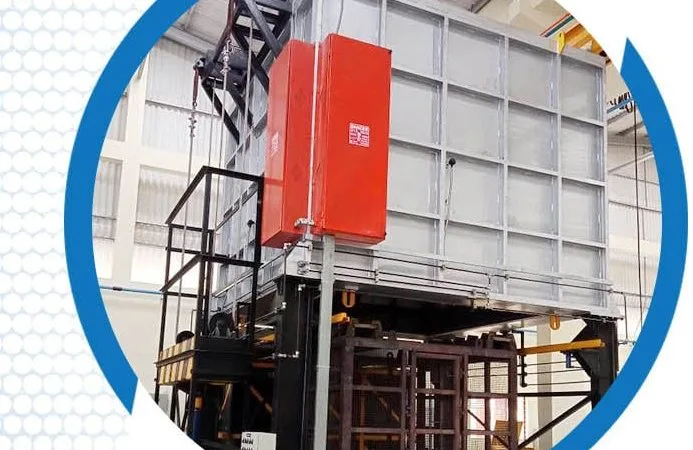
Modern manufacturing often requires metals to have specific levels of strength, hardness, toughness, ductility, and wear resistance. A controlled thermal process can help manufacturers achieve these properties while maintaining the required dimensions and quality of components. This is where a Heat Treatment Furnace becomes an important part of industrial production.
A heat treatment furnace provides controlled heating, holding, and cooling conditions for metals and alloys. Depending on the material and process, it can be used for annealing, hardening, tempering, normalizing, ageing, stress relieving, and other thermal treatments.
What Is a Heat Treatment Furnace?
A Heat Treatment Furnace is industrial equipment designed to heat materials to a specified temperature and maintain controlled conditions for a defined period. After the heating and soaking stage, the material is cooled according to the required treatment cycle.
The main purpose is to modify the physical and mechanical properties of a material without changing its basic shape. Proper temperature control and uniform heating are important for achieving repeatable results.
Major Advantages of a Heat Treatment Furnace
1. Precise Temperature Control
One of the main benefits of a Heat Treatment Furnace is accurate temperature control. Modern systems can use temperature sensors, controllers, PLC systems, and HMI interfaces to monitor and manage the heating cycle.
Precise control helps ensure that components receive the required thermal treatment and reduces variations between production batches.
2. Consistent Processing
Consistency is important when manufacturers process large quantities of components. A properly designed furnace can provide controlled heating and cooling conditions, helping manufacturers achieve more repeatable results.
This is particularly useful for automotive, engineering, steel, aerospace, and other industries where consistent material properties are required.
3. Improved Material Properties
Heat treatment can be used to modify important material characteristics. Depending on the selected process, it may improve hardness, strength, ductility, toughness, machinability, or resistance to wear.
For example, annealing can improve ductility and machinability, while hardening can increase hardness and wear resistance. Tempering can then be used to reduce excessive brittleness after hardening.
4. Better Production Efficiency
Industrial furnaces can be designed according to production volume, component dimensions, heating requirements, and operating conditions. Continuous systems can move components through different heating zones, while batch systems can process a defined load at a time.
The appropriate configuration can therefore support efficient production while maintaining the required treatment cycle.
5. Automation and Process Monitoring
Modern Heat Treatment Furnace systems can include automated temperature control, programmable cycles, data recording, alarms, and safety systems.
Automation reduces the need for constant manual adjustment and can help operators maintain the same process parameters from one cycle to another.
6. Suitable for Different Heat Treatment Processes
A single furnace design may be configured for specific industrial applications. Common processes performed using industrial heat treatment equipment include:
- Annealing
- Hardening
- Tempering
- Normalizing
- Stress relieving
- Solution annealing
- Ageing
- Preheating
The required furnace design depends on the material, temperature range, load capacity, production volume, and treatment process.
Applications Across Different Industries
A Heat Treatment Furnace is used in many manufacturing sectors. Common applications include automotive components, steel processing, aerospace parts, engineering products, foundries, tools and dies, heavy fabrication, and general metal processing.
The furnace configuration can vary significantly between applications. Heavy components may require a bogie hearth or specialized loading system, while high-volume production may benefit from continuous furnace designs.
What to Consider When Selecting a Furnace?
Before selecting a heat treatment furnace, manufacturers should evaluate several technical factors:
- Required operating temperature
- Material type and grade
- Component size and weight
- Production capacity
- Heating method
- Temperature uniformity
- Furnace insulation
- Atmosphere requirements
- Automation level
- Loading and unloading arrangement
- Energy efficiency
- Safety requirements
Selecting equipment based on the actual production process can help manufacturers achieve more reliable thermal processing.
Final Thoughts
A Heat Treatment Furnace provides the controlled thermal environment required for many modern metal-processing applications. Precise temperature control, repeatable processing, automation, production flexibility, and improved material properties are some of the key reasons these systems are widely used in manufacturing.
For manufacturers planning a new heat treatment system, understanding the required material properties and production conditions is an important first step. Furnace capacity, heating method, temperature range, automation, and process requirements should all be considered before final equipment selection.