
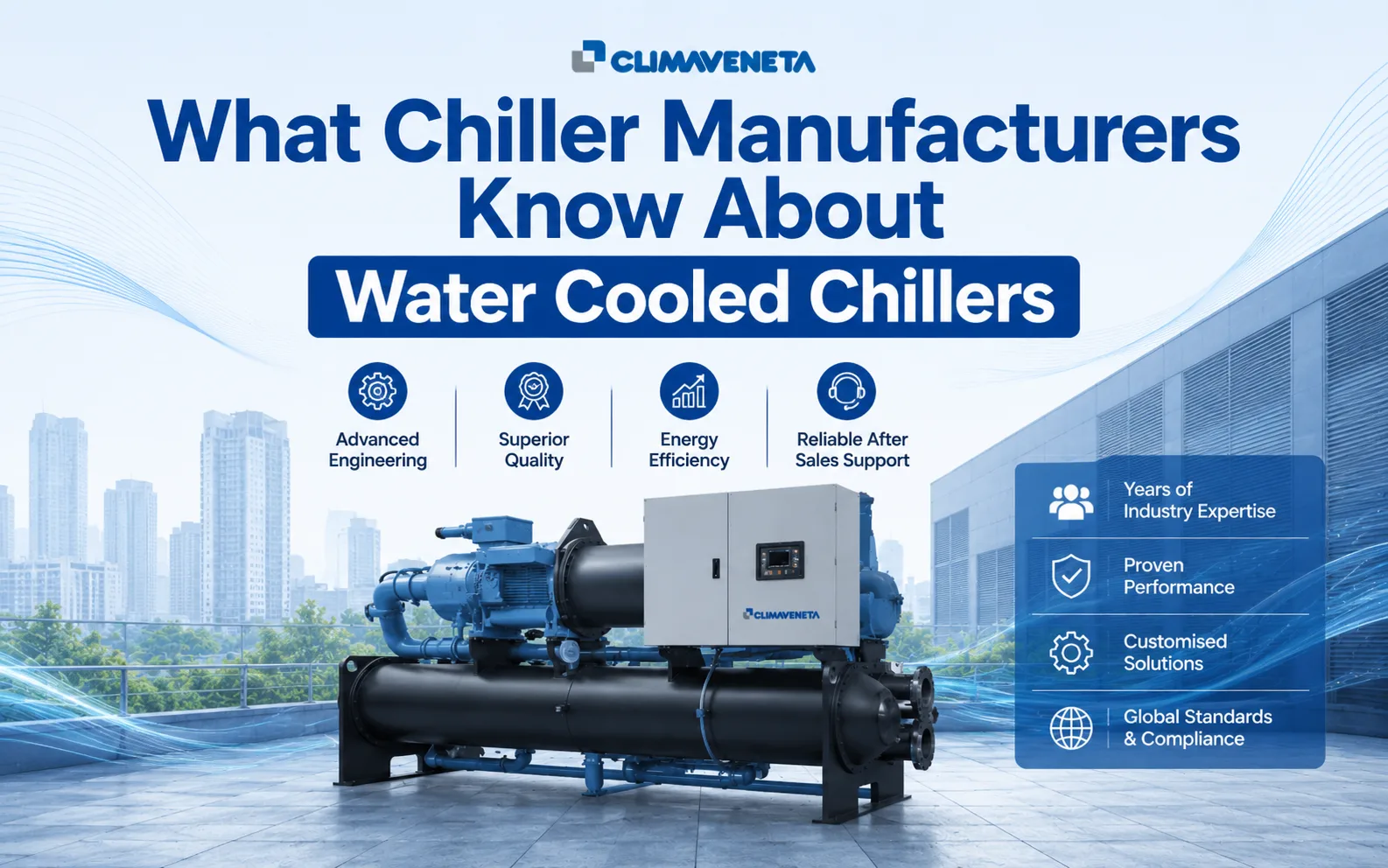
There is a gap in most water cooled chiller conversations.
On one side, facility managers and procurement teams are evaluating systems based on capacity, upfront cost, and basic efficiency ratings. On the other side, chiller manufacturers are looking at the same systems through a completely different lens — one shaped by years of application data, installation experience, and post-commissioning performance.
That gap matters. Because the decisions made at the selection stage determine how a water cooled chiller performs not just in year one, but across its entire operational life.
Here is what experienced chiller manufacturers consistently factor in — and what most buyers don't think to ask about.
Rated Efficiency Is Not the Same as Real-World Efficiency
Every water cooled chiller comes with an efficiency rating. What that number doesn't tell you is how the system performs across the full range of conditions it will actually encounter in operation.
Water cooled chillers spend the majority of their running hours at partial load — not at the full load conditions used to generate the rated efficiency figure. A system that looks competitive on paper may perform very differently when operating at 50% or 60% capacity during off-peak hours or seasonal transitions.
Chiller manufacturers pay close attention to part-load efficiency metrics like IPLV and ESEER precisely because these numbers reflect how a system will actually behave across a typical year of operation — not just under ideal test conditions.
For buyers, the takeaway is straightforward. Ask for part-load efficiency data alongside full-load ratings. The difference between two systems that look similar on paper can be significant when measured across annual operating hours. Chiller manufacturers with strong application experience will always lead with this data rather than headline efficiency figures alone.
Condenser Water Temperature Has More Impact Than Most Realise
Water cooled chillers reject heat through condenser water — and the temperature of that water directly affects how hard the compressor has to work.
Chiller manufacturers design systems with specific condenser water temperature ranges in mind. When a facility operates with condenser water temperatures lower than design conditions — which happens more often than expected, particularly in cooler months — the chiller can actually deliver better efficiency than its rated figures suggest.
This is an operational advantage that is frequently overlooked at the selection stage. A well-specified water cooled chiller, paired with a properly designed cooling tower, can outperform its rated efficiency for a significant portion of the year.
Understanding this relationship — between condenser water temperature, cooling tower selection, and chiller performance — is something chiller manufacturers factor into system recommendations but rarely gets discussed in standard procurement conversations.
The Cooling Tower Is Part of the System
This is one of the most common gaps in how water cooled chiller decisions are made.
A water cooled chiller does not operate in isolation. Its performance is directly tied to the cooling tower it works with. An undersized or poorly maintained cooling tower raises condenser water temperatures, which increases compressor load, reduces efficiency, and accelerates wear on the system.
Experienced chiller manufacturers evaluate the full system — chiller, cooling tower, pumps, and piping — rather than the chiller unit alone. The efficiency of each component affects the others, and optimising one without considering the rest leaves performance gains on the table.
For facilities investing in water cooled chillers, this means the cooling tower specification deserves as much attention as the chiller itself.
Lifecycle Cost Looks Very Different from Purchase Cost
Water cooled chillers typically require a higher initial investment than air cooled alternatives. This is where many procurement decisions get anchored — on the upfront number.
What chiller manufacturers know, and what long-term operational data consistently confirms, is that the purchase price is a relatively small part of the total cost of ownership for a large cooling system.
Electricity costs dominate. A system that delivers even a modest efficiency improvement over a conventional alternative compounds those savings across thousands of operating hours per year, over a system lifetime that typically spans fifteen to twenty years.
Maintenance costs also factor in. Water cooled chillers require water treatment, cooling tower maintenance, and regular inspection of heat exchanger surfaces. These costs are real and need to be factored into any honest lifecycle analysis.
The facilities that make the best long-term decisions are the ones that evaluate total cost of ownership — not just the line item on the purchase order.
Application Fit Matters More Than Specification Alone
Chiller manufacturers see a wide range of applications — and one thing that becomes clear across that experience is that the same water cooled chiller specification can perform very differently depending on where and how it is installed.
Load profile, operating hours, ambient conditions, water quality, and the quality of system integration all influence how a water cooled chiller performs in practice. A system that is well matched to its application and properly commissioned will consistently outperform a higher-rated system that has been selected purely on specification without considering the operating environment.
This is why experienced chiller manufacturers invest time in understanding the application before recommending a system — because the specification is only part of what determines real-world performance. Chiller manufacturers who skip this step are the ones whose installations quietly underperform for years without a clear explanation.
Conclusion
Water cooled chillers are not complicated systems. But getting the most out of them requires understanding more than the numbers on a datasheet.
Part-load efficiency, condenser water temperature management, cooling tower integration, and total cost of ownership are the variables that separate a well-performing installation from one that quietly underdelivers year after year.
This depth of application knowledge is what distinguishes experienced chiller manufacturers from those simply selling equipment. It is also what facilities benefit from when they engage with manufacturers who have built and deployed these systems across diverse real-world environments.
Climaveneta India is among the chiller manufacturers bringing this application-focused approach to water cooled chiller solutions in India — combining engineering depth with an understanding of the specific demands of Indian industrial and commercial cooling environments.