Manual lead handoffs create a quiet tax on outbound campaigns. A prospect gets researched in one tool, exported to a spreadsheet, uploaded into a sequencer, contacted by an SDR, then entered into a CRM after someone remembers. Fields go missing, ownership gets fuzzy, and follow-ups slip.
A b2b sales platform should remove those gaps. For an agency, the core stack should connect CRM, email, LinkedIn, calling, calendars, enrichment, automation, and reporting. The best setup moves a qualified lead from discovery to sequence to conversation to pipeline without repeated data entry.
Why Does a B2B Sales Platform Need CRM Integrations?
CRM connections matter when an agency manages outbound campaigns for several clients and needs every contact, activity, owner, and opportunity tied to the correct account. A useful connection supports two-way data flow, not just a one-time contact import. The client’s CRM software should remain authoritative for ownership and opportunity status.
The CRM should act as the source of truth for account status, opportunity stage, ownership, suppression rules, and revenue attribution. The outreach system should write activity back to that record. A reply, booked meeting, call outcome, or sequence exit should update the sales record without asking a rep to copy information between screens.
This is where b2b sales automation becomes useful. Agencies can set rules such as “new qualified contact enters sequence,” “positive reply creates a task,” or “closed opportunity stops prospecting.” The result is less admin work and cleaner reporting. A sales automation platform should support the same logic across clients; outbound sales automation handles the repetitive execution.
Which CRM Integrations Should a Lead Gen Agency Offer?
The strongest starting set covers enterprise, mid-market, and smaller clients. HubSpot, Salesforce, Zoho, and Pipedrive are sensible priorities.
A strong sales CRM integration should map custom fields, account records, owners, lifecycle stages, campaign IDs, suppression status, and opportunity data. Agencies should test two-way updates and duplicate detection before launching a client campaign.
CRM automation becomes valuable when it can start, pause, or stop outreach. If a prospect books a meeting, the active sequence should pause. If an opportunity closes, cold follow-ups should stop. If ownership changes, the next task should reach the new owner.
Field mapping is a real agency problem. One client may call a field “Lead Source,” another “Acquisition Channel,” and another may store the same value in a custom property. The integration should let an operator map those differences without rebuilding every campaign.
What Should Sales Engagement Integrations Sync?
A sales engagement system should sync events that affect selling, not every piece of system noise. The minimum useful set includes contacts, sequence status, email activity, calls, tasks, meetings, replies, owners, and suppression events.
Sequence management deserves special attention. Agencies should be able to push qualified contacts into campaigns from the CRM and remove them after a meaningful sales event. One-way exports create stale records when prospects reply, book meetings, change jobs, or become active opportunities.
Sales outreach software should write enough context into the CRM for a rep to understand what happened. A timeline showing the latest message, reply status, meeting date, and next task is more useful than disconnected activity logs.
The same rule applies to an outbound sales platform. Email, LinkedIn, and phone steps need a common prospect state. Otherwise one channel can keep contacting someone after another channel has already produced a conversation.
How Should Outreach Sequences Work With a CRM?
The cleanest model is trigger, enrich, sequence, detect, and update. A lead enters from the CRM or prospecting source, receives validation, enters a sequence, and generates events that flow back into the CRM.
Step 1: Define Entry Rules
Start with firmographic, role, territory, lifecycle, and ownership rules. A campaign should have clear inclusion and exclusion logic for customers, active opportunities, bounced contacts, and opted-out people.
Step 2: Validate Before Sending
Sales prospecting tools should check whether a contact is reachable before enrollment. Email status, job title, company, phone availability, and buying signals can improve list quality. Validation should happen close to send time since records change.
Step 3: Build Conditional Sequences
Sales sequencing should branch on prospect behavior. A positive reply can create a human follow-up task. No response can trigger another channel. A booked meeting can end the sequence. A bounce can suppress the contact.
Step 4: Write Activity Back
Every meaningful event should update the right contact or account. That includes sends, replies, calls, meetings, sequence exits, and ownership changes. Test these events with a small record set before scaling.
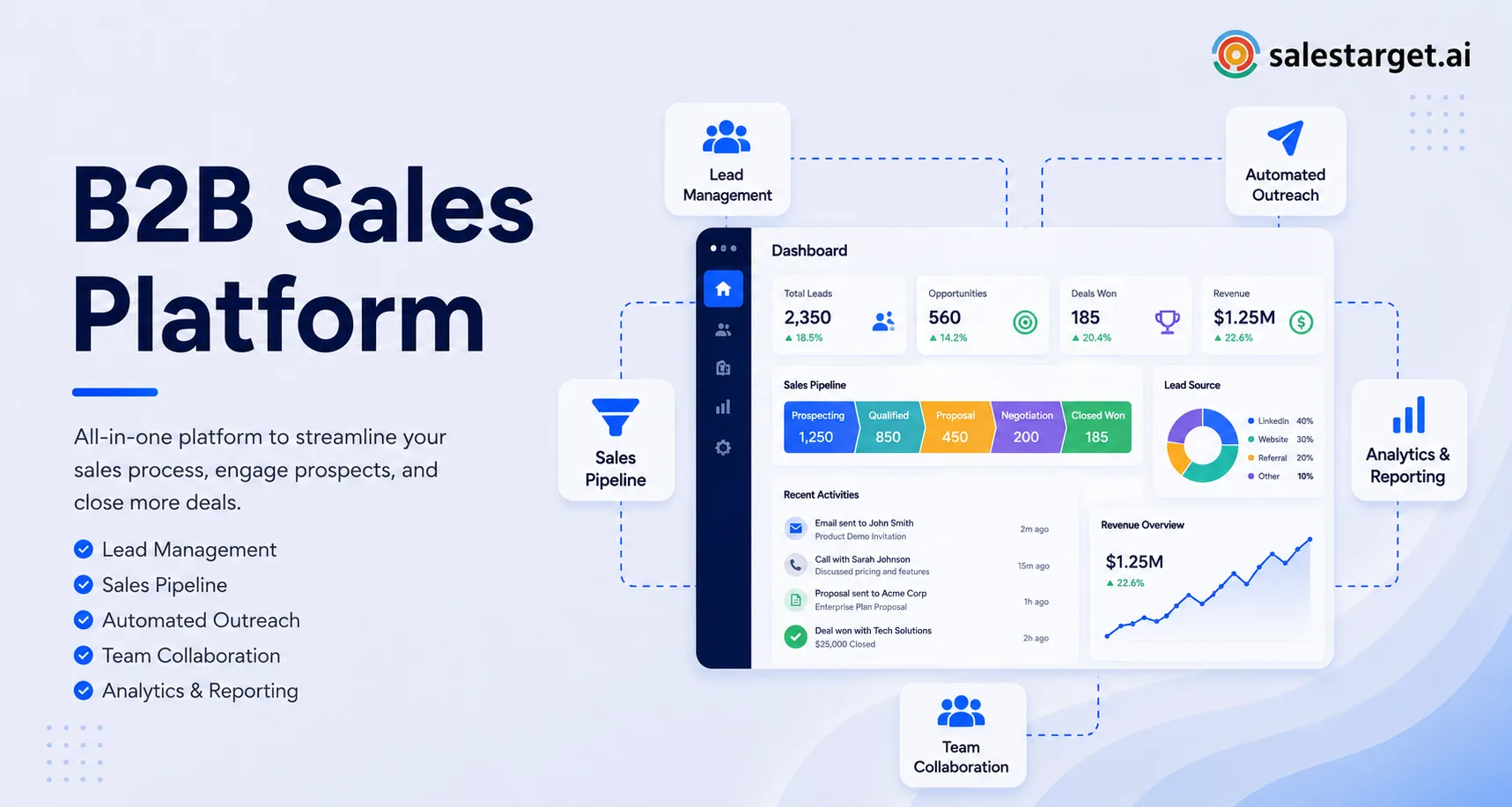
SalesTarget.ai follows this connected model by combining prospect data, email outreach, LinkedIn outreach, validation, and a built-in CRM. Its CRM connects with HubSpot, Salesforce, and Zoho, plus Google Calendar, Google Meet, Calendly, Slack, and Zapier.
If your current stack depends on CSV exports between every stage, review this B2B sales platform integration guide for prospecting before adding another point tool.
Which Integrations Matter for Multichannel Outreach and a Sales Engagement Platform?
Cross-channel outreach works best when channels share the same prospect state. Email, LinkedIn, and phone activity should not behave like three independent campaigns.
Email outreach automation should support inbox connections, sending controls, authentication checks, reply handling, and sequence status. LinkedIn outreach automation should support connection requests, messages, follow-ups, timing controls, and safety limits. Phone activity should create a usable call record and next action.
The key is the decision layer between channels. A positive email reply should stop remaining automated touches and create a rep task. If there is no response after planned email steps, the next action can move to LinkedIn or a call task.
For agencies, client-level separation matters. Each client should have distinct sending identities, CRM mappings, sequences, suppression lists, reporting, and permissions. A shared workspace is useful only if ownership and data boundaries remain clear.
What Lead Data and Enrichment Connections Should You Support?
A lead generation platform should connect discovery with activation. Agencies need to move a qualified record from research into outreach without exporting spreadsheets or manually copying fields. Strong b2b lead generation software should make that handoff just as direct.
b2b prospecting tools should expose company, role, contact, and intent information in a form the CRM and sequence builder can use. Enrichment should fill missing fields rather than create duplicate records.
A sales intelligence platform can add buying signals, company changes, hiring activity, technology information, and related context.
lead enrichment software should support field-level updates and source visibility. If a phone number changes, the operator should know what changed and when. If a contact leaves the company, future messages should stop.
SalesTarget.ai's Lead Explorer combines 840M+ professional profiles, 146M+ business entities, 4,000+ intent signals, and 50+ data sources. Its enrichment flow can return professional email, personal email, phone, and mobile data, with email validation before outreach.
How Should Agencies Connect Calendars, Meetings, and Team Alerts?
A b2b lead generation workflow is incomplete if a booked meeting does not reach the person responsible for the opportunity. Calendar and meeting connections should create a clean handoff from prospect response to scheduled conversation.
Google Calendar and meeting tools should sync availability, booked meetings, and event details. Calendly can act as the booking layer. Slack can notify the right channel when a high-intent reply or meeting occurs.
Prospecting automation should stop short of blind activity. Alerts need clear rules so teams hear about meaningful events rather than every open or click.
Zapier and API connections help with client-specific workflows. A client may need to send a qualified lead to another business system, create a project record, or trigger an internal approval.
What Should You Compare Before Choosing an Integration Stack?
The CRM and outreach integration checklist should focus on data behavior rather than the number of logos on an integrations page.
CapabilityWhat to checkCRM syncTwo-way contacts, accounts, owners, deals, and custom fieldsActivity loggingEmails, calls, meetings, tasks, replies, and sequence statusTrigger supportCRM events can start, pause, or stop outreachData qualityValidation, deduplication, enrichment, and suppressionChannel coordinationEmail, LinkedIn, and phone share prospect statusSchedulingCalendar availability and meeting outcomes sync correctlyAutomationWebhooks, APIs, or workflow connectorsReportingCampaign activity connects to pipeline and revenuePermissionsClient data and records stay separatedError handlingFailed syncs are visible and retryableSales engagement integrations should be judged by actual workflow behavior. A platform may connect to a CRM yet offer weak field mapping. Another may sync a calendar but fail to update sequence status after a meeting. Test real sample records before approval.
What Are the Benefits of Connected CRM and Outreach Workflows?
The main benefit is operational consistency. A connected stack gives reps one current view instead of forcing them to reconstruct history from email, LinkedIn, spreadsheets, and campaign reports.
sales workflow automation reduces repetitive updates. lead management software can route records, create tasks, and maintain ownership rules. sales pipeline automation can move opportunities based on events that already happened rather than manual status changes.
For an agency, reporting is just as important. Campaign activity can be connected to meetings and pipeline stages, giving clients a clearer view of what happened after the initial reply.
SalesTarget.ai reports 91% follow-up completion and about six hours saved per rep each week through its CRM workflows. It reports 2.4X more meetings from the same leads. These are company-reported product metrics, so they should be treated as reference points, not guarantees.
A connected system can improve execution without increasing the number of tools an SDR must keep open.
What Integration Mistakes Should B2B Sales Agencies Avoid?
The first mistake is connecting too many tools before defining the source of truth. Decide which system owns contacts, accounts, opportunities, suppression status, and campaign state before building workflows.
The second is syncing everything. Send back the events that help a rep act or a manager measure performance.
The third is ignoring negative events. Bounces, unsubscribes, job changes, duplicate records, and closed opportunities need explicit rules. Automation that only handles positive actions can create list-quality problems.
The fourth is skipping test records. Run a controlled batch through discovery, enrichment, sequence enrollment, reply handling, meeting booking, and CRM updates.
The fifth is failing to plan client separation. Agencies should use distinct workspaces, permissions, sending accounts, suppression lists, and reporting views where the architecture requires them.
What Is the Best Integration Setup for a B2B Sales Platform?
A practical stack has three layers: a CRM for ownership and pipeline, a prospecting and enrichment layer for fresh data, and an outreach layer for coordinated sequences.
The strongest setup keeps prospect state consistent from first record to closed opportunity. A lead should not become “qualified” in one tool, “active” in another, and “booked” in a spreadsheet.
For teams evaluating b2b sales tools, the deciding question is simple: can the system move a verified prospect from discovery to outreach, detect meaningful intent, update the CRM, and create the next sales action without manual copying?
Final Thoughts
The right integration strategy is less about collecting the biggest connector list and more about removing the handoffs that cause lost leads. A B2B lead gen agency should prioritize CRM sync, sequence triggers, activity logging, data validation, channel coordination, calendars, alerts, automation, and client-level data controls.
A b2b sales platform earns its place when it can move a verified prospect from discovery to outreach, detect meaningful intent, update the CRM, and create the next sales action without manual copying.
SalesTarget.ai is built around that workflow. It combines lead discovery, enrichment, email and LinkedIn outreach, validation, AI assistance, and CRM workflows in one platform. If your agency is spending too much time moving leads between prospecting, sequencing, and CRM tools, use SalesTarget.ai to consolidate those steps and give reps a cleaner path from prospect to pipeline.