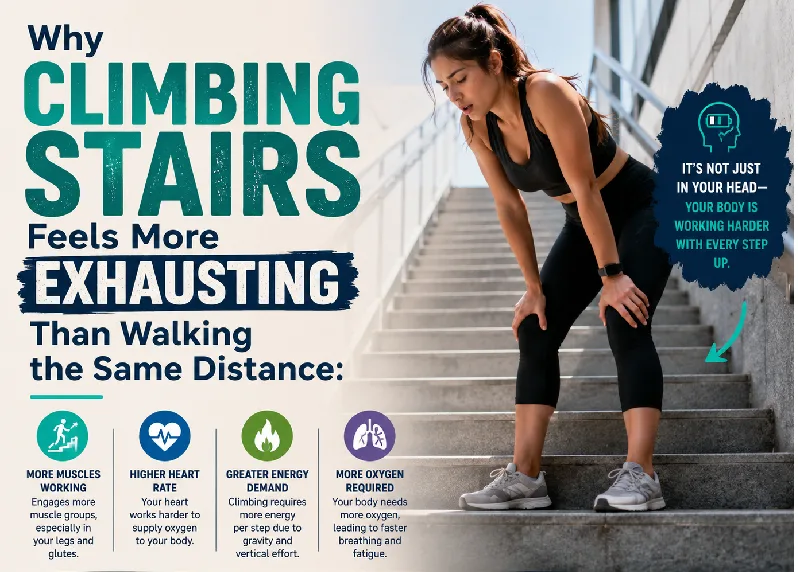
In your daily life, you must have noticed that going down a lengthy corridor does not present much difficulty. You can travel several meters without giving it too much thought. But when you take even a couple of flights of stairs, it immediately becomes obvious how hard it is: breathing becomes heavy, muscles start feeling tired, and heartbeat speeds up.
This phenomenon is rather common, and most people find it hard to figure out why. Well, physics comes into the spotlight to explain this event. While you appreciate how the textbook theories work everywhere, your physics tutor will help you understand them better.
Gravity: The Constant Force Working Against Every Step
The most prominent cause for stairs being difficult to navigate is gravity. While moving about on flat surfaces, the human body mainly displaces in a forward direction, maintaining its vertical position. In other words, the effect of gravity will be there; however, it will not offer significant resistance to the motion.
When you move upwards, you are actually working against the pull of gravity. Stated simply, it requires enough power in the legs to lift the whole body vertically up with every step taken. This fight against gravity is the main reason for stairs being difficult. The higher one goes, the longer the body fights against gravity.
The Energy Cost of Elevation: Why Every Step Feels Heavier
Walking up stairs uses more energy than walking on a level surface. In terms of physics, rising means gaining gravitational potential energy, which implies storing energy as altitude gains.
The simple experience of shopping would apply here. It is much easier to slide the grocery bag along the floor than lift it to a high shelf. This very concept works for your body because each step is an expenditure of energy, raising your body's altitude.
Let's understand it better with the equation you must have learnt at your IP physics tuition.
Ep = mgh
Where:
m = mass of the object or your body
g = acceleration due to gravity
h = height above the reference or from the ground
At the best A-level physics tuition, you will learn that this energy demand adds up quickly. Unlike walking, where energy is mainly used to maintain movement, stair climbing constantly consumes extra energy for elevation. That is why fatigue can build much faster than expected.
Muscle Load and Oxygen Demand: The Body’s Internal Response
The physical exertion involved in stair climbing involves not just power and energy but also internal responses from the body. The larger muscles of your body, like your calves, thighs, and glutes, work extra hard to elevate your body.
This means that the need for oxygen increases. And to supply this oxygen, you breathe harder and faster.
Let me give you an overview here:
FactorEffect on Stair Climbing GravityIncreases resistanceHeight gainedRequires more energyMuscle engagementCauses faster fatigueOxygen demandRaises heart rate and breathing
Conclusion
Although stairs are rather simple, they provide one of the most obvious examples of physics used in everyday life. Stairs prove that movement involves more than just a distance. It's also about direction, position, force, energy and how the body responds.
When you next feel out of breath while going up the stairs, know that it is not only about walking. You are overcoming gravity, exerting additional energy, and using your body in a manner it would not be asked to do on a flat surface. To appreciate physics better in every major and minor event, you should look no further than the best physics tuition in Singapore. Enrol now at SG Physics and see how your textbooks turn into a real-life problem-solving thrill.