The way people interact with websites is changing rapidly. Earlier, most website visitors were individuals browsing pages, reading information, or filling out forms. Today, websites also receive visits from AI assistants, autonomous agents, automated crawlers, and different types of software. This shift makes understanding website activity more important than ever. Businesses need to know not only how much traffic their websites receive but also who or what is generating that traffic.
Traffic detection plays an important role in helping website owners understand visitor activity. Traditional analytics tools provide information such as page views, sessions, referral sources, and visitor behavior. However, these metrics do not always explain whether an interaction comes from a real person, an AI-assisted user, or an autonomous agent. Without this additional context, businesses may find it difficult to make accurate decisions about their website performance and security.
Why Traditional Website Traffic Analysis Is No Longer Enough
Traditional website analytics were primarily designed around human visitors. They help businesses measure engagement, understand popular pages, and evaluate marketing campaigns. However, the increasing use of AI-powered tools has introduced new types of website interactions.
For example, an AI assistant may visit a product page to collect information for a user. An autonomous agent might navigate a website, compare different services, or submit a request through an online form. Meanwhile, automated crawlers may access website content for indexing or research purposes.
These activities can appear similar to regular visitor sessions in standard analytics reports. As a result, businesses may struggle to understand their actual audience and distinguish useful automation from unwanted activity.
A more detailed approach to website monitoring is needed to understand the different types of visitors and the evidence behind their interactions.
What Is AI Agent Detection for Websites?
AI agent detection for websites refers to identifying interactions generated by autonomous AI agents and distinguishing them from other types of website activity.
AI agents can perform tasks with limited human involvement, such as collecting information, accessing specific pages, interacting with forms, and communicating with APIs. Unlike traditional crawlers, some agents can complete multi-step tasks on behalf of users.
Identifying these interactions helps businesses understand how AI-powered systems access their digital platforms. It also allows website owners to decide whether an interaction should receive a normal browsing experience, structured information, additional verification, or a different response.
However, detecting AI agents is not always straightforward. Some agents identify themselves through published user-agent details or signed requests, while others may provide limited information. A reliable detection approach should consider multiple signals instead of relying on a single browser identifier or automated score.
Four Types of Website Visitors Businesses Should Understand
Modern websites may receive several types of interactions. Understanding these categories can help businesses make better decisions.
Human Visitors
These are people who directly browse websites, read articles, explore products, and interact with online services. They represent traditional website traffic and are important for measuring customer engagement.
Human + AI Interactions
Sometimes, a person uses an AI assistant to research information, prepare content, or complete a task. In this situation, the activity is still connected to a human user, but AI plays a role in the process.
Autonomous AI Agents
These are software agents that perform tasks on behalf of users or other systems. They may visit product pages, collect information, interact with services, and access available website endpoints.
Unknown Interactions
Not every website request provides enough information to identify its source confidently. Instead of automatically classifying such activity as human or automated, businesses should keep it under an unknown category until stronger evidence becomes available.
How Businesses Can Improve Website Traffic Detection
Improving traffic visibility requires more than counting visitors. Businesses should examine different signals and understand what those signals actually prove.
Monitor server and browser activity: Review request patterns, browser interactions, and available session information to understand how visitors interact with different pages.
Check declared identities: Look for published user-agent information and client declarations from AI services. Remember that user-agent strings can be copied.
Verify signed requests: When an agent supports HTTP Message Signatures, validating its signature against the operator's published key can provide stronger identity evidence.
Analyze traffic by page: Compare activity across landing pages, product pages, registration forms, documentation, and APIs.
Keep uncertain activity visible: Avoid forcing every request into a human or bot category when the available evidence is insufficient.
Create appropriate website policies: Decide how different types of interactions should be handled based on their purpose and the sensitivity of the requested action.
These practices help businesses understand their digital audience while reducing the risk of blocking legitimate AI-powered activity.
How AgentCredia Helps Businesses Understand Website Visitors
AgentCredia addresses the growing need for better visibility into human and AI-driven website interactions through its Proof of Actor solution.
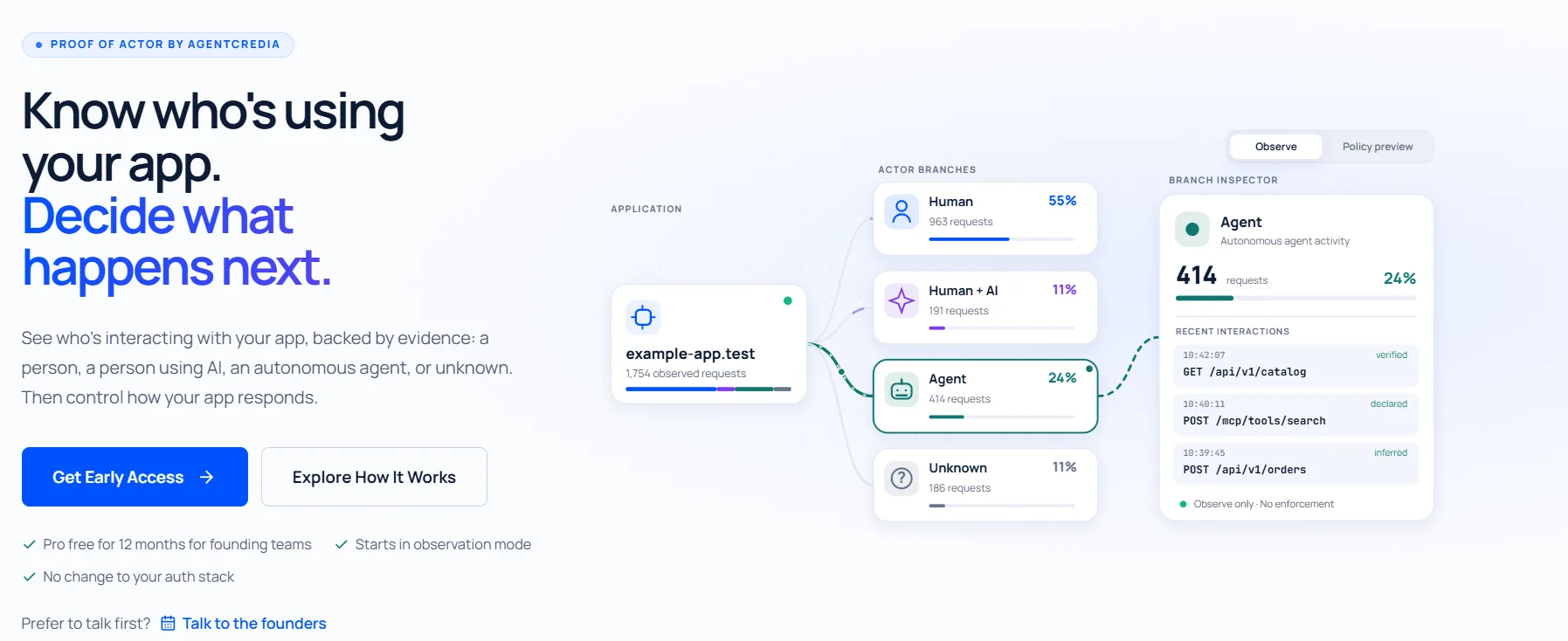
Rather than treating every automated interaction as unwanted traffic, Proof of Actor helps applications understand who or what is acting. It classifies supported interactions into four categories: Human, Human + AI, Agent, and Unknown.
The solution also provides an evidence basis for its classifications:
Verified: Supported identity evidence, such as a valid agent request signature.
Declared: Information explicitly provided by an agent or application.
Inferred: Classification based on available behavioral or interaction signals.
Unknown: Insufficient evidence to make a confident determination.
This evidence-based approach helps businesses understand their visitor mix, identify which agents interact with particular pages, and recognize where detection coverage is limited.
Another important feature is its observation-first approach. Businesses can review classifications and available evidence before deciding how their websites should respond. They can then create policies for individual routes, allowing verified agents to access structured content while keeping normal experiences available for human visitors.
For example, a verified AI agent visiting a product documentation page may receive structured information, while a person submitting a contact form can continue using the standard website experience.
The Future of Website Traffic Monitoring
As AI assistants and autonomous agents become more common, website traffic analysis will need to evolve. Businesses will increasingly need to understand not only the number of visitors but also the nature of their interactions.
Better traffic visibility can help marketing teams understand changing visitor patterns, developers improve website experiences, and security teams make more informed decisions about automated requests.
However, detection should always be based on available evidence. No single method can reliably identify every AI agent or determine whether all human activity is AI-free. Maintaining an unknown category is therefore an important part of responsible traffic classification.
AgentCredia is working toward this future with Proof of Actor, helping businesses and developers build websites and applications that can understand human, AI-assisted, and autonomous agent interactions.
Understanding your website visitors is becoming just as important as counting them. With evidence-based detection and flexible policies, businesses can prepare their websites for an internet where humans and AI agents work together.