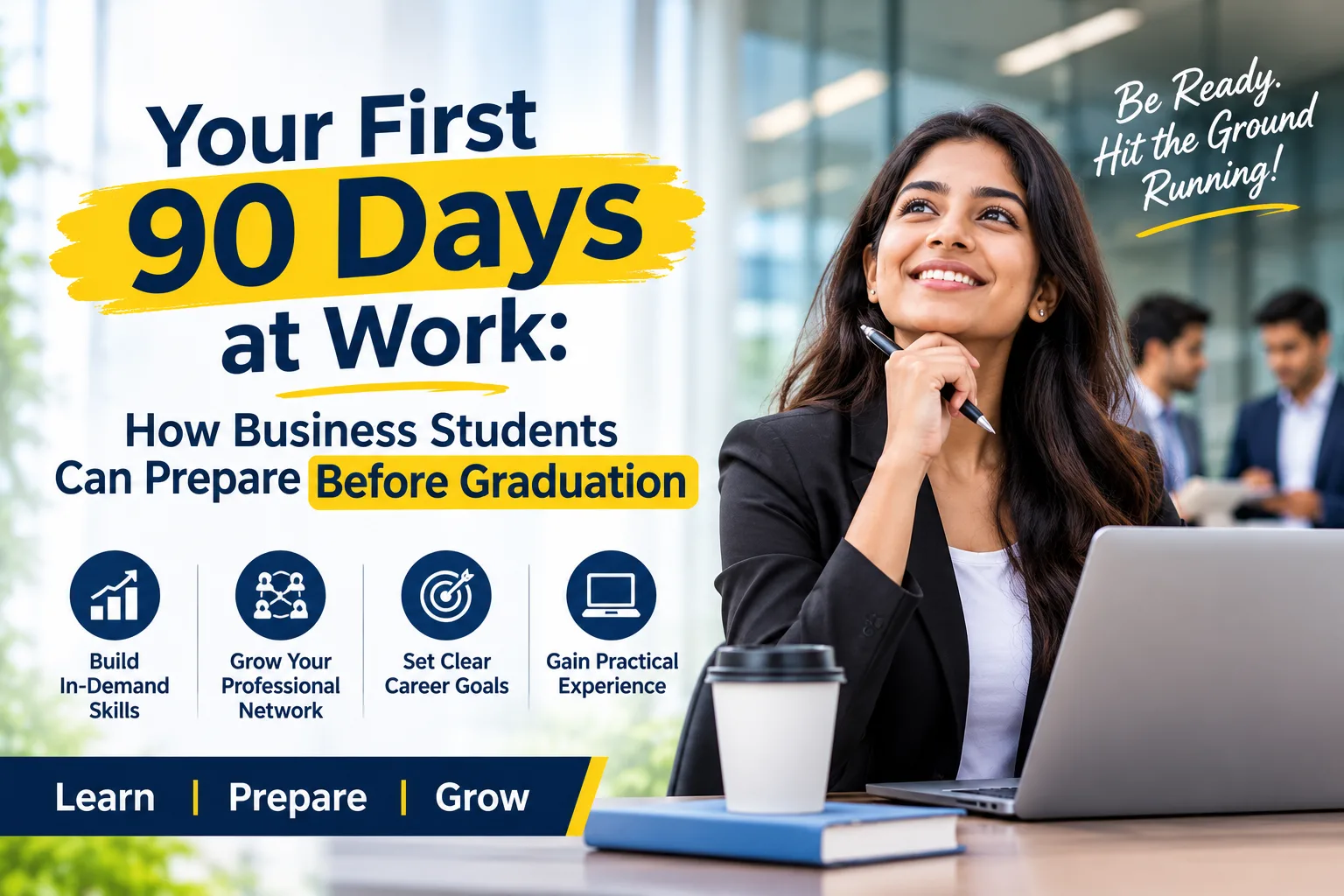
Getting your first job is an exciting milestone, but moving from college life into a professional workplace can bring new challenges. Students may understand business concepts from their courses but still need to learn how to manage deadlines, communicate with colleagues, handle feedback and complete tasks in a professional environment.
The transition becomes easier when students prepare before graduation. This is an important consideration for anyone researching a Top B School in Bangalore. Along with academic knowledge, students should look for opportunities to develop workplace habits and practical skills that can help them adjust to professional responsibilities.
Think of your first 90 days at work as a learning period. Your goal is not to know everything immediately. It is to understand your role, learn from others, become dependable and gradually contribute more confidently.
1. Understand What Employers Expect From Fresh Graduates
Employers hiring fresh graduates may expect them to understand basic concepts related to their role, communicate clearly and complete assigned responsibilities.
They may not expect a new employee to have the experience of a senior professional. However, they generally value a willingness to learn, attention to detail, punctuality and the ability to accept feedback.
Students can prepare by understanding the type of work associated with their preferred career area. Someone interested in marketing should explore campaign coordination, customer research and reporting. A student interested in finance can strengthen numerical confidence and spreadsheet skills.
Reading job descriptions is a useful starting point because it reveals the qualifications and abilities employers commonly request.
2. Learn How to Communicate Professionally
Professional communication can be different from everyday conversations. Employees may need to write emails, share progress updates, ask questions and explain problems.
A useful habit is to make messages clear and specific. Instead of saying that a task is difficult, explain what you have completed, where you are facing a problem and what information you need.
Students can practise professional communication during college by preparing reports, presenting projects and participating in discussions.
It is also important to listen carefully. Before responding to an instruction, make sure you understand the expected result, deadline and format.
3. Become Comfortable With Workplace Technology
Different organisations use different software and digital platforms. Some common tasks may involve spreadsheets, presentations, shared documents, email, project management systems or business reporting tools.
Students do not need to learn every platform before joining a company. Instead, they should develop the ability to use common digital tools and learn new systems when required.
Spreadsheet knowledge is useful across many business functions. Students can practise organising data, using basic formulas, sorting information and preparing simple charts.
Presentation skills are also valuable because employees may need to explain research findings or project progress.
4. Understand the Importance of Time Management
College assignments and workplace responsibilities both involve deadlines, but professional tasks may affect other people and business processes.
Students can prepare by learning how to plan their work. Break larger assignments into smaller tasks, estimate the time required and identify which activities are most important.
When priorities change, communicate early instead of waiting until a deadline is missed.
A simple weekly plan can help students balance classes, projects, skill development and personal responsibilities. The objective is not to fill every hour with work. It is to use time thoughtfully and complete important commitments reliably.
5. Learn to Receive and Use Feedback
Feedback is part of professional development. A manager may suggest changes to a report, ask for clearer communication or explain a more efficient way to complete a task.
Students should try to understand the reason behind the feedback rather than viewing every correction as criticism.
Ask questions if the instructions are unclear. Make a note of repeated suggestions and use them to improve future work.
College projects provide a useful place to practise this habit. Review comments from faculty members and classmates, identify areas for improvement and apply the lessons to the next assignment.
6. Build Experience Through Internships and Projects
Internships can help students understand professional expectations before entering full-time employment. They may provide exposure to workplace communication, reporting, coordination and business processes.
Not every internship offers the same experience, so students should understand the responsibilities before accepting an opportunity.
Academic projects can also demonstrate practical ability. A marketing research assignment, financial analysis exercise or business planning project can provide examples of how students apply their knowledge.
Keep a record of your work. Explain the objective, your contribution, the tools used and what you learned. This information can be useful when preparing a CV or answering interview questions.
7. Prepare for Your First Workplace Team
Most business roles involve working with other people. A new employee may need to coordinate with colleagues from different departments, share information and ask for assistance.
Students can practise teamwork through group assignments and student activities. Learn to divide responsibilities, meet agreed deadlines and communicate when something changes.
It is equally important to understand that people may approach a problem differently. Respectful discussion and willingness to consider other viewpoints can make collaboration more effective.
A dependable team member does not need to know every answer. They should be willing to contribute, ask sensible questions and complete their responsibilities.
8. Develop a Clear Career Direction
Students do not need to choose one permanent career path immediately. However, having a general direction can make skill development more focused.
Explore areas such as marketing, finance, human resources, operations, business development and analytics. Read about the responsibilities associated with entry-level positions and identify the skills that appear frequently.
You can then choose relevant projects, courses or internships that support your interests.
A career direction should be flexible. Your interests may change as you learn more about different industries and roles.
9. Evaluate Whether a Business School Supports Career Preparation
When comparing a Top B School in Bangalore, investigate the academic curriculum as well as the opportunities that help students prepare for professional life.
Ask about practical assignments, internships, industry interaction, communication development, career guidance and student projects. Find out whether career services include CV preparation, mock interviews or other recruitment support.
Verify the information for the specific programme you are considering. Do not assume that every service is guaranteed to every student.
AIMS IBS Business School is one institution prospective students can research when exploring business and management education in Bangalore. Review its current official programme details, admission information and available student support to assess whether its offerings fit your career expectations.
10. Make Your First 90 Days a Learning Opportunity
When starting a new role, focus on understanding your responsibilities and workplace processes.
Days 1–30: Observe and understand. Learn about the team, tools, work processes and expectations. Ask questions and take notes.
Days 31–60: Practise and contribute. Complete assigned tasks, seek feedback and become more confident with regular responsibilities.
Days 61–90: Improve and take initiative. Identify ways to work more effectively, communicate progress and take responsibility for suitable tasks.
This is a simple preparation framework, not a fixed rule. Every workplace has different expectations and timelines.
Conclusion
Preparing for a first job should begin before graduation. Students can build workplace confidence by practising professional communication, improving digital skills, managing time, learning from feedback and gaining practical experience.
When choosing a Top B School in Bangalore, consider whether the programme supports both academic development and career preparation. A business qualification provides a foundation, but consistent learning and active participation help students turn that foundation into professional capability.
FAQs
1. How can business students prepare for their first job?
They can practise communication, develop digital skills, complete projects, explore internships and learn how to manage deadlines.
2. What skills do employers value in fresh graduates?
Depending on the role, employers may value communication, teamwork, problem-solving, adaptability, digital confidence and a willingness to learn.
3. Are internships useful before graduation?
Yes. Internships can provide workplace exposure and help students understand professional responsibilities.
4. How can students improve their interview preparation?
Research the role, practise explaining academic projects, prepare examples of teamwork and problem-solving, and understand the organisation.
5. What should students check when choosing a B-school?
Compare the curriculum, practical learning, faculty information, career support, internships, fees and official programme details.