From Roots to Revolution: The Three Ages of Data Science
Imagine a healthcare startup aiming to predict patient readmissions to optimize care and reduce costs. In 2010, the data scientist on the team would have relied heavily on traditional machine learning models—logistic regression, decision trees, and support vector machines—to extract insights from structured EHR (electronic health record) data. Fast forward to 2026, and the approach might involve deep learning models analyzing complex imaging data or time-series vitals. Meanwhile, large language models (LLMs) like GPT-6 can now process unstructured doctor’s notes, patient feedback, and medical literature to provide nuanced predictions and recommendations.
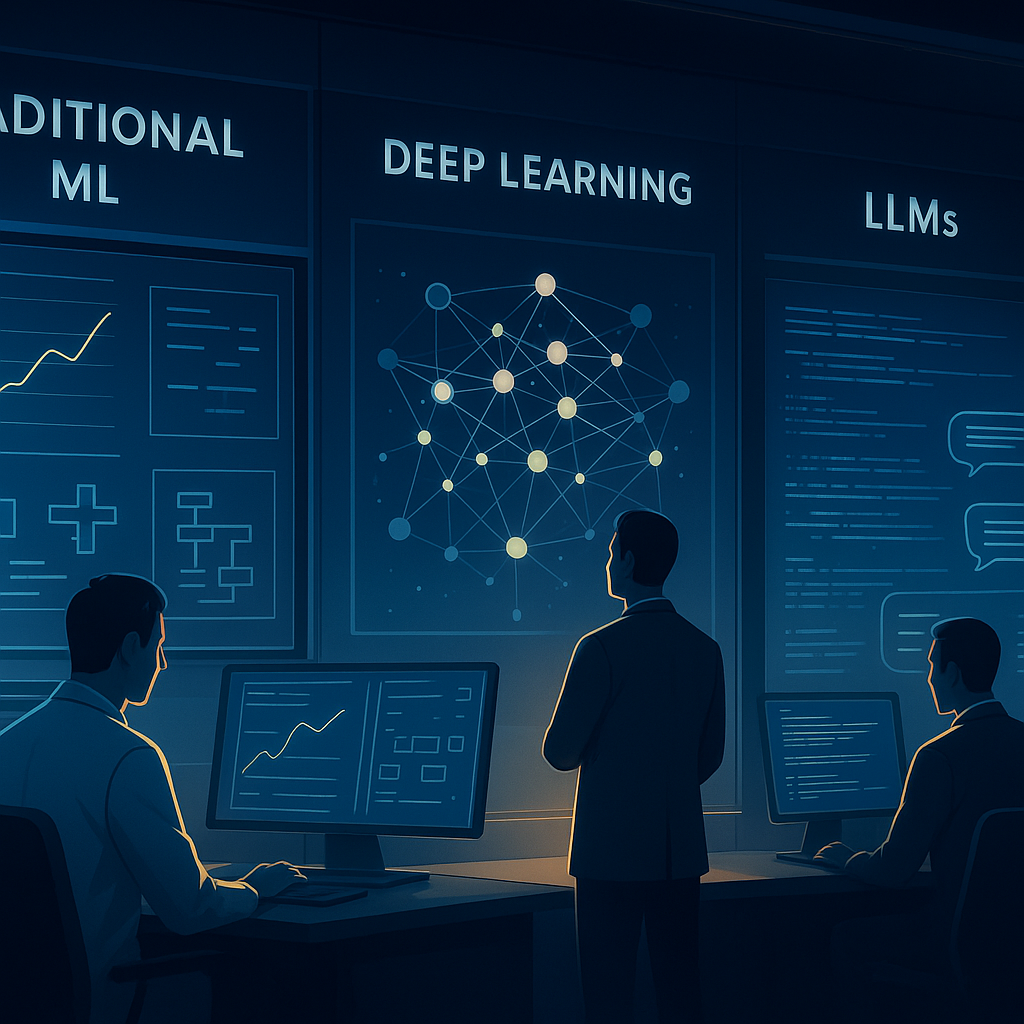
This evolution encapsulates the three distinct ages of data science: Traditional Machine Learning (ML), Deep Learning (DL), and Large Language Models (LLMs). Each age emerged from advances in computational power, data availability, and algorithmic breakthroughs, shaping how organizations approach problem-solving with data. Understanding when to deploy each is vital for maximizing accuracy, interpretability, and efficiency.
“The choice between traditional ML, deep learning, and LLMs boils down to data type, problem complexity, and desired outcomes.” — Dr. Meera Patel, AI Research Lead at MedTech Innovations
In this article, we dissect these three ages by tracing their origins, comparing their strengths and limitations, and illustrating their application through a unified healthcare example. We then survey the latest 2026 developments and offer strategic guidance on future-proofing data science initiatives.
Background and Context: Charting the Rise of Data Science Paradigms
Traditional machine learning has its roots in statistical modeling and pattern recognition techniques developed throughout the 20th century. Algorithms like k-nearest neighbors, Naive Bayes, and support vector machines gained prominence in the 1990s and early 2000s, fueled by increasing digitization and the availability of structured datasets. These models excelled at classification and regression problems but struggled with high-dimensional unstructured data such as images and text.
The rise of deep learning in the 2010s marked a seismic shift. Fueled by advances in graphics processing units (GPUs) and vast annotated datasets, deep neural networks—especially convolutional neural networks (CNNs) and recurrent neural networks (RNNs)—enabled breakthroughs in image recognition, speech processing, and natural language understanding. Companies like Google, Facebook, and OpenAI spearheaded this movement, pushing AI performance to unprecedented levels.
Large language models emerged in the early 2020s, leveraging transformer architectures and self-supervised learning on colossal corpora of text. With models scaling from billions to trillions of parameters, LLMs like GPT-6, released in 2025, can generate human-like text, perform complex reasoning, and integrate multi-modal inputs. They represent a new frontier, blurring lines between data science, AI, and cognitive computing.
This historical arc reflects not only technological progress but also evolving data ecosystems and business needs. As data volume and complexity grew, so did the demand for models that could leverage unstructured and heterogeneous data sources more effectively.
Core Analysis: Comparing Traditional ML, Deep Learning, and LLMs Through Healthcare Readmission Prediction
Consider the challenge of predicting 30-day hospital readmissions for chronic heart failure patients—a critical metric for improving patient outcomes and reducing healthcare costs.
Traditional Machine Learning Approach
In this phase, the data scientist engineers features from structured EHR data: demographics, lab results, medication lists, and previous admissions. Algorithms such as logistic regression and random forests analyze these features to classify patients’ risk levels.
- Advantages: High interpretability, relatively low computational requirements, and well-understood statistical foundations.
- Limitations: Requires extensive feature engineering; struggles with unstructured text or imaging; moderate accuracy on complex data.
Example: A 2018 study published in the Journal of Healthcare Informatics demonstrated that random forests trained on 50+ variables achieved a 75% accuracy in predicting readmissions.
Deep Learning Approach
With the advent of deep learning, models can ingest raw data like echocardiogram images, continuous vital signs, and time-series data without manual feature extraction. CNNs analyze imaging, while LSTMs or transformers handle temporal patterns in vitals.
- Advantages: Superior at capturing complex nonlinear relationships; reduces need for manual feature engineering; excels with high-dimensional data.
- Limitations: Requires large labeled datasets; less interpretable; high computational cost.
Example: By 2023, several hospitals integrated deep learning models that improved readmission prediction accuracy to over 85%, particularly when combining imaging and time-series data.
Large Language Models Approach
LLMs can analyze vast unstructured text data—clinical notes, discharge summaries, patient feedback, and medical research—extracting context and latent signals inaccessible to traditional or deep models.
- Advantages: Can perform zero-shot or few-shot learning; integrate diverse data modalities; generate explanations and summaries.
- Limitations: Model size and inference cost; potential for hallucination; requires careful tuning to domain specificity.
Example: In 2025, MedAI deployed an LLM-based system that parsed physician notes and literature to augment readmission risk models, pushing prediction accuracy beyond 90% and providing interpretable risk factors.
“LLMs are not just predictive engines but knowledge synthesizers, bridging data and domain expertise seamlessly.” — Dr. Alan Kim, CTO at MedAI
The comparison highlights that while traditional ML remains valuable for structured data and interpretability, deep learning is unrivaled for complex multimodal data, and LLMs unlock insights from unstructured text and knowledge bases. The optimal choice depends on the data landscape and business objectives.
Current Developments in 2026: Integration, Efficiency, and Ethical Challenges
As of mid-2026, the data science ecosystem reflects a convergence of these three paradigms. Hybrid models combining traditional ML’s interpretability, deep learning’s feature extraction power, and LLMs’ contextual understanding are increasingly common, especially in regulated sectors like healthcare and finance.
Key 2026 trends include:
- Multimodal Models: Architectures simultaneously processing images, time-series, and text have matured, enabling holistic patient risk profiles.
- Model Compression and Edge Deployment: Advances in model pruning and quantization allow deploying complex models like LLMs on edge devices, reducing latency and improving privacy.
- Explainability Tools: New frameworks help unpack decisions from deep and LLM-based models, addressing regulatory demands and trust issues.
- Domain-Specific LLMs: Pretrained LLMs fine-tuned on specialized corpora (e.g., medical, legal) have become standard, improving accuracy and reducing hallucination.
- Ethical AI Governance: Increased focus on bias mitigation, data privacy, and transparency, with regulatory bodies enforcing standards across all model types.
These developments underscore that data science is no longer about choosing a single “best” method but orchestrating complementary approaches aligned with organizational needs and data realities.
For readers interested in broader implications of these AI advances, you might enjoy our analysis on how AI shapes our future.
Expert Perspectives and Industry Impact
Industry leaders emphasize that successful data science projects hinge on matching the problem, data, and model carefully. Dr. Meera Patel of MedTech Innovations highlights:
“Organizations often default to deep learning or LLMs driven by hype rather than fit-for-purpose analysis. Traditional ML still outperforms for many tabular datasets and offers crucial explainability.”
Meanwhile, Dr. Alan Kim at MedAI stresses the transformative power of LLMs:
“LLMs accelerate research by synthesizing literature and clinical notes, enabling more informed decision-making and personalized care.”
These insights reflect a broader industry shift toward hybrid AI systems where human expertise and machine intelligence co-evolve.
In practice, companies across sectors are investing in multi-disciplinary teams merging data science, domain knowledge, and software engineering to architect scalable, maintainable AI solutions. According to recent Statista data, over 65% of Fortune 500 firms now employ hybrid AI pipelines combining traditional ML, DL, and LLMs.
For a deeper dive into the evolution of these AI methodologies, consider reading our comprehensive overview of the three ages of data science.
What to Watch: Future Outlook and Strategic Takeaways
Looking ahead, several forces will shape the trajectory of traditional ML, deep learning, and LLMs:
- Data Quality and Availability: As more organizations unlock structured and unstructured data, the demand for models that can integrate heterogeneous sources will grow.
- Automated Machine Learning (AutoML): Tools simplifying model selection, hyperparameter tuning, and deployment will democratize access but require clear understanding of each paradigm’s trade-offs.
- Regulatory Landscape: Governments worldwide are tightening AI regulations, emphasizing transparency, fairness, and accountability — favoring interpretable and auditable models.
- Energy Efficiency: Concerns over the carbon footprint of training large models will drive innovation in green AI and more efficient architectures.
- Human-AI Collaboration: Hybrid intelligence systems, where humans guide and correct AI outputs, will become standard, especially in critical domains.
Practitioners should base model choice on:
- Data modality and volume: Structured tabular data favors traditional ML; complex images/time-series favor DL; unstructured text and knowledge integration favor LLMs.
- Interpretability requirements: Traditional ML offers clarity; deep learning and LLMs need explainability frameworks.
- Computational resources and latency constraints: Lightweight models for embedded systems vs. cloud-based heavy inference.
- Domain specificity: Fine-tuning LLMs on specialized corpora improves relevance and trust.
Ultimately, mastery of these three ages and the ability to hybridize them will define successful AI strategies in 2026 and beyond.