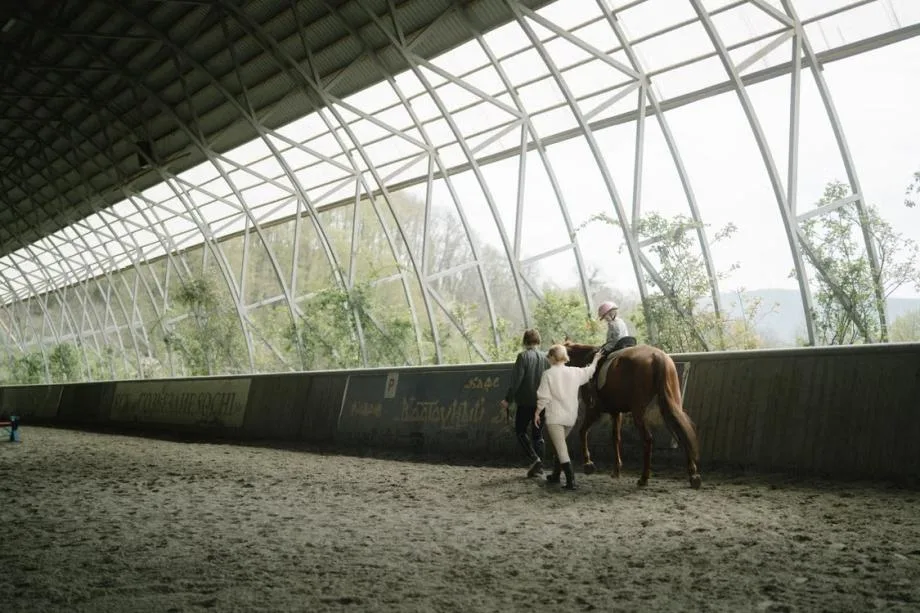
Arena owners often start with whatever is already in the barn. A chain harrow borrowed from the pasture, a landscape rake, or a homemade drag can smooth a surface well enough for a few rides. Over a full season of lessons, training, and turnout, though, the gap between improvised tools and a purpose-built horse arena groomer becomes easier to see.
Footing groomed with the right equipment tends to stay more uniform, and routine upkeep takes less guesswork. A well-chosen horse arena groomer also gives the owner a baseline, since each pass does the same job at the same depth.
What Is a Dedicated Arena Groomer?
A dedicated groomer is a drag designed around footing rather than adapted from another job. The University of Kentucky Cooperative Extension Service equipment guide says selecting the right equipment and maintenance protocol is essential to keeping an arena usable, and it breaks drags down into components such as tines, harrows, and rollers. It also explains that a simple single-unit drag is commonly used on plain sand or single-substance surfaces and typically levels the top layer without moving the footing much.
That distinction matters. A riding arena drag built from several working parts can loosen, redistribute, and level in one pass, while a single-purpose tool may only skim the top.
Why Does Leveling Alone Fall Short?
Smoothing the surface is only part of the job. The same extension program's dragging and treatments publication states that arena maintenance is more than leveling, and that simply smoothing the surface isn't enough to maintain an arena over time because repeated use wears away the base. Hoof traffic compacts some areas, pushes material toward the rail, and leaves ruts and prints behind. A tool that cannot work below the surface or move material back toward the middle leaves those problems in place.
The USDF footing guidance reprinted in Arena Maintenance Shouldn't Be a Drag describes a sequence of tools rather than a single pass. A tine- or spike-toothed harrow aerates the surface and breaks up chunks, and a chain-link harrow then smooths the finish. Equipment made for arenas can combine some of those steps into fewer passes, depending on the model.
Does the Footing Type Change the Answer?
Research suggests it does. Scientists from the Animal Health Trust and the Swedish University of Agricultural Sciences studied the effects of harrowing, and one result was that superficial harrowing did not affect one surface type. That points to different surfaces needing different maintenance. A tool that works on one footing may do little on another, which is why adjustable depth and several working parts give an owner more room to match dirt, sand, or man-made footing.
Where Do Improvised Tools Tend to Fall Short?
A homemade or borrowed tool can work in a pinch. Over time, a few limits tend to show up:
● Depth control. Many improvised drags work at a fixed depth, which limits how well compaction can be addressed.
● Sizing. An arbitrary width may not suit the arena, the tow vehicle, or the gates and corners.
● Repeatability. Results can vary from pass to pass, which makes a steady routine harder to keep.
● Parts. A one-off tool has no replacement tines or tips, so a worn piece can mean rebuilding it.
None of this makes a simple drag useless. A small private ring that rarely sees heavy traffic may do fine with basic tools. Quality arena grooming equipment also lasts longer when worn parts can be replaced instead of the whole unit. The case for a dedicated groomer grows with the number of horses, riders, and hours the surface sees each week.
How Should a Groomer Be Matched to the Setup?
Start with the tow vehicle. An ATV-compatible groomer suits owners without a tractor, while a tractor-mounted drag covers larger arenas in fewer passes. A riding arena drag that matches the vehicle's pulling power works more steadily than one that strains it. Next, weigh arena size, footing depth, and how often the surface is used.
When browsing arena groomers, check which working parts are included and whether the depth can be adjusted. Replacement parts deserve a look as well, since tines, tips, and tires wear with normal use, and a design with available parts keeps upkeep predictable. A checklist covering build quality, flexibility, and compatibility, such as what to look for before investing in arena grooming equipment, helps compare options side by side.
Choosing a Groomer That Fits the Arena
The right choice depends on workload, footing, and the vehicle available. Owners ready to compare arena groomers for sale will find that EZ Groomer, a veteran, family-owned company, offers tractor models from 4 to 12 feet and ATV models sized for different pull vehicles, with free shipping on groomers.
Anyone searching for an arena groomer in Molalla, OR, or tired of working with improvised tools can call 503-956-8062 to talk through sizing for their arena.