A brandable name is not only a name that sounds good. It is a name you can say, spell, remember, register and build on without fighting avoidable problems later.
Many founders start with creativity and end with availability. They brainstorm names, pick a favourite, imagine the logo, then check the domain. If the domain is taken, the whole decision reopens. A better process checks ownership while the shortlist is still flexible.
Start with the business, not the wordplay
Write one sentence before you generate names: who the business serves, what it offers, and what feeling the name should create.
For example, “a bakery for busy parents who want fresh sourdough without planning ahead” gives better naming material than “a food business.” It points to warmth, home, craft and convenience. It also helps you reject names that are clever but empty.
A brandable name does not need to describe everything. It needs to fit the business you are building.
Use five brandability checks
Before you check domains, test each name for basic brandability:
- Say it once. Can someone repeat it correctly?
- Spell it from sound. Will customers type it correctly?
- Picture it on a sign, app icon or invoice. Does it look credible?
- Say it in a sentence: “I ordered from ___.” Does it sound natural?
- Imagine growth. Will the name still work if the product range expands?
If a name fails pronunciation or spelling, a free domain will not save it. Customers cannot recommend what they cannot repeat.
Check the domain while you still have options
The domain check belongs in the shortlist stage. Check the exact name first, then decide whether variations are acceptable.
Look at .com first if your audience expects it, but judge extensions by fit. A software tool may be comfortable with .ai or .io. A local service may care more about trust and spelling than extension fashion. The wrong extension is the one your customers will mistype or distrust.
This is where a business name generator with domain check helps: names and availability stay in the same flow, so you do not fall in love with a name before learning whether you can own it.
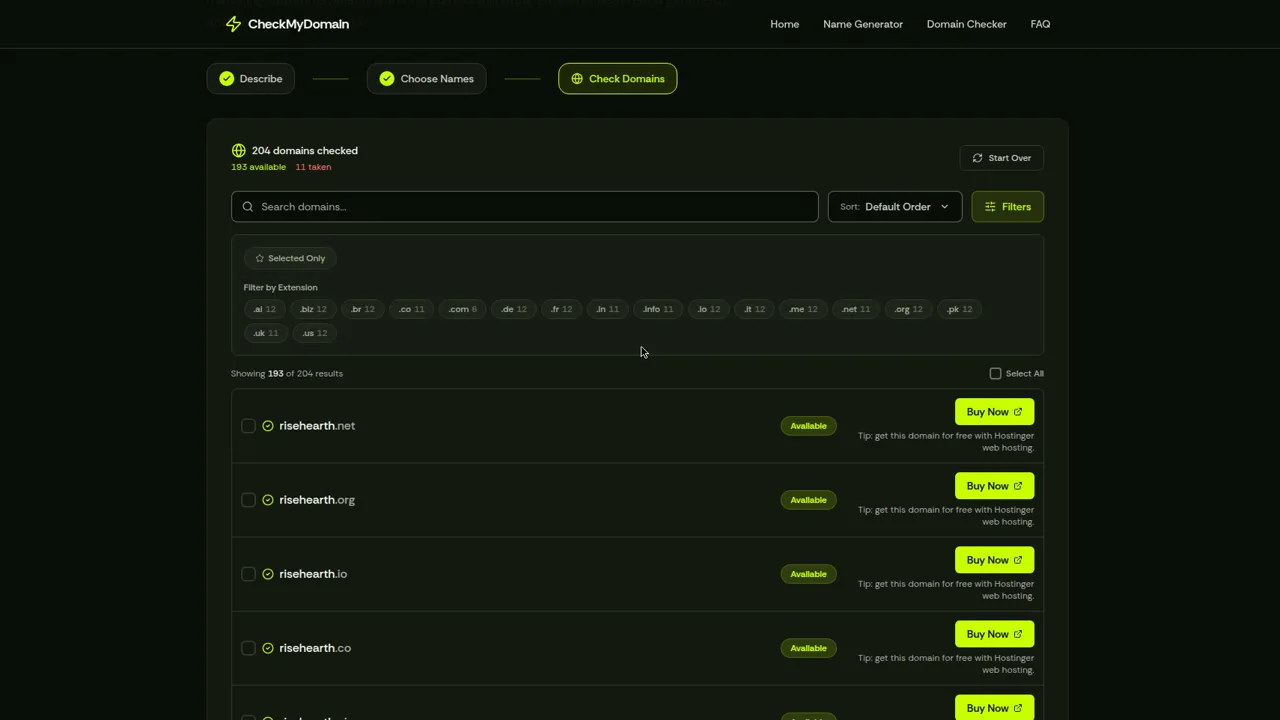
In one test run, a single bakery description produced 12 names. Checking those names across extensions created 204 domain checks: 193 available and 11 taken. That does not mean every available name was good. It means early checking gives you real choices instead of one fragile favourite.
Do not confuse available with safe
A domain availability result is useful, but it is not a legal clearance.
A free domain does not prove that no trademark exists. An available social handle does not prove the domain is free. A name that sounds different may still be confusingly close to a competitor in the same market.
Use the domain check to remove impossible options. Then do basic trademark and competitor checks before you invest in packaging, ads or a launch. For a serious brand, legal advice is cheaper before launch than after.
Score the shortlist
Give each name a quick score:
- Clarity: does it suggest the offer or audience?
- Memory: can people recall it after one hearing?
- Spelling: is the typed version obvious?
- Ownership: is a suitable domain available?
- Flexibility: can it grow beyond the first product?
- Risk: is it too close to an existing brand?
Do not average away a fatal flaw. A name with a free domain but impossible spelling is weak. A beautiful name with no usable domain is also weak. The winner is usually the name with no serious failure.
A quick example
Imagine a bakery shortlist with names such as Rise & Hearth, Local Loaf Co. and Sourdough Studio. Rise & Hearth feels warm and premium, but the ampersand can create spelling questions. Local Loaf Co. is clear and friendly, though it may limit the business if it later sells more than bread. Sourdough Studio is specific and memorable, but it works best if sourdough stays central.
None of those judgements can be made from the name alone. You also need the domain result. If the clearest name has no usable domain, it may lose to a slightly less perfect name that customers can find and type. That is the practical side of brandability: creative fit plus ownership.
Choose and register
Set a deadline for naming. Shortlist, score, check, register the domain, then move on. The name matters, but customers will judge the business by the product, service and trust you build after launch.
A brandable name you can actually own beats a perfect name you cannot use.