What Does Customer Lifecycle Management Mean in CRM?
Customer relationships are not built through a single interaction. They develop over time, beginning when someone first discovers a business and continuing through repeated purchases, engagement, and long-term loyalty. Managing these interactions effectively is one of the primary goals of Customer Relationship Management (CRM) software.
Customer Lifecycle Management (CLM) in CRM refers to the process of tracking, managing, and optimizing every stage of a customer's journey with a business. Instead of treating each interaction as an isolated event, CRM systems help organizations maintain a complete view of customer relationships from the first point of contact to ongoing engagement.
Understanding Customer Lifecycle Management is essential for businesses that want to improve customer experiences, increase retention, and create more meaningful relationships. This guide explains what Customer Lifecycle Management means in CRM, why it matters, the different lifecycle stages, and how CRM software supports each phase.
Understanding Customer Lifecycle Management
Customer Lifecycle Management is the strategic approach of managing every interaction a customer has with a business throughout the entire relationship. Within a CRM system, this process becomes structured through organized customer data, automated workflows, communication history, and performance tracking.
Rather than focusing only on acquiring new customers, Customer Lifecycle Management encourages businesses to understand how relationships evolve over time. Every interaction contributes to a customer's overall experience, making it easier to deliver relevant communication, timely support, and personalized engagement.
CRM software acts as the central platform that records these interactions, ensuring teams across sales, marketing, and customer service work with consistent customer information.
Why Customer Lifecycle Management Matters in CRM
Managing customer relationships without a structured lifecycle often leads to inconsistent communication, missed opportunities, and fragmented customer information.
Customer Lifecycle Management provides several advantages:
- Creates a complete customer view across departments
- Improves communication consistency
- Helps identify customer needs at different stages
- Supports personalized engagement
- Increases customer retention
- Enables data-driven decision making
- Improves collaboration between teams
- Simplifies customer tracking
Since every customer moves through multiple stages before becoming a loyal advocate, CRM systems help ensure that no important interaction is overlooked.
The Main Stages of Customer Lifecycle Management
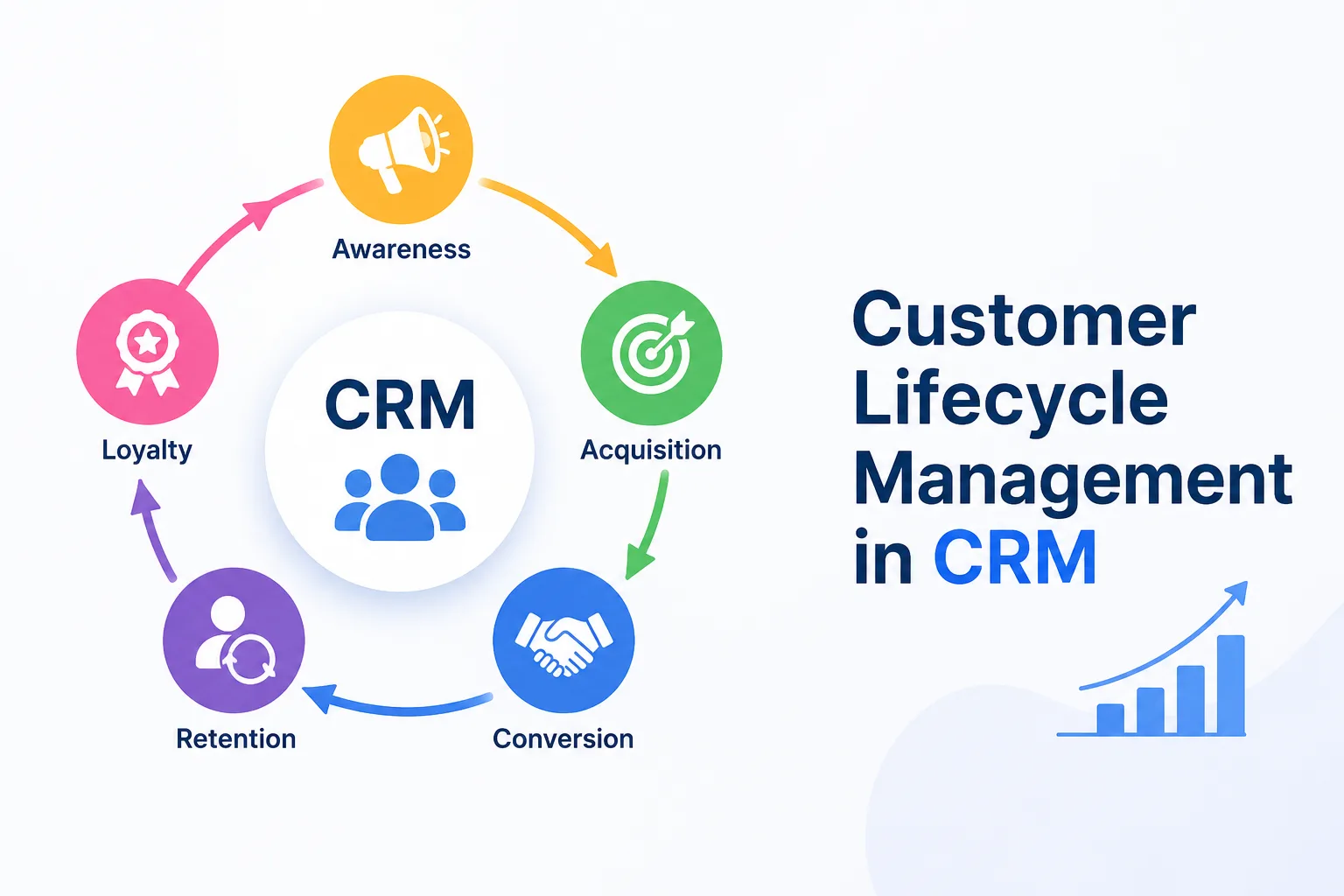
Although organizations may define lifecycle stages differently, most CRM strategies include five primary phases.
1. Awareness
The customer lifecycle begins when potential customers become aware of a business, product, or service.
At this stage, CRM systems primarily collect information generated through marketing activities, including:
- Website inquiries
- Contact forms
- Newsletter subscriptions
- Event registrations
- Digital campaigns
- Social media interactions
The goal during the awareness stage is to capture relevant information that can later support relationship building.
CRM software stores this information in a centralized database, making future engagement more organized and efficient.
2. Acquisition
Once a potential customer expresses genuine interest, the acquisition stage begins.
During this phase, CRM systems help businesses manage leads by organizing customer information, tracking interactions, assigning ownership, and monitoring progress through the sales pipeline.
Typical CRM activities include:
- Lead qualification
- Contact management
- Follow-up scheduling
- Opportunity tracking
- Sales pipeline management
- Task reminders
Managing acquisition within CRM ensures that customer information remains accessible throughout the buying journey.
3. Conversion
Conversion occurs when a prospect becomes a customer. Although making a purchase represents an important milestone, Customer Lifecycle Management does not end here. Instead, CRM systems transition the customer record from lead management to ongoing relationship management.
Important CRM functions during conversion include:
- Recording purchase information
- Updating customer status
- Managing contracts
- Creating onboarding tasks
- Assigning customer success activities
- Triggering welcome communications
Accurate record management during this stage establishes the foundation for long-term customer engagement.
4. Retention
Retention is often considered one of the most valuable stages of Customer Lifecycle Management.
Existing customers require continuous engagement to maintain positive relationships. CRM software supports retention by helping businesses stay organized and responsive throughout the customer journey.
Retention activities commonly include:
- Customer support tracking
- Follow-up reminders
- Renewal notifications
- Feedback collection
- Satisfaction monitoring
- Service history management
Since CRM systems maintain historical customer information, teams can respond with greater context and consistency.
Maintaining customer relationships through structured communication also reduces the likelihood of missed follow-ups or duplicate interactions.
5. Loyalty and Advocacy
The final lifecycle stage focuses on strengthening long-term relationships.
Customers who consistently receive positive experiences are more likely to continue engaging with a business over time.
CRM platforms assist with this stage by tracking:
- Customer engagement
- Repeat interactions
- Communication history
- Service requests
- Customer preferences
- Feedback trends
This information enables businesses to maintain meaningful engagement while continuously improving customer experiences.
How CRM Supports Customer Lifecycle Management
Customer Lifecycle Management relies heavily on organized information, automation, and collaboration. CRM software brings these elements together within a single platform. Some of the most important CRM capabilities include:
Centralized Customer Data
Customer information is often scattered across emails, spreadsheets, and multiple applications. CRM software consolidates this information into one location.
This centralized database typically includes:
- Contact information
- Communication records
- Purchase history
- Notes
- Documents
- Customer preferences
- Activity timelines
Having one source of information improves accuracy and collaboration across departments.
Workflow Automation
Many lifecycle activities involve repetitive administrative work.
CRM automation helps reduce manual effort by automatically:
- Assigning leads
- Sending follow-up reminders
- Updating records
- Creating tasks
- Triggering notifications
- Managing approval workflows
Automation ensures that important lifecycle activities continue without unnecessary delays.
Customer Segmentation
Not every customer follows the same journey.
CRM systems allow businesses to organize customers into different groups based on various criteria such as:
- Industry
- Business size
- Customer status
- Purchase history
- Engagement level
- Interests
Segmentation enables more relevant communication throughout each lifecycle stage.
Communication Tracking
Every interaction contributes to the customer relationship. CRM software records communications across multiple channels, allowing teams to understand previous conversations before engaging again. This creates greater consistency while reducing duplicated efforts.
Reporting and Analytics
Customer Lifecycle Management becomes more effective when businesses can measure progress.
CRM reporting helps monitor:
- Lead conversion rates
- Customer retention
- Sales pipeline performance
- Response times
- Customer engagement
- Activity completion
These insights support continuous improvements throughout the customer journey.
The Role of Automation in Customer Lifecycle Management
Automation has become an essential component of modern CRM systems.
Instead of relying entirely on manual processes, businesses can automate routine lifecycle activities while maintaining consistent customer engagement.
Examples of lifecycle automation include:
- Welcome emails after lead registration
- Follow-up task creation
- Customer onboarding workflows
- Renewal reminders
- Feedback requests
- Internal notifications
Automation improves efficiency while helping teams focus on building stronger customer relationships.
Common Challenges in Customer Lifecycle Management
Even with CRM software, organizations may face challenges if lifecycle processes are not properly managed.
Some common issues include:
Incomplete Customer Data
Missing information reduces the effectiveness of customer engagement and reporting.
Poor Data Quality
Duplicate records or outdated information can create confusion across departments.
Inconsistent Processes
Different teams following separate procedures often result in fragmented customer experiences.
Limited Customer Visibility
Without centralized CRM records, employees may lack the context needed for effective communication.
Low CRM Adoption
If employees do not consistently update customer information, lifecycle management becomes less accurate.
Addressing these challenges requires clearly defined CRM processes and regular data maintenance.
Choosing the Right CRM Strategy
Customer Lifecycle Management is not only about selecting CRM software. Success also depends on configuring the system to match business processes, customer journeys, and organizational goals.
This is where professional guidance can make implementation more effective. Businesses looking to tailor workflows, automate lifecycle stages, and improve customer relationship processes often benefit from Zoho CRM Consulting. A well-planned consulting approach helps align CRM features with lifecycle management objectives, ensuring customer data, automation, reporting, and communication workflows support every stage of the customer journey without adding unnecessary complexity.
When CRM is configured around clearly defined lifecycle processes, teams can work more efficiently while delivering a more consistent customer experience.
Best Practices for Effective Customer Lifecycle Management
To maximize the value of Customer Lifecycle Management within CRM, businesses should follow several best practices.
Keep Customer Data Updated
Accurate information supports better communication and more reliable reporting.
Standardize Customer Processes
Consistent workflows improve collaboration between departments.
Use Automation Thoughtfully
Automate repetitive tasks while keeping important customer interactions personalized where appropriate.
Monitor Lifecycle Metrics
Review performance regularly to identify areas for improvement.
Encourage CRM Adoption
Ensure employees understand the importance of maintaining complete and accurate customer records.
Continuously Refine Workflows
Customer expectations and business processes evolve over time. Regularly reviewing lifecycle workflows helps maintain efficiency and relevance.
Conclusion
Customer Lifecycle Management in CRM is the structured process of managing customer relationships from the initial point of contact through long-term engagement. Rather than viewing customer interactions as separate events, CRM systems connect every stage of the relationship into a unified journey supported by centralized data, automation, communication tracking, and performance insights.
By understanding each lifecycle stage—awareness, acquisition, conversion, retention, and loyalty—businesses can create more consistent customer experiences while improving operational efficiency. CRM software provides the tools needed to organize information, automate routine activities, and maintain visibility across the entire customer journey.
When supported by well-defined processes and the right CRM configuration, Customer Lifecycle Management becomes an essential framework for building stronger customer relationships and ensuring every interaction contributes to a more organized, efficient, and customer-focused approach.