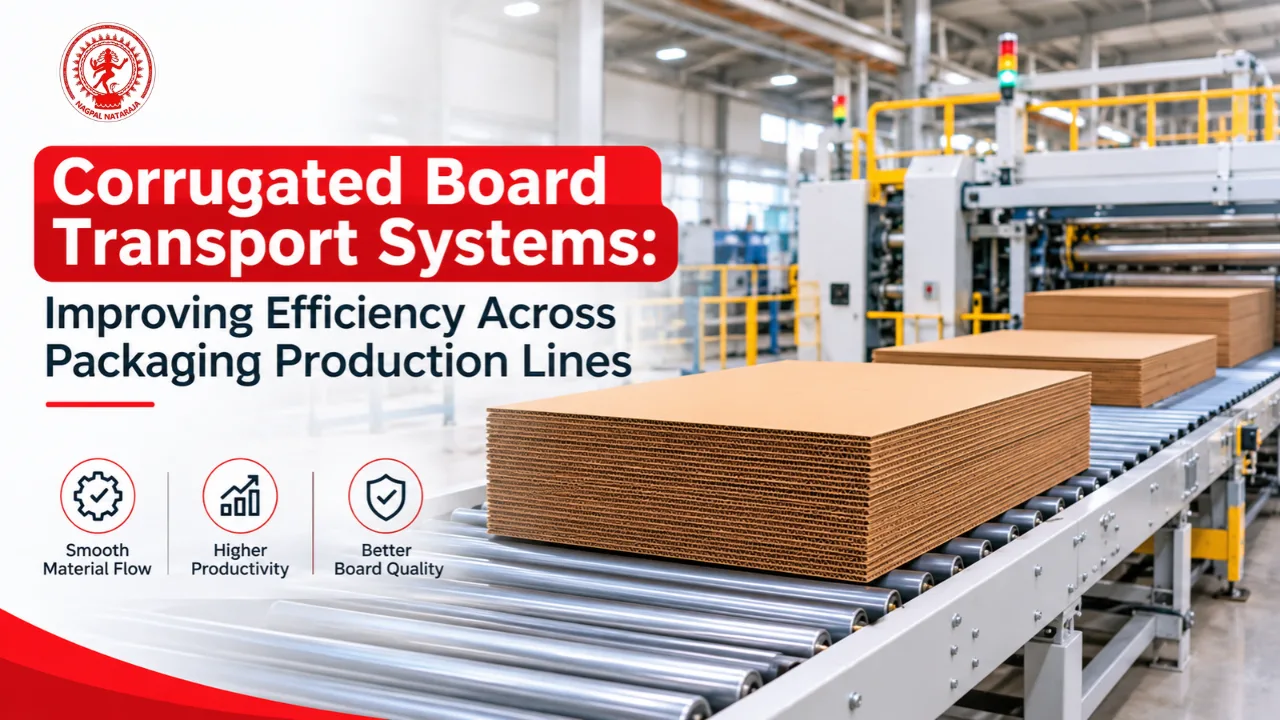
In corrugated packaging manufacturing, production efficiency depends on more than the speed of individual machines. How materials move between different production stages also plays an important role in maintaining output, reducing handling delays and protecting board quality.
A corrugated board transport system helps manufacturers move sheets and boards from one processing stage to another in an organised manner. Depending on the plant layout and production requirements, this may involve conveyors, roller systems, stackers and other material handling equipment.
As packaging manufacturers handle larger order volumes and tighter delivery schedules, an efficient board transportation arrangement becomes increasingly important. A well-planned system can reduce unnecessary manual movement, improve workflow and help maintain a steady production pace.
Understanding a Corrugated Board Transport System
A corrugated board transport system refers to the equipment and arrangements used to move corrugated sheets throughout a manufacturing facility. It connects different machines and work areas so that boards can move smoothly without repeated manual handling.
In a typical corrugated box manufacturing plant, boards pass through several stages, including corrugating, cutting, stacking, printing, slotting and die-cutting. The transportation arrangement between these operations influences how efficiently the entire production process works.
Common equipment used for board transportation includes:
- Belt Conveyors: Move corrugated sheets between production sections using a continuous belt.
- Roller Conveyors: Allow flat sheets and stacked boards to travel along designated paths.
- Sheet Transfer Systems: Help transfer boards between machines or production stations.
- Automatic Stackers: Arrange finished sheets into organised stacks for further processing.
- Board Handling Equipment: Supports lifting, shifting and positioning materials within the factory.
The choice of equipment depends on board dimensions, production capacity, available floor space and the level of automation required.
Why Efficient Board Transportation Matters in Corrugated Manufacturing
Material handling is often overlooked when manufacturers evaluate production performance. However, delays between two machines can affect the overall output even when both machines are operating properly.
An effective corrugated board handling system helps address several common production challenges.
1. Reduces Unnecessary Manual Handling
Manual movement of corrugated sheets requires additional labour and can slow down operations, particularly when production volumes increase.
Conveyor-based transportation reduces the need to carry or shift boards repeatedly. Workers can focus more on machine supervision, quality inspection and other essential tasks.
This also helps create a more organised movement pattern across the factory floor.
2. Helps Maintain Continuous Production Flow
Production equipment performs best when material reaches each processing stage at the required time.
If sheets accumulate near one machine while another remains underutilised, production flow becomes uneven. Properly planned conveyor systems help regulate material movement and reduce unnecessary waiting between operations.
For manufacturers operating high-speed corrugating lines, synchronised transportation can be particularly useful.
3. Minimises Board Handling Damage
Corrugated board is designed to provide strength and cushioning, but improper handling can affect its edges, flutes and overall structure.
Repeated manual shifting, dropping or uneven stacking may cause damage that affects the quality of finished cartons.
A suitable board transport arrangement helps reduce unnecessary contact and supports controlled movement between production sections.
4. Improves Factory Floor Organisation
Unplanned material movement can create congestion around machines and working areas.
Designated conveyor routes provide a more structured way to move sheets across the facility. This makes it easier to organise workstations, manage intermediate storage and maintain clear movement paths for employees.
Better floor organisation can also simplify material tracking and production supervision.
Different Types of Corrugated Board Transportation Systems
Not every corrugated packaging plant requires the same transportation arrangement. The right solution depends on the production process, available space and required output.
Belt Conveyor Systems
Belt conveyors use a moving belt to transport corrugated sheets across different sections of a facility.
They are useful when boards need to move continuously over a defined route. Their configuration can be planned according to the distance between machines and the dimensions of the material being handled.
Roller Conveyor Systems
Roller conveyors use a series of rollers to move sheets or board stacks.
They can be suitable for transferring materials between workstations, temporary storage areas and packaging sections. Depending on the arrangement, roller conveyors may operate through gravity or a powered mechanism.
Automatic Sheet Transfer Systems
Automatic sheet transfer systems help move boards from one machine to another with less manual intervention.
These systems are particularly relevant in integrated manufacturing facilities where production stages operate in coordination with one another.
Automatic Stacking and Delivery Systems
After cutting, corrugated sheets need to be collected and arranged for the next production stage.
Automatic stackers help organise the output into manageable piles, making subsequent printing, converting or storage operations easier to handle.
Factors to Consider When Selecting a Board Transport System
Choosing material handling equipment requires an understanding of the entire production environment. A system that works well in one facility may not be suitable for another.
Manufacturers should evaluate the following factors before selecting a transportation arrangement.
| Selection Factor | What Manufacturers Should Evaluate |
| Board Dimensions | Maximum sheet width, length and thickness |
| Production Speed | Output rate of connected machines |
| Load Capacity | Weight and volume of sheets being transported |
| Factory Layout | Distance between machines and available floor space |
| Automation Level | Manual, semi-automatic or automatic handling |
| Board Protection | Measures to prevent edge damage and flute compression |
| Maintenance | Accessibility of components and servicing requirements |
These considerations help manufacturers select equipment that supports their existing operations while allowing room for future production expansion.
Integrating Transportation Equipment with Corrugated Production Lines
The effectiveness of a corrugated board transport system depends on how well it works with the machines around it.
For example, a corrugating line produces continuous board material that passes through cutting and stacking operations. The resulting sheets may then move towards printing, slotting or die-cutting sections.
If the transportation equipment is not properly matched to machine output, bottlenecks can develop between these stages.
Manufacturers should therefore consider the following points when planning integration:
- Match conveyor capacity with the output of connected machines.
- Maintain suitable transfer points between production sections.
- Allow sufficient space for sheet movement and temporary stacking.
- Consider board dimensions and handling requirements.
- Coordinate automatic stackers with downstream processing equipment.
- Provide convenient access for cleaning, inspection and maintenance.
A coordinated arrangement helps reduce unnecessary material movement and makes production scheduling easier.
The Role of Automation in Modern Board Handling
Automation is changing how corrugated packaging manufacturers manage internal material movement.
Instead of relying entirely on workers to transfer sheets between different machines, manufacturers can use powered conveyors, automatic stackers and integrated handling arrangements.
These systems can support more consistent material movement, particularly in facilities handling large production volumes.
However, automation should be introduced according to actual operational requirements. A small manufacturing facility may benefit from a simple roller conveyor, while a high-volume plant may require a more integrated transportation arrangement.
The objective should be to improve material flow without introducing unnecessary equipment or operational complexity.
Maintenance Practices for Reliable Material Movement
Regular maintenance helps keep transportation equipment operating safely and consistently.
Even a well-designed system can experience performance issues if its moving components are not inspected and maintained.
Some useful maintenance practices include:
- Inspect conveyor belts for wear, damage and alignment issues.
- Check rollers and bearings for smooth movement.
- Keep transfer areas free from paper waste and other obstructions.
- Inspect motors, drives and electrical connections.
- Check safety guards and emergency stop arrangements.
- Follow the equipment manufacturer's recommended maintenance schedule.
Preventive maintenance can help identify minor problems before they interrupt production.
Natraj Machines: Supporting Efficient Corrugated Manufacturing Operations
Efficient material movement is an important consideration when planning a corrugated packaging facility. From paper feeding and board formation to sheet cutting and stacking, every production stage needs suitable machinery to maintain a coordinated workflow.
Natraj Machines, established in 1965, manufactures corrugated box making machinery and complete corrugation plants for packaging manufacturers. Its product range includes single facer machines, corrugating machines, complete corrugated board plants and auxiliary equipment, including paper conveyors.
By offering machinery for different production requirements, Natraj helps manufacturers plan their corrugation operations around production capacity, factory layout and automation needs.
Manufacturers looking to understand the machinery requirements of a corrugated production facility can explore the complete corrugating machinery range from Natraj Machines.
For a better understanding of equipment selection, production stages and plant planning, readers can also refer to Natraj's Corrugation Plant Guide.
Conclusion
An efficient corrugated board transport system is an important part of a well-organised packaging manufacturing facility. It supports the movement of sheets between production stages, reduces unnecessary manual handling and helps maintain a consistent workflow.
From basic roller conveyors to automated sheet transfer and stacking arrangements, manufacturers have several options depending on their production requirements.
The most suitable system is one that matches machine output, protects board quality and fits the available factory layout. By considering material handling during production planning, corrugated packaging manufacturers can create a more organised and efficient manufacturing environment.