Why India's FMCG Sales Strategy Must Start at the Micro-Market Level
A sales strategy that works in one part of a city may struggle just a few kilometres away.
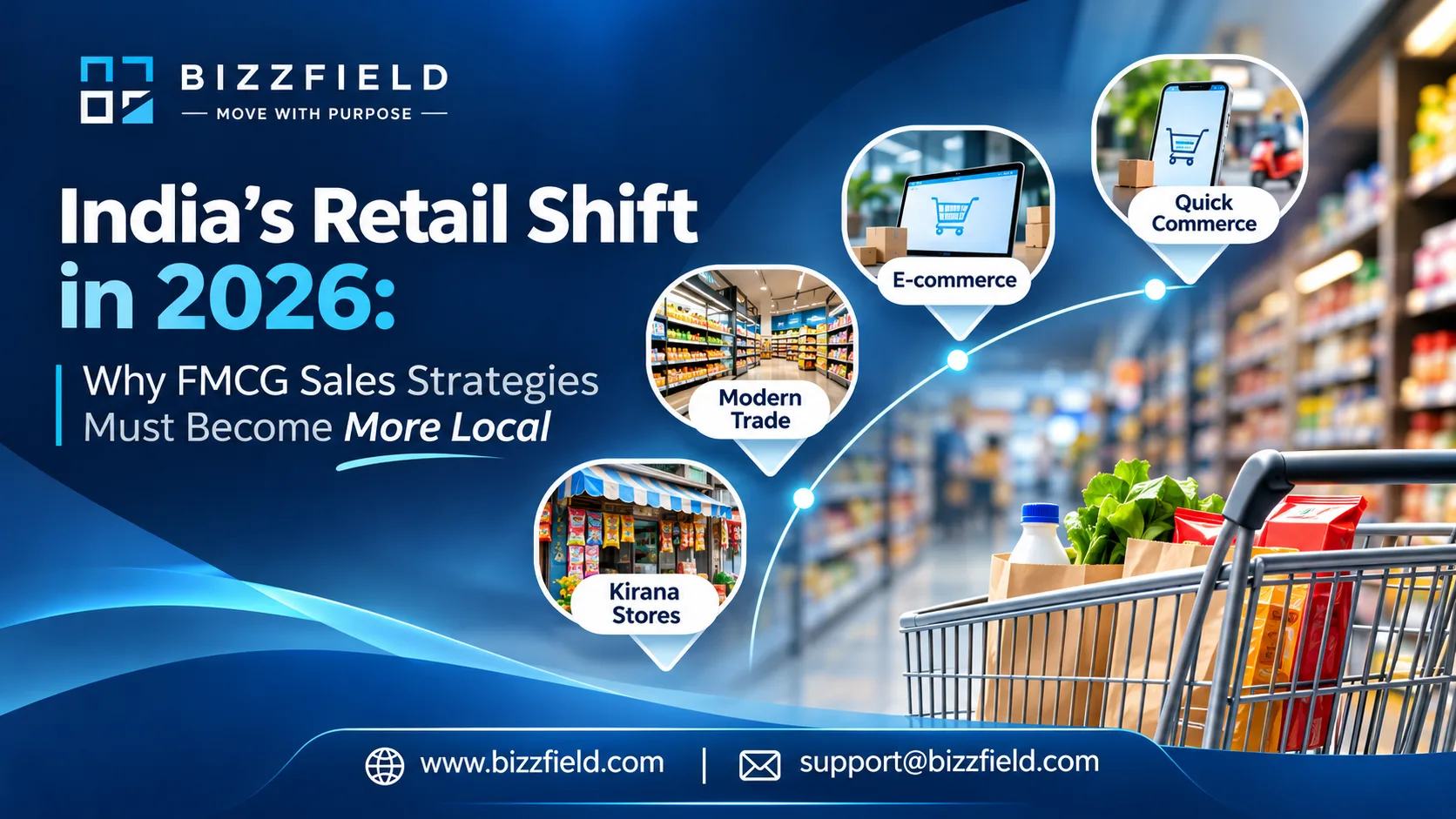
One locality may have hundreds of traditional kirana stores. Another may be dominated by organised retail. A nearby customer cluster may rely more heavily on quick-commerce platforms. The products being sold might be similar, but the buying patterns, availability requirements and retail relationships are not.
This is an important challenge for FMCG businesses operating across India. Expanding distribution remains important, but simply increasing the number of outlets does not guarantee effective market execution.
The next opportunity lies in understanding smaller market clusters and adapting sales activities to what is actually happening within them.
India's Retail Market Is Becoming More Diverse
India's retail ecosystem has traditionally relied heavily on general trade. According to the Department for Promotion of Industry and Internal Trade (DPIIT), the country has over 1.4 crore kirana stores, accounting for nearly 75–80% of FMCG sales.
This makes neighbourhood retail an important part of the distribution landscape, even as digital channels continue to develop.
Quick commerce is adding another dimension. An Economic Times report published on 27 May 2026 found that quick commerce accounted for 60–75% of total online sales for several leading FMCG companies in FY26. This figure refers to their online sales mix, not their overall FMCG sales.
Meanwhile, organised retail and e-commerce continue to shape product discovery, assortment and purchasing behaviour.
The result is not a simple shift from traditional retail to digital retail. Different channels are operating alongside one another, often serving the same customers at different points in their shopping journeys.
Why National Sales Plans Need Local Context
A national distribution strategy provides direction, but it cannot explain every local market condition.
Consider an FMCG company operating in three different areas.
In the first area, kirana stores form the majority of its retailer network. Regular sales visits, distributor coordination and product availability may be the main execution priorities.
In the second, organised supermarkets have a stronger presence. Product assortment and shelf execution may deserve more attention.
In the third, digital ordering and quick-commerce fulfilment have a greater influence on how customers purchase everyday products.
Using identical outlet priorities and sales routines across all three areas may overlook important differences.
This is where micro-market planning becomes relevant. Instead of treating an entire city or district as one uniform territory, businesses can examine smaller clusters based on outlet concentration, demand patterns, channel mix and retailer behaviour.
It allows sales leaders to ask more useful questions: Which outlets matter most in this locality? Which products are gaining attention? Where is availability becoming an issue?
General Trade Is Also Moving Towards Digital Procurement
One development worth watching is the digitisation of traditional retail procurement.
DPIIT and ONDC's DigiDukaan initiative had connected more than 21,000 retailers with over 450 brands across Hyderabad, Jaipur and Mumbai as of September 2026.
This development suggests that digital procurement is increasingly becoming relevant to neighbourhood retailers.
For FMCG companies, the opportunity goes beyond making order placement easier. Better digital information can help improve coordination between brands, distributors and retailers.
However, adoption alone does not solve every distribution challenge. Businesses still need dependable stock information, clear commercial processes and effective distributor relationships.
Digital tools work best when they support the existing retail ecosystem rather than create unnecessary complexity for its participants.
What Changes for FMCG Sales Teams?
As retail channels become more diverse, field sales teams need to understand more than the geographical boundaries of their assigned territories.
Their responsibilities increasingly involve maintaining accurate outlet information, planning relevant retailer visits, recording orders consistently and sharing useful market feedback.
A representative working in a dense kirana market may have different priorities from someone covering organised retail outlets.
Sales managers therefore need visibility into actual field execution, not just monthly target achievement.
Some important operational areas include:
Outlet coverage: Are representatives visiting the right outlets at the appropriate frequency?
Product availability: Are important SKUs available where customers are likely to purchase them?
Order patterns: Are regular retailers maintaining their usual purchasing frequency?
Distributor coordination: Is information about inventory and secondary sales reaching the relevant teams?
Territory performance: Are managers able to understand differences between local market clusters?
These factors provide a more useful picture of execution across the sales network.
Where Sales Force Automation Fits In
A micro-market strategy is difficult to execute when field information is incomplete or scattered across spreadsheets and separate communication channels.
Sales Force Automation software can help bring important field activities into a structured system.
Retailer visit management, smart beat planning, digital order booking and territory performance monitoring help businesses organise their sales operations. Distributor management and secondary sales tracking can provide additional visibility into distribution activities.
The purpose is not to make every decision automatic. It is to give representatives and managers reliable information that supports better execution.
For example, a manager reviewing territory performance should be able to examine outlet coverage and order activity alongside sales figures. This helps identify where further investigation may be needed rather than relying on a single target-achievement number.
Building a More Precise Sales Strategy
FMCG businesses do not need a completely different distribution model for every neighbourhood. They need a framework that allows local differences to influence how sales activities are planned.
A practical starting point is to divide large territories into meaningful market clusters, understand the retail channels within each cluster, review product and outlet information, and adjust field priorities accordingly.
Technology can support this process, but the quality of the underlying information and the experience of the sales team remain essential.
Solutions such as BizzField SFA support businesses in organising retailer visits, beat planning, order booking, distributor management and sales performance monitoring.
For businesses evaluating their field sales processes, the important question is not simply how many outlets they cover. It is whether their teams understand the markets they serve and execute their plans accordingly.
India's retail market is not becoming uniform as it grows. It is becoming more diverse.
And that is precisely why the next stage of FMCG sales growth will require a closer understanding of local markets, not just a larger national sales plan.
Disclosure: This article is contributed from the perspective of BizzField, a Sales Force Automation and distribution management platform.
Learn more: https://www.bizzfield.com/bizz-field-sfa